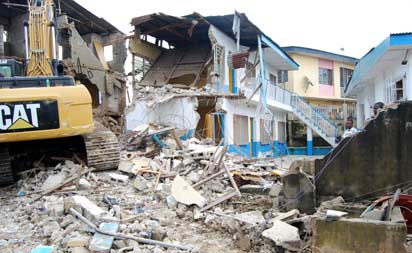
a collapsed building
By Chris Ochayi
ABUJA: The Federal Government last week decried the level of rot in the building and construction sector, which it said has reduced the sector to a conduit pipe for all forms of nefarious activities thereby denying the economy the necessary resources for impactful development.
Vice President, Mohammed Namadi Sambo, an Architect, who made the remarks while declaring open the 2nd Building and Construction Economic Round table, BCERT organised by the Quantity Surveyor Registration Board of Nigeria, QSRBN, in Abuja, said the government is seriously worried about the disturbing trend of sharp practices in the sector.
The theme of the round table was “the role of the building and construction sector in achieving visions 20-2020
Sambo who was represented by the Minister of Housing and Urban Development, Ms. Amal Pepple said a situation where the cost of projects in Nigeria currently ranks among the highest in the country is no longer acceptable.
The Vice President who tied the success of the transformation agenda and vision 20-2020 to adherence to the issue of value-for-money, transparency, probity and accountability within the building and construction sector, challenged the quantity surveyor to find lasting solution to the cost of building project in Nigeria. He enjoined QSRBN and other regulatory bodies in the industry, to continue to support the ongoing efforts by the government to bring sanity to the housing and construction sector.
“The need for all regulators to be extra vigilant cannot be over emphasised. Achieving professional excellence through greater ethical disposition of practitioners under your jurisdiction is an imperative if the sector must play its rightful role in the achievement of both the Transformation Agenda and Vision 20-2020. This brings to the fore the issue of value-for-money, transparency, probity and accountability within the building and construction sector,” he said.

a collapsed building
Continuing, the Vice President lamented that “there are insinuations that the building and construction sector is a conduit pipe for all forms of nefarious activities hereby denying the economy the necessary resources for impactful development.
The Federal Government is seriously worried about this disturbing trend, and hereby challenges quantity surveyors, as building and construction cost experts, to find a lasting solution to the problem of high cost of building and construction projects in the country”.
“One way of starting is for us to have a constructive engagement on how we can effectively harness your expertise to achieve much with the limited resources in the capital budget provisions through better project costing to enable us record higher levels of project completion. A situation where the cost of projects in Nigeria currently ranks among the highest in the world is unacceptable,” the Vice President said.
QSRBN President, Mallam Husaini Adamu Dikko said the vision of the country becoming one of the top biggest economies in the world by the year 20-2020 is achievable. “Considering where we are coming from and where we are today, this is indeed ambitious though not unachievable. But we must buckle up and all hands must be on deck to gain the necessary momentum and synergy required to make the vision realisable,” he said.
He stated that “BCERT and many other programmes of the Quantity Surveyors Registration Board of Nigeria, QSRBN, constitute our modest effort towards the achievement of Vision 20-2020”.
Mallam Dikko declared: “We are quantity surveyors and the body of knowledge of our profession is encapsulated in cost engineering, procurement and project management, thus making the building and construction sector our natural sphere of influence and operation.
“As experts, concerned in the financial probity, and achieving value for money in the conceptualisation, planning and execution of building and construction projects, quantity surveyors can use their expertise to leverage on construction economy and resources optimisation within the building and construction sector of the Nigerian economy.
This implies that we can minimize output within the sector using the same resources in our currently under performing economy. This will translate in the building of more roads, houses, rail tracks, hospitals, schools, refineries, energy/power plants and other infrastructure which can drive economic growth and development”.
Disclaimer
Comments expressed here do not reflect the opinions of Vanguard newspapers or any employee thereof.