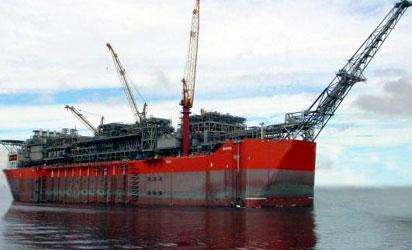
Bonga oil field …alleged source of the massive spill
By EMMA AMAIZE, Regional Editor, South-South
DISPLACED life: MORE than six months after the December 20, 2011 crude oil spill in the Niger Delta that devastated the flora and fauna of most coastline communities in the region, inhabitants of the affected settlements are living hopelessly, as they have been displaced from their major means of livelihood: fishing.
The home economy is biting hard with hunger becoming endemic according to our findings. Residents have also complained of the harzadous effects of the chemical dispersants used by Shell Nigeria Production Oil Company, SNPECo, to dissolve the spilled crude oil.

Bonga oil field …alleged source of the massive spill
Nevertheless, SNPECo, whose deep-sea oil production facility, known as Bonga Floating Production Storage Vessel, FPSO, supposedly caused the massive damage, had maintained doggedly, in the past six months, that the spilled 40,000 barrels of crude oil did not surge to the communities in question.
Accusing fingers
SNEPCo pointed accusing fingers at a third party, ostensibly oil thieves. Though, the company carried out clean-up exercises in a good number of the communities on grounds of corporate social responsibility, the activity was also steeped in controversy, as some of the communities declined on grounds that proper procedures were not followed.
Disbelieving hush on fingerprinting result: Clearly intriguing in the Bonga spill affair is the fact that despite assurances that the result of the crude oil samples, taken abroad shortly after the incident for fingerprinting to determine the origin of the spill, would be known in two weeks, it has been a game of deception, in the last six months.
The question on the lips of many is: Where is the National Oil Spill Detection and Regulation Agency, NOSDRA, whose duty it is to monitor such spills, find out what happened and provide protection for host communities from the oil companies. The unconfirmed story making the rounds is that the agency has been settled, and as a supervisory body, its silence on the matter for more than six months is suspicious.
Vanguard gathered on good authority that Shell already had the result of the samples it took abroad for fingerprinting, but is keeping the findings secret. NOSDRA, which is the regulatory agency and the Directorate of Petroleum Resources, DPR, also collected samples for fingerprinting and no word has come from them since then.
Time for NOSDRA to be out of bed
How long it will take NOSDRA to rise up to its responsibility is in the womb of time, but an industry source said the results of the different tests carried showed some dissimilarities and the authorized agency to make definite pronouncement on the culpability or otherwise of Shell is NOSDRA.

His Highness, Rev Desikan, Bakiri community
The Nigerian Maritime Administration and Safety Agency, NIMASA, at the time challenged the propriety of the claim by Shell that the spilled 40,000 barrels of oil did not pollute communities.
The agency’s director general, Ziakede Patrick Akpobolokemi, at a media briefing in Lagos, said preliminary investigation report on the oil spill at the SNEPCo’s Bonga facility indicated that the leak came from the Bonga FPSO platform operated by Shell, located about 120 kilometres off Nigeria’s coast and produce 200,000 barrel of oil per day.
Shell’s Corporate Media Relations Manager, Mr. Tony Okonedo, however, said that only fingerprinting would determine the source of the oil.
FG not shown satisfactory concern: Oddly, beyond the overfly visits of some of the ministers at the time and stopover by some members of the National Assembly, the Federal Government has been playing deaf on the plight of the affected communities. It seemed to be satisfied with the response of Shell to the clean up exercise, which, no doubt, was wonderfully handled, but if truth be told, government has not demonstrated that it is troubled about the after effects on the oil communities. Okonedo told Vanguard in Warri recently that some of oil communities, which initially refused clean up because of some rigid conditions bothering on compensation, have capitulated.
Ostensible therapy: What looks like a seeming remedy for NOSDRA came more than six months after with the disclosure, Monday, at Abuja, by NOSDRA director general, Dr. Peter Idabor, when he appeared before House of Representatives Committee on Environment that SNEPCO had been fined $5billion over the massive oil spill that occurred at its Bonga oil field on December 20, 2011.
The committee’s public hearing was meant to provide key actors in the Bonga oil spill an opportunity to brief the committee on the claims of affected communities. Idabor said the sum was an “administrative penalty” considering the large quantity of crude oil discharged into the environment by Shell and the impact of the incident on the water and aquatic life.
Penalty not compensation
According to Idabor, the penalty was also consistent with what was obtainable in other oil producing countries such as Venezuela, Brazil and the United States of America.
He, however, pointed out that the penalty was not the same as compensation since compensation could only be demanded from a polluting company after a proper post impact assessment has been conducted and scientific evidence of impact established. Idabor disclosed that NOSDRA, Shell and other relevant stakeholders have concluded plans to conduct the post impact assessment on the spill as soon as approval for funding was secured from National Petroleum Investment Management Services.
Is it an afterthought?
Not many took Idabor serious on the issue of post impact assessment, as it is outlandish that NOSDRA was only considering a post-impact assessment on such a spill nearly seven months after the disaster and even at that, no funding has been approved for it. This is coming even when some of the oil communities had dragged the agency and SNEPCO to court for dereliction of duty, seeking among other reliefs, that the court should order the agency to carry out a Joint Investigation Visit, JIV.
As expected, Shell differs: Expectedly, Shell has contested the fine, saying it had done nothing wrong to deserve the fine. Mr. Okonedo said, “We do not believe there is any basis in law for such a fine. Neither do we believe that SNEPCo has committed any infraction of Nigerian law to warrant such a fine. “SNEPCo responded to this incident with professionalism and acted with the consent of the necessary authorities at all times to prevent environmental impact as a result of the incident.”
Heat of the controversies
In the heat of the controversies over the spill, especially with regard to third party spill, which was cited in several other parts of the Niger Delta, Shell claimed it had sent samples of the spill to laboratories abroad for tests to confirm its liabilities. But till date, nothing was heard of the result of the tests.
Irabor’s validation: But, the NOSDRA boss explaining the reason for the $5 billion fine noted that “although adequate containment measures were put in place to combat the Bonga oil spill, it, however, posed a serious environmental threat to the offshore environment.” He said: “The spilled 40,000 barrels impacted approximately on 950 square kilometres of water surface; affected great number of sensitive environmental resources across the impacted area and has direct social impact on the livelihood of people in the riverine areas whose primary occupation is fishing.

Hon Albert Olomubatuta, leader, Bakiri community
“It also potentially caused a number of physiological effects on aquatic lives while surviving aquatic species around the spill site would migrate to a farther distance to situate new habitat thereby forcing coastal communities to move deeper into the sea to carry out fishing activities.”
Chairman, House Committee on Environment, Hon. Uche Ekwunife had at the opening of the interactive session expressed displeasure that seven months after the spill, there were doubts if Shell carried out a thorough clean-up programme as the oil firm was said to have hurriedly resumed operations on the facility. She further stated that there were also indications that Shell had refused to accept full responsibility for the incident and had rebuffed claims from communities affected by the spill.
Vanguard investigation: Vanguard, as customary, undertook a fresh tour some affected communities, villages, fishing camps to find out how the people were coping.
Dust over toxicity of dispersants: Osteen Igbapike, a lawyer, holding power of attorney for Azamabiri and other affected communities, said that apart from dislocation of their economy, the major problem faced by the people now is the toxic dispersants used by SPDC.
“The toxicity of the dispersants used by the oil company has posed a fresh problem to the communities, villages, fishing camps and cooperative societies that go round the coastline of the Bight of Benin, located within the Forcados and Ramos estuaries, not far-flung from Bonga”, he explained.
Fishing communities
According to him, “Aghoro 1 and its communities, fishing camps and villages in Burutu and Ekeremor local government areas of Delta and Bayelsa states to wit: Bakri-Ama, Birigbene, Famous-Ama, Azatotor, Shellkiri, Ekpekpie, Woroworo-Amagbene, Newyeargbene, Febarghawaregbene, Akarakemegbene, Omoligbene, Daunimighagbene, Ayama, Gbogbogbene, Stevengbene, Ajolgbene, Idegbene and Oldmangbene are affected”.
“Also hit are Ebiyegbene, Izanforgbene, Zituade, Mikagbene, Kokomokeme-gbene and Okorlorgbene in Warri South-West local government area of Delta State; Pine-gbene, Warezimor-gbene, Bragbene, Ekpidizuye, Ofugbene and Biagbene fishing camps in Diebri community, Warri South-West local government area of Delta State; Azamabiri community and its seven fishing camps in Kou kingdom, Bayelsa state.
“Others are fishing, farming and cooperative societies, among them, Ausbok fishing multipurpose co-operative society, Egbenebo fishing group I, Egbenibo-Idumu fishing group, Deep fishers group, Owei-Ware multipurpose , Wenebokefe group I, Wenebokefe group II, Ituwere, Kokoide Zitu, Shark fishing group and Ocean fishing mongers, (Agge).
Hazardous chemicals used as dispersants –His Highness, Rev Desikan Bakiri community
At Bakiri community in Ekeremor local government, the leader of the community, His Highness, Rev Austin B. Desikan told Vanguard: “Our life and land have remained in shambles since the SPDC crude oil spill from Bonga.
No water to drink
“It has greatly affected our life and aquatic life until date. Our existence in this part of the world is dependent on the river and because of the pollution, we cannot fish again, there is no water to drink either and it is currently affecting our health. My people have been suffering from fever, stooling, vomiting since then”.
Miscarriage, other health complications now prevalent: He asserted that the chemicals used by Shell to disperse the crude oil spill was causing miscarriage and other problems to the people, adding, “Doctors ask us which water we are drinking whenever our people are taken to hospital and we tell them it is the same water that was polluted since we have no alternative.
“The kind of stooling I am talking about here is different, regular and fervent”, he added, dismissing the suggestion that the ailments could be natural.
According to Rev Desikan, “Since this spill in December, 2011, it has not been well with us. We use to have electricity from Shell, but it is not longer working, there is not health centre here. We are in Bayelsa State, but Warri in Delta State is nearer to us than Yenagoa, our state capital, so we take our sick kinsmen to Warri or Aghoro community, depending on how serious the case is”.
We are yet to recover — Olomubamuta
A leader of the community, Hon. Albert Olomubamuta, said, “Six months after the spillage, our people have not recovered from the disaster.” He showed Vanguard part of the crude allegedly from Bonga oil field, which the villagers scooped at the time of the spill, maintaining, “We are still feeling the effect up till date”. A villager, Enoch Oruseibio told Vanguard, “I fell ill when I drank the water because of the dispersants that were used by Shell to disperse the crude oil. It affected other members of the community too”.
Our fishes smell poison — Mrs. Abukawa
Woman leader of the community, Mrs. Christmas Abukawa said, “I am still fishing in the river, not because I am not aware that the fishes smell chemical, chemical, poison, poison, but because there is no other way I can raise money to pay my children’s school fees and clothe them. It has happened, it has happened; we are still bearing the brunt”.
Disclaimer
Comments expressed here do not reflect the opinions of Vanguard newspapers or any employee thereof.