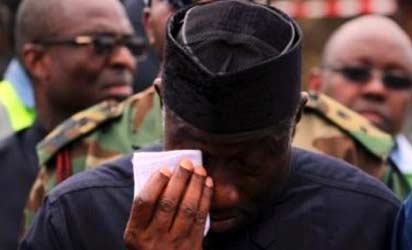
*President Jonathan
By Is’haq Modibbo Kawu
“You travel by road, tankers will catch fire; by air, plane crashes; you sit in your house, a plane comes to meet you; you go to church or even a mosque, Boko Haram will come after you; you go by sea, militants attack you; you finally run to your village, and you are kidnapped! There is no safe place in Nigeria. What a life!” – Text message from a friend.
I WRITE these lines with mixed emotions: sadness at the loss of lives early this week in the tragic killings in a Bauchi church when a suicide bomber rammed into a church filled with worshippers. We were still digesting the story from Bauchi, when story of the air crash involving a DANA airline plane broke, with the loss of all passengers and crew onboard and several other people on the ground, in a densely populated area of Lagos.
And then anger; because in truth, it could have been anyone of us, frequent travellers, that was caught up in that tragic crash. The crash has brought to fore, the general state of aviation in Nigeria, especially the airworthiness of the aircraft ferrying us around the country; the regimes of maintenance; the pervasive corruption that holds the air transportation sector in a bear hug, and the danger which the cumulative effect of these problems has on our national life.
I fly literally all the time, but I do with my heart in my mouth, every time I enter any of the planes in Nigeria’s airspace. Nigeria is far too compromised by the pervasive corruption in the land, that what is a surprise, is that we don’t have these crashes everyday!
Malfunctioning air craft
The DANA air crash has therefore given us another opportunity to reflect on this vital aspect of modernity which we nevertheless treat with a contemptuous indifference to the human suffering which these crashes engender. As for the ill-fated aircraft, it has now come to the public space that it has a record of malfunctioning, dating back to the years before it was brought into the Nigerian airspace.
Its original American owners saw the danger it represented to their customers and de-commissioned it; it came here despite its record of faults and was permitted to carry Nigerians, who the authorities have concluded, are far less worthy of the protection which American humanity gets and which ensured that the plane could no longer operate in American airspace. Similarly, it was reported that some members of staff of the airline had expressed reservation about putting the plane in the air given the problems it had manifested in recent times.
Of course, in the long run, the pursuit of profit to the detriment of human lives finally triumphed over the caution allegedly expressed; and the result is the tragic crash which took the lives of young and old; men and women. There were very touching human stories that emerged in the 24 hours after the crash, which should melt even a heart of stone! But where was the necessary regime of regulation that should have alerted about the state of the aircraft? A lot of motion has accompanied the crash but if experience will serve as guide, we can predict the outcome of the investigation ordered by President Goodluck Jonathan even before it gets started.
The President also declared three days of mourning, with a pledge of “the fullest possible investigation into the crash”. It must be a very difficult moment to be Nigeria’s president; Jonathan is swamped by a myriad of problems and it is very clear that his government looks like it is buckling under.
There are fundamental issues raised by the crash. Last week revealed the unwholesome underbelly of the transportation sector in our country, with the deaths harvested on the Lagos-Ibadan expressway following the explosion of tankers and the various vehicles that burned on that vital but absolutely dilapidated road. Taken from 2002, trillions of naira has been appropriated to rehabilitate roads, yet our roads have become increasingly worst.
For example, all the roads that lead to Ilorin, from Lagos, Abuja or Kaduna are an absolute disaster; there are no functional trains so increasingly we are forced to fly airplanes that we cannot vouch for their airworthiness. As the title of an old TV documentary put it, our lives are in their hands. And they have continued the habitual practice of making a mess of these lives: on the roads; by air and as a result of what amounts to a deliberate effort to institute a national railways system, even when decades of life without them have taught the lessons of their imperative!
Quest for foreign investments
We lurch from crisis to crisis and get ever more promises from a President who seems befuddled by the enormity of the crises phenomena he presides over.
In the DANA air crash, we clearly reached a tipping point. Why did we allow its management to play Russian roulette with the lives of Nigerians, when it seemed clear, as revealed after, that the ill-fated aircraft has the record that should have made it impossible to fly? Is it not time to review the obsession with foreign investment when it has often opened access for all sorts of persons to exploit Nigerians?
Check it out: industrial relations practices have worsened on the back of the foreign investment mantra, that protects foreign capital while tolerating the exploitation of labour in conditions that recall the worst excesses of 19th Century industrial capitalism.
The failure of regulation is premised upon the corrupt collusion of officials with those who are prepared to cut corners and as we saw on Sunday, such criminal behaviours can lead to unacceptable and tragic loss of lives! The state that is ostensibly set up to protect lives and property ends up supervising the incineration of the lives of citizens.
So when the President declared three days of national mourning, it seemed to me, that the irony of the declaration was lost to him. Three days? At the rate we are going, we will have to declare 365 days of mourning: to mourn the escalating killings by Boko Haram and the counter-insurgency by the state; to mourn victims of kidnapping that often end in the death of victims despite payment of ransome; to mourn the daily harvest of death on our roads; in badly run hospitals and the negligence and irresponsibility of medical staff; to mourn a systematic plunder of national resources by a bandit ruling elite, which regularly steals billions and trillions as basic infrastructure goes to ruin and young people are left without hope for a future; to mourn the systematic institution of electoral heists which return ever higher figures in elections to parties and candidates who ruin the nation in the cumulative effect of their actions in power. We can add to that list forever!
Ours is a country which is in mourning, not just for three days, but for as long as those who rule us remain as clueless and as piratical as they are. By their action and inaction, they are leading our country to perdition, because it is not acceptable to continue to harvest the number of deaths we do each day of our lives; something just has to give!
Prof. Jean Heskovits: Reminder on being Nigerian
PROF. Jean Heskovits, the long-term watcher of Nigeria, last week came calling in these shores, to present a speech. It was at an event dedicated to the memory of a Nigerian patriot, the much-lamented General Joseph Nanven Garba: soldier, diplomat, sportsman, gentleman and patriot.
I think everyone should endeavour to read the truly remarkable speech Prof. Heskovits gave at the occasion. In truth, the intrepid academic knows our country and in the breadth of analysis and the sweep of description of the various aspects of the often controversial and clogged Nigerian persona and the country’s multi-layered history, she was able to remind us, as a friend of Nigeria, the importance of our country.
It is very refreshing to read through a speech which was damning in its description of our foibles and failures, but was filled nevertheless with an optimism about the Nigerian condition, if we get the basic things right.
Those who have made a habit of promoting the breakup of our country were reminded that it can never be done in a way that will meet their romanticised ‘post-Nigeria’ hankerings! In truth, as this reporter has always known and consistently argued, Nigeria is not the simplistic “mere geographical expression” of Chief Awolowo; the dynamics are far more complex.
In any case, there are no nations that came into being, as “acts of God” forget the racist pretenses of Zionism!); they are products of human social evolutions.
We can therefore work to build a country with the tremendous potentials of Nigeria, if the ruling class becomes responsible, driven by a nation-building ethos, while the citizens also imbibe the sense of responsibility which nation-building calls for. It is clear, that the combination of implementation of policies advocated by imperialist institutions and the irresponsibility of the ruling class, have lead to the gradual decline in the ability of the Nigerian state to provide basic decencies for the Nigerian people.
So social institutions that we took for granted a few decades ago, like the world-class university system; functional national railways system; the hospitals ran by qualified medical personnel, to mention a few, have become unavailable to the majority of Nigerians who have become overwhelmingly young.
A situation like that breeds anti-patriotic feelings; and then add the fact that we do not teach history in our schools anymore and you get the slide into the mindset of breaking up the country as the answer to all the problems in the land.
Nigeria’s problems are enormous but they are not insurmountable and Nigeria matters. Those who have taken the time to study Nigeria for decades like Prof. Jean Heskovits, know that for a fact. Unfortunately, there are many of our compatriots driven by anger, frustration and in a lot of cases, deep-seated ignorance of the values of history, to make conclusions that de-legitimise the country.
They undervalue the manner we have become so intertwined as a people; others parrot statements that we are not yet a nation, as if that is an occasion, not a process.
This does not underrate the frustrations that citizens feel in the hands of an irresponsible and uncaring state. But Nigeria is worth fighting for and it is the duty of its patriots to reclaim it for the sake of the present and the future.
Disclaimer
Comments expressed here do not reflect the opinions of Vanguard newspapers or any employee thereof.