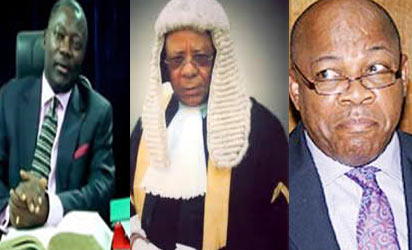
*Oyetibo (SAN), Clarke (SAN) and Agbakoba (SAN)
By DAYO BENSON, ABDULWAHAB ABDULLAH & BARTHOLOMEW MADUKWE
Last week’s decision of House of Representatives to summon President Goodluck Jonathan to appear before it over security situation in the country, particularly the north, has spawned fresh Constitutional questions in legal circles.
One is whether the 1999 Constitution as amended vests such power on the lower legislative chamber. Another is the Constitutional basis of such a summon vis-à-vis the time honoured doctrine of ‘Separation of Powers’ as enshrined in the grun norm.
Against the backdrop of worsening insecurity in some parts of the north occasioned by incessant bombing of churches and other killings, the latest being Kaduna and Damaturu penultimate Sunday, the House of Representatives had asked President Goodluck Jonathan to appear before it and explain steps being taken to tackle the situation.
Following critical comments that trailed the summon, in some quarters, the House insisted it has power under Section 89 (1) (c) of the Constitution. According to the Section, “for the purposes of any investigation under Section 88 of this Constitution and subject to the provisions thereof, the Senate or the House of Representatives or a committee appointed in accordance with Section 62 of this Constitution shall have power to summon any person in Nigeria to give evidence at any place or produce any document or other thing in his possession or under his control, and examine him as a witness and require him to produce any document or other thing in his possession or under his control, subject to all just exceptions.”
Sub-section 1(d) provides for power of the House to compel the attendance of anyone that fails to appear when summoned. The Sub-section reads “in the event a person fails to appear, the Senate or House of Representatives shall issue a warrant to compel the attendance of any person who after having been summoned to attend, fails, refuses or neglects to do so and does not excuse such failure, refusal or neglect to the satisfaction of the House or the committee in question.”
However, Section 308 of the Constitution provides immunity for the President. Senior Advocates of Nigeria spoken to expressed their views on the issue.
It is wrong in law- Prof Itse Sagay (SAN)
I think it is a wrong move because in my view, it affects the whole idea of power. Even though they have oversight responsibility over the executive, there is no doubt about that. But they should invite appointees of the President, not the President who like themselves is elected and head of the executive.

*Oyetibo (SAN), Clarke (SAN) and Agbakoba (SAN)
I think it is wrong, it is not done. For the House of Representatives to invite the President to a committee meeting, in order to tell him to explain and cross-examine him and all that. That is why the President has ministers, chairmen of various agencies. Those are the people they should call, not the President himself.
It is wrong in terms of the dignity of the office. It is wrong in law in the sense that the President is an elected person, who leads a separate arm of government. So they have no right to summon him.
Summon legally correct but breaches protocol- Olisa Agbakoba (SAN)
The House of Representatives have the power to summon the President to appear before it because the Constitution of Nigeria, Section 88, gives the House of Representatives power to exercise oversight function over any person. And of course, that any person in the provision of Section 88 would include the President. Technically speaking, the House of Representatives has that kind of power.
But in my own personal view, it is inappropriate for the House of Representatives to summon the President in the manner they have done. I think it breaks protocol because no matter the tension within the House of Representatives and the President, which we all know is going on, the President still remains the number one citizen. And generally by diplomatic protocol, the President makes an invitation to the House that he wants to come and address them.
In the United States of America, the President addresses the congress on January 20 so that while the law supports what the House has done. In my own personal view which may not be right, I think it is distasteful for the House of Representatives to summon the President of Nigeria, who is the number one citizen.
If the President had been invited, that would be, perhaps, more acceptable. But I personally feel that it is wrong to summon the President because in that sense the House may also summon the Chief Justice of Nigeria to appear before the House and then we will begin to ask the question “how far does the House have power to look into the other tiers of government (Legislature, Judiciary and Executive)?” And I don’t know whether the judiciary can summon the Speaker of the House. I don’t know whether the President can summon the Speaker without the House saying that he cannot do so.
So if the purpose of the summon was to shed light on issue that require clarification, then I would say that an invitation to the President to come is unacceptable. But the summons under Section 88 of the Constitution to the President, in the way that the House would summon any other Nigerian is unacceptable to me. I think it breached protocol. And while it is legally correct, it was improper for the House of Representatives to do so.
And that is why we have Section 308 of the Constitution. The immunity clause is provided in the Constitution, not for the person, but to protect the office of the President and Governor, from debasement and defilement, in particular some people who will use the fact that it has summon the President to court anyhow.
They lack Constitutional power to do so
— Robert Clarke (SAN)
The House of Representatives does not have any power to summon the President to appear before it. The Constitution guarantees ‘Separation of Power’. The only time the President visits the parliament is to present its budget and that is the mandatory provision of the Constitution. Outside that, the House of Representatives have no constitutional power to order the President to come and make a representation on matters. I don’t think they have the power.
The security of the country is vested in the Presidency. It is not a legislative matter at all. It is the sole directory of the President to maintain the security of the country. If by lapses the House of Representatives now wants explanation, it will send for his Minister of Defence. They don’t have the power. Security matters are not within the competence of National Assembly at all.
Their duty is to make laws and to see that those laws are carried out by the executive. So when we are talking about carrying out an executive task, maintenance of security, it is the duty of the President. They can only pass rules to suggest, but the President is not bound by it.
President needs not appear in person
— Emeka Ngige (SAN)
The House of Representatives, like any other legislative House, has the power to summon any government official, including the President. It is the same Constitution that gives the legislature power to invite, and has equally given the President power to execute its function through aides, ministers and other offsets in government.
So where they invite the President to come and discuss issues about security, the President is entitled to send his National security adviser, or the Attorney General of police or any of the Service Chiefs.
Unless there is specific legislation or provision in the Constitution that compels personal attendance or personal presence of the President to be discharged of a particular function. Like in America where the Constitution specifically provides that at a certain date in any given year, the President can address both chamber of the congress and discuss things of the Union. It is something that the President has to come or his Vice President, if the President is incapacitated. We don’t have such provision in Nigeria Constitution, under any other status.
Members of the House of Representatives may be deferring under the apprehension of there power to invite any public officer. Yes they can invite, but the President is not bound to appear in person. The President can honour it, by sending special representative. If he likes to appear in person, he can equally appear.
I remember during the period of former president Olusegun Obasanjo, the House summoned him when Ghali Na’Abba was Speaker and Obasanjo did not appear in person. He sent one of his personal aides. So to me, that is the essence of Presidential system of government. The President can appear through his officers or his ministers.
The House has power to summon the President but he may not appear in person because it is just like an invitee.
House can’t summon him
—Tayo Oyetibo (SAN)
The House of Representatives of the Federal Republic of Nigeria cannot lawfully issue a summons to the President of the Federation to appear before it or before any of its Committee.
Although Section 89(1 )(c) of the Constitution empowers the Senate and House of Representatives or any of their Committees to “summon” any person in Nigeria to give evidence at any place or produce any document or other thing in his possession or under his control for the purposes of any investigation being carried out under Section 88 of the Constitution, and it is incontestable that the President is a person in Nigeria, the nature of the power exercisable under Section 89(1 )(c) is revealed by Section 89(1 )(d) and circumscribed by Section 308(1) of the Constitution.
Section 89(1 )(d) of the Constitution reveals the nature of the power exercisable under Section 89(1 )(c) to be a compulsive power in that the latter provision further empowers the Senate and House of Representatives to issue a warrant to compel the attendance of any person who, after having been summoned to attend, fails, refuses or neglects to do so and does not excuse such failure, refusal or neglect to the satisfaction of the House or the Committee in question.
A combined reading of Section 89(1 )(d) and 89(1 )(c) of the Constitution would show that the categories of persons who can be summoned under Section 89(1 )(c) must be those against whom a warrant can be issued to compel their attendance if they failed to do so.
Under Section 308(1 )(b) of the Constitution, the President enjoys immunity from any Criminal or Civil Process by reason of which he cannot be arrested or imprisoned during his period of office in pursuance of the process of any court or “otherwise”. The latter expression – “otherwise” covers the process of the National Assembly.
The law does not normally give a power that cannot be enforced. In so far as the President cannot be arrested for refusal to obey a Summons issued by the House of Representatives, it would not serve any legal purpose to issue a Summons that cannot be enforced.
In the light of the clear provisions of the Constitution on this subject, it would be in the interest of our nascent democracy for the House to put an end to the unnecessary constitutional controversy.
Disclaimer
Comments expressed here do not reflect the opinions of Vanguard newspapers or any employee thereof.