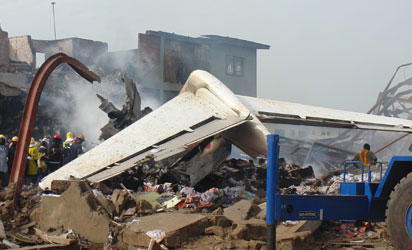
File Photo: Wreckage of Dana Airline which crashed at Iju Isaga area of Lagos.
By Ochereome Nnanna
DANA Air was my preferred airline. Their ticketing system was easy – you could buy your ticket in advance and collect your boarding pass immediately for convenient boarding on travel date, unlike some others where you had to come two hours to boarding and stand in long queues.
Flights were generally smooth with reduced effect of turbulence if you sat at the front area seats. Touchdowns were above industry average. And the air hostesses in their blood red-and-white outfits looked good enough to change a man’s mood – for the better.
These were the reasons that I specifically asked my travel agent to book me on a 4.20pm Dana Air flight to Abuja on Sunday, June 3, 2012. We were to fly on their 9j 345 aircraft. Braving a slight touch of malaria, I arrived at the Murtala Muhammed Airport Terminal Two (MMA2) at about 3.00pm, went and obtained my boarding pass, bought a couple of newspapers to read on board and settled in at the departure lounge to await the call for boarding. It never came.
Other airlines were departing normally and ours had been delayed for about 45 minutes without any word. Then, a group of travellers on the Lagos – Abuja route suddenly returned to the departures lounge through the gate they took to board their aircraft about 30 minutes before. That was the first sign of trouble. Usually, those exiting an aircraft would leave through arrival, not departure. The bemused passengers later told curious enquirers like me that they had already sat down ready for departure when the flight crew asked them to disembark; that there was a serious incident involving another aircraft.
Soon after people received this troubling news, the crowd in the departure lounge clustered around the glass windows to catch a glimpse of what could have gone wrong. It was then that people started receiving news alerts on their smart phones that a Dana Air plane had crashed somewhere around the airport. I quickly went downstairs to the check-in counter of the airline to find out if it was true. Operations were still going on normally, as passengers were still being checked in, though a large crowd of anxious customers wanted to know exactly what was going on. Staff of the airline said until they received confirmation from their office they would continue to assume the news was a rumour.
Suddenly, one of the operations staff of Dana got a call on his walkie-talkie. He called his colleagues working at the check-in counters and they conferred in hushed tones for a few seconds. Then, with grim expressions on their faces, they started closing shop. That was when I knew that indeed, Nigeria had been visited by a demon which was last exorcised in November 2006 when an ADC airline fell in Abuja airport. In a little while, families and relations of those on board the ill-fated flight started arriving, with the usual heart-rending dissolve into utter grief. At this point my malaria became worse and I needed to go home and lie down to watch the unfolding tragedy on television.
I was able to confirm that the flight that crashed (9j 997) was not the one that was supposed to take us to Abuja, but you never could tell. They could always switch their passengers from one flight to the other “for operational reasons”.
This sad incident brought again to the fore how far behind the advanced countries we are at playing in this advanced technological arena. I frequently watch Air Crash Investigations on National Geographic Channel and I know how air crash investigators value the sanctity of the crash site. In advanced countries, emergency and security services would be on a crash site before the citizens get there. They quickly cordon off the area and handle issues of search, rescue, fire-fighting and evacuation of casualties professionally. In most cases, crash investigators go through the site with a toothcomb.
The smallest evidence could lead to the discovery of factors that led to the tragedy. Since the primary reason for documenting a crash site is to ensure that future flights are made safe with lessons learnt, the failure of investigators to determine the cause of a crash is regarded as a major loss to the aviation industry in the world at large. That is why a crash in the remotest part of the world attracts the curiosity of investigators of the National Transportation Safety Board, NTSB, of the USA.
Watching the milling crowd that invaded the Iju crash site on Sunday, I developed goose-pimples. How on earth would investigators be able to successfully process the crash scene? There was total chaos. Those gathered there could be there for any number of reasons ranging from pure curiosity, pity, patriotic impulse to help in salvage operations and (believe this) the quest to loot the valuables of the dead victims. It was probably the fact that human vultures were the first to invade the arrive scene of the Bellview Airlines crash of 2005 over Lissa, Ogun State that helped render the cause of crash inconclusive.
When will the authorities administering our aviation industry and the safety and emergency services evolve a partnership with the people to know exactly what to do once an incident of this nature takes places until the professionals arrive? Now that we are asking questions, when will those who failed in their duties of inspecting aircraft be brought to justice if aircraft put in their care for safekeeping falls from the skies? Many unofficial clues point to the possibility that the ill-fated aircraft has been troubled repeatedly without much being done by the authorities to keep it from flying. Will the culprits just walk free once again?
Finally, what has become of the insurance compensation for the families of the crash victims of 2005 and 2006? Must we wait for Chief Gani Fawehinmi to come back from the dead before a good lawyer takes up the fight for the compensation of families of victims? Let us remember: We must fly, and no one is immune!
Disclaimer
Comments expressed here do not reflect the opinions of Vanguard newspapers or any employee thereof.