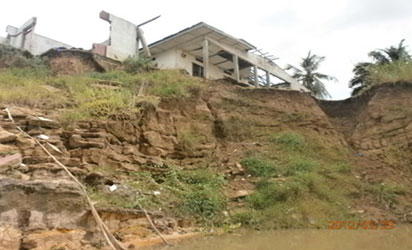
Erosion site
By Samuel Oyadongha, Yenagoa
“We are really helpless. I almost lost my life trying to rescue my canoe and fishing nets one early morning when a large section of the land caved into the river,” lamented Lucky Opuana, chairman, Anibeze Community Development Committee, an Isoko community in the Sagbama local government area of Bayelsa State which is also the home town of renowned historian, Prof Obaro Ikime.
For the people of this riverside settlement whose very existence like several others in the predominantly riverine state is now hanging in the balance on account of the devastating erosion caused by the tempestuous River Forcados, a tributary of the magnificent River Niger, this certainly is not the best of times.
As the people go through the motions of daily life, the troubled look in many eyes betray layers of unspoken fears and uncertainty. Nobody is sure whose house would be the next to be swallowed in this predominantly farming and fishing settlement by the river.
Sadly, the people no longer have enough land to farm due to the devastating coastal erosion which has eroded about 70 per cent of its landmass. Also fishing which the people could have relied on for survival has suffered tremendous neglect due to the precarious situation in the community where families are constantly relocating due to the erosion menace which has swept away several buildings.
Though the plight of the people of the community had been in the media lately, nothing tangible had been done to mitigate the erosion menace. This may have informed the visit of the Bayelsa State Coordinator of the environmental advocacy group, Environmental Right Action and Friends of Earth, ERA/FoEN), Comrade Alagoa Morris and his crew to the troubled community penultimate week for an on-the-spot assessment of the situation.
But a visibly disturbed Morris who had toured virtually all the communities in the state in the course of the discharge of his duty as ERA coordinator in Bayelsa saw more than he bargained for at Anibeze where the people are living on borrowed time.
He aptly captured the scenario thus: “The situation was really frightening and better imagined than being a member of the community facing such ecological trauma. The hope of the people that help would eventually come their way has really ebbed, considering their efforts in the past to seek the attention of the State and Federal Government agencies as what the community is facing is beyond their means.
“The community folks are very apprehensive about their fate. For, losing their houses, roads, church and school buildings has become an annual ritual as they helplessly watch these valuable personal and communal properties and land go into the Forcados River,” he said.
In his submission to the visiting ERA team, the Chairman of Anibeze Community Development Committee, Mr. Lucky Opuana, said though he was young to know the time the erosion problem started in the community: “However, I have lived in this community and witnessed most of the land and buildings being washed into the river”. He did not stop there.

Erosion site
“It is very pathetic and we don’t know what to do to protect our land and buildings now. By your visit, we hope the authorities will hear our cries and come quickly to our assistance. We have lost two big generators given to the community by the administration of Chief Melford Okilo in the old Rivers State.
“Two of our major roads within the community and electric polls and wires have all been swallowed by the rivers. We have lost over 250 houses to this erosion menace. And this is besides Church and school buildings, farms, farmlands and economic trees.
“The first primary school the community had that was built in 1922 with teacher’s quarters is now in the middle of the river. Churches affected include the Christ Apostolic Church, Deeper Life Bible Church, Jehovah’s Witness Church, African Church, St. John’s Anglican Church and Idibo Oghene.
“This house I am staying now is my uncle’s building. My father’s building has also gone into the river; see (pointing) what is left of it. Even my uncle’s own is almost gone; as you can see it is less than one metre to the slope. This is how people in this community have been packing from one house to the other. This has given us serious accommodation problem too.
“My father’s death in 2004 was also related to this ecological threat we are facing. He came out one morning and, standing in front of his house and looking at the nearness to the river encroachment, he said to himself: ‘Is this what my eyes will see?’ And he suffered stroke immediately. That led to his early demise,” he said.
Continuing, he said: “Our community leaders have tried in the past to draw the attention of government to our plight. Apart from writing letters to state and Federal Government agencies, they made efforts to meet with officials of those agencies; all with a view to finding solution to our plight. We wrote to the former Oil Mineral Producing Areas Development Commission, OMPADEC.
“A letter was also written to the Director, Federal Environmental Protection Agency, FEPA, dated October 21, 1993. As we were in Rivers State then, another letter was written to the state government, dated September 19, 1993. The Sole Administrator of Sagbama local government was also sent a letter dated January 9, 1990.
“Another letter dated September 30, 2008 was sent to the Niger Delta Technical Committee. We are really in need of help. As you can see, this is not what we can handle by ourselves; it is beyond us. We need the government to come and assist us protect this land. We are not happy at all; living in constant fear as we cannot relocate and become strangers elsewhere. This has been our ancestral home”.
Also lamenting the plight of his people, Chief Samuel Akeni, a two-time Chairman of the Anibeze Community Development Committee said: “This ecological problem we are facing started long ago, even before I was born. I am now 78 years old and I know where our land extended to when I was a youth in this community. Our land extended beyond the middle of what the river now is…
“Like I said, the ecological menace was here before I left and I returned to meet it. Sadly I came and met an apprehensive and helpless community folks. We have really lost valuables individually and collectively some of which include graves, sacred lands, churches, schools, electric lines and generators, buildings and farmlands.
At a certain time we resorted to prayers; the churches prayed and prayed. But we discovered that this is not a matter of prayers. We keep on relocating when our houses go into the river. This house I am staying is the fourth house I am now living, though this one is made of mud. “We wrote to State and Federal Government agencies. Some visited and left with promises. Journalists have also visited and reported our plight. But all went in vain as even those who promised assistance failed to fulfill their promises”.
Continuing, he said: “When Albert Horsfall was in charge of OMPADEC we sent delegations to meet with officials of OMPADEC and FEPA, besides letters written to them. In one occasion, we prepared to receive officials of OMPADEC, but they didn’t come after promising to visit.
“So, in my view, the government cannot feign ignorance of our plight. When we heard of the dredging of the River Niger and how coastal communities would be assisted with shoreline protection, our hopes were rekindled. But since then we have continued to hear only the billions of naira voted for the project; nothing else since the time of President Obasanjo to late President Yar’Adua and now, Dr. Goodluck Jonathan.
“It is very sad that government has not taken steps to protect people and communities suffering such grave ecological disaster. Still, we can only cry to government; there is nothing we can do. It is obvious that the situation is overwhelming and beyond our efforts to salvage”. The problem is bigger than us. It is not a matter of hoe and cutlass; government should come to our aid now.
“We single handedly cleared a road to the East/West Road in those days and we used to maintain it. Then too, car drove down here during the dry season. But today, because of the ecological challenge, most of the youths are reluctant to return home. What is now the middle of the river was where the community extended to before; as our water front. We have lost about 70 per cent of our land to the river. We are appealing to the Federal and State government to come and help us; we have no other place to go…
The environmental advocacy group, ERA noted that based on visits and analysis of the ecological situation and threat facing the people, “the ecological problem of the Anibeze people is far too above what a community can shoulder. The federal and Bayelsa State government should take steps to effectively address this ecological issue.
“The federal and state government interventionist’s agencies should collaborate and draw also from the ecological funds to effectively tackle the Anibeze ecological threat. This collaboration is most needful for the overall benefit of our communities facing ecological threats”.
“If not already existing in the ministries of environment, a special department for ecological matters be established at the federal and state levels to effectively monitor, record/study and address related issues of ecology. There is the urgent need for a full department or agency of the Bayelsa State government assigned to ecological issues threatening our communities.”
Disclaimer
Comments expressed here do not reflect the opinions of Vanguard newspapers or any employee thereof.