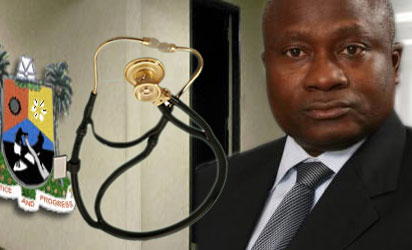
Commissioner for Health, Dr. Jide Idris
By Olasunkanmi Akoni, Ebun Sessou and Monsur Olowopejo
Following the sacking of 788 doctors in public health institution, Lagos State Government Tuesday said there was no room for negotiation with doctors but can appeal even as it said it has no regret on the sack decision, “the decision was considered in the interest of the residents of the state.”
Meanwhile, tempers rose at the floor of the Lagos State House of Assembly when the Speaker, Adeyemi Ikuforiji, informed his colleagues that the striking doctors whose issues the members were sorting out at the particular time, had been sacked by the state government as the news immediately polarised the House.
On the negotiation, Commissioner for Health, Dr. Jide Idris made the remark while briefing Newsmen at the 2012 ministerial press briefing in commemoration of the second term, first year in office of Governor Babatunde Fashola and in a separate media briefing by Head of Service, Mr Adesegun Ogunlewe.

Commissioner for Health, Dr. Jide Idris
Ogunlewe in his own address stated: “A dismissed officer cannot negotiate under the civil service rule. The only option open to them is to appeal through their employers, Health Service Commission, HSC, Lagos State University Teaching Hospital, LASUTH and the state governor has the final say.
“We have had people in the past who were dismissed and that dismiss was presented by their employers that is the Health Service Commission and the Lagos University Teaching Board. There is still room for appeal and that will go as far as the governor.”
However, Idris explained, “The state government has an important responsibility, which is to provide healthcare for the residents of state. That is the focus of the state government now and sacking the doctors is one aspect of it.”
According to Idris, “The decision of the state government to sack the 788 doctors was not a palatable one if one considers the history of how the strike started and all the effort the state government made in order to prevent it.
“But the bottom line of this one is that we have people who entered the service under specific rules and regulation. This were people whom when they took their decision, they were warned that the rules and regulation which they signed onto when they were employed by the state government would be referred to.
“According to the law, the state government reserves the right to formulate policies affecting the entire civil servants. And once one allows these rights to hit into the fabric of discipline and the fabric that binds together the civil service, then there would be chaos.
“This decision is not the end to strike in the health sector, everyone has the right to embark on strike while the state government also has the right to decide the policies on certain issues.”
“As it is now, we still have a thousand of doctors’ still working in the state owned hospitals. The new doctors had their orientation programme yesterday and they are currently been deployed to the entire state owned hospitals and there are plans to recruit more doctors to further increase provision of healthcare in the state.”
Disclaimer
Comments expressed here do not reflect the opinions of Vanguard newspapers or any employee thereof.