…the book
By Ozah Mike Ozah
Emeka Nwosu’s new book, Nigeria and the Crisis of the Nation Station – Agenda for National Consensus, could not have come at a better time.
Apparently a catalogue analysis of major issues and challenges besetting the Nigeria nation, the book should serve as a valuable reference material to those calling for Sovereign National Conference and to students, scholars and interested minds in political science and political philosophy.
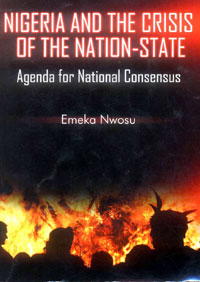
The book’s cover design of black and flaming red and yellow seem to capture the darkness, insecurity and the clear and present or imminent danger which the issues discussed pose to a nation that has remained on the political, social and economic precipice for too long.

...the book
The author’s informed commentaries on various aspects of the Nigeria state and society are food for thought for citizens and nationalists with genuine concern for the survival and sustenance of the Nigeria dream. It is a clarion call for positive renaissance for a better and humane society where governance will be for the good of the governed.
The book touches on such important themes in national discourse as politics and leadership, democracy, rule of law, human rights, the national question, the economy, religion, media, ethnicity, corruption, terrorism and national security, the education system, decaying society, infrastructure, values and the environment; issues that have consistently agitated the Nigerian polity often with dire consequences.
The Jos crisis (chapters 11, 12 & 46) for instance, which has exploded into Boko Haram terrorism, has held the nation spell bound for two long now, reminiscing in the older generation the pogrom of the mid 1966. It is only hoped that it will not shove the nation over this precarious precipice and spill into civic disorder.
The author’s style of writing in free flowing prose and his in-depth, lucid and logical analysis commends the book to readers. It is noted however that, like many modern day writers, the computer has tended to influence the author’s spellings thus rendering many words in American English instead of British.
“Thus, calibre becomes caliber and centre, center etc. The author also fell for the current trend in Nigerian journalism of referring to published works as “carried”, instead of “published.” I think the trend is un-English.
Journalists have a duty to write in good English because often their works mould young minds. So, even though it is said that journalists write history in a hurry, they cannot afford to hurriedly present the language in which they write.
Emeka Nwosu’s Nigeria and Crisis of the Nation State is a book for all seasons for politicians, political science and philosophy students, journalists and all Nigerian patriots with a genuine concern for a re-branded Nigeria.
Disclaimer
Comments expressed here do not reflect the opinions of Vanguard newspapers or any employee thereof.