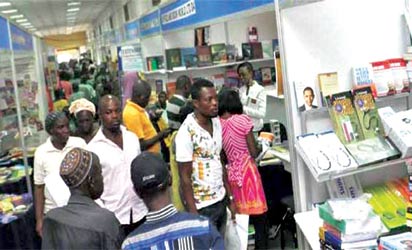
*Participants at the 11th edition of Nigeria International Book Fair which ended last week at the Mult-ipurpose halls of University of Lagos, Nigeria.
By Japhet Alakam
As part of its avowed mission to empower the people by promoting reading culture and bringing books and other instructional materials closer to the people for better education and self-improvement , the Nigerian Book Fair Trust Fund last week held its 11th edition of the Nigeria International Book Fair (NIBF 2012) at the Multi-purpose halls of the University of Lagos, Nigeria.
The fair which was organised by Nigerian Book Fair Trust, a coalition of major stakeholders in the Nigerian book sector as usual lived up to its bidding as over 150 exhibitors from Nigeria and other parts of the world participated.

*Participants at the 11th edition of Nigeria International Book Fair which ended last week at the Mult-ipurpose halls of University of Lagos, Nigeria.
The fair also opened another window for many to network in the book and publishing sector with direct contact with major players in the industry from within and outside the country. For many who have been looking for where to buy books, connect with publishers, especially young writers, schools and schools’ children as well as the general public, the fair provided an avenue to meet their educational needs under one roof in a conducive environment.
Apart from the exhibition, one other major feature of the fair was the annual International Conference of Nigeria International Book Fair that brings together stakeholders in the book industry to rub minds on topical issues that bother on the stability of the industry.
And this year’s international conference held at Afe Babalola Auditorium, University of Lagos, and Lagos, Nigeria as usual looked at a crucial issue that threatens the growth of the book industry in Africa with the theme: The State of Infrastructural Development in Africa and the Future of the Book Trade.
The speakers at the conference were of the view that though the book industry is lacking infrastructural support that should aid its growth, that there is future for the book industry if major players think outside the box and see the current challenges as surmountable.
The conference was chaired by Ambassador Segun Olusola, Chairman of African Refuge Foundation, while the keynote speaker was Ghanian born Richard Crabbe, a book expert from the World Bank group who has been in the book business for years.
Crabbe in his well researched paper engaged the minds of the audience on the future of books in Africa by looking at the infrastructural problems in Africa, how it affects the growth and stability of the book trade and what is to be done to address the situation.
In his address, Mr. Samuel Kolawole, Chairman of NBFT highlighted the importance of infrastructure to economic growth and its input to human development. He said that it has an extensive influence on the entire economy and the existence of a state, and hence the book industry is no exception.
He acknowledged the fact that infrastructural development in Africa has been very poor in spite of considerable amount of resources which has been deployed to it. And explained that the trust of the global book trade is that despite infrastructural deficiency, the content, which defines a good book will be presented to the public hence the publication of non- bound books or novelty titles like; e-books and online book sales.
The keynote speaker, Crabbe in his paper opened the mind of many to the challenges in the book industry and the way forward. According to him, current research indicates that Africa which is labeled a hopeless continent ten years ago is today hailed as the rising continent.
Africa, he said is “experiencing significant changes in many areas and as she braces these changes the question for the publishing industry will be: how will it prepare and position itself to fulfilling the needs of potential readers/users.”
The continent, he continued, “ is living with the development of the information communication technology in the world today, technology now enables digitising a work to allowing for repurposing and repackaging into various formats and onto different platforms for use in different media.”
The world bank expert went on to highlight some of the likely benefits accruing from a virile book industry to which include: removal of burden of printing en mass, shipping the materials before printing, correcting mistakes without incurring extra cost, making it easy for people to assess books from any part of the world thereby satisfying the local and the international market at the same time.
Based on the much advertised clamour about the Bring Back the Book Culture by the President, one would have expected that at such a debate on the future of the book industry, people from the presidency, the education ministry and legislators will be present. But they were not there neither their representatives.
Even the Minister of Education Prof. Ruoqaayyatu Rufaí who was supposed to be the Special Guest of Honour and the House Committee Chairman on Education, Farouk Lawan, who was billed to chair the event were conspicuously absent and were not even represented.
Another group of people that were not represented include; the financial institutions which were supposed to be there too . So the absence of the Education Minister and House Committee Chairman and others from the presidency brings to the fore the reason why the education sector is continually neglected.
Other activities that marked this year’s fair include the unveiling of Prof. Wole Soyinka’s new book , special education workshop, Children’s programmes and the NBFT Life Time Achievement Award which was conferred on two eminent people in the book industry including; Chief M.O. Akinleye, former Chief Executive Officer of University Press Plc and foremost librarian, Prof. Felicia Adetoun Ogunseye.
Disclaimer
Comments expressed here do not reflect the opinions of Vanguard newspapers or any employee thereof.