BY MCPHILIPS NWACHUKWU
Readers of this review will wonder at what makes funeral, which in its deep denotative African sense is seen to be a harbinger of pain, anguish and sorrow an aesthetic exercise. Ironically, this exigency in pain, sorrow and loss at some levels provides rich and deep cultural, religious and scholarly aesthetics.
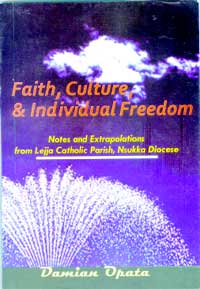
And such is what Damian U Opata’s brilliant offering on the subject of death and burial as captured in his new book, Faith, Culture &Individual Freedom… gives to the reader.
Revolving round 2010 traditional burial of his dead parents, the book chronicles an ugly account of crises of faith that ensued between the author’s family and the catholic parish of Lejja in Nsukka Diocese over traditional burial obsequies accorded to the author’s deceased parents.
According to the account, while the children of the deceased wished to bury their dead parents according to traditional dictates because in the deceased life time, they practiced traditional beliefs, the Catholic Church at Lejja, through the intervention of her over zealous parish priest, Reverend Father Asadu preferred that the burial be done in the catholic way.
Following the refusal of the family of the deceased to this suggestion, the Church on the instruction of the parish priest imposed an ultimate penalty of ostracism on not only the Opata’s family, but also on all the other catholic members of the Lejja parish that attended the burial to sympathize with the bereaved family.
While Opata’s account tries to justify his family’s decision to going about the burial of their parents in the traditional way, it equally opens up a number of other interesting issues bothering on burial rites, acceptance, freedom and culture conflict.
Most interestingly, Opata’s book provides a rich template on the pattern of Igbo burial, which is now subsumed in the religious frivolities of the Christian churches. It also provides logical account of the kinds of ritual exigencies undertaken during the burial of one’s parents in the Igbo culture areas and why such rituals are undertaken.
Through this interesting narrative, the reader is led into the Igbo world view about death and death/ancestor relationship and why certain cultural expectations are to be met during the burial of dead old men or women.
The book, Faith, Culture &Individual Freedom… is also employed by the author to challenge the position of the
ejja parish Priest, who pronounced punishment of ostracisation on his family and the families of other catholic members of the community that attended the said burial and therefore argues that through that unchecked action that the church deliberately and outrageously infringed on their human rights.
This feeling becomes stronger when viewed from the fact that such an obnoxious infringement is pursued in a country supposedly operating a constitution that provides for freedom of religion and lawful association.
Therefore, the book further argues that the Catholic Church at Lejja has no right what so ever to detect for the Opata’s family or for any other persons the faith to profess and how to profess it.
Faith, Culture and Individual Freedom is one other brilliant offering from Opata, whose previous forays in the discourse of Igbo traditional religion, art and theory of art as explored in his seminal books; Ekwensi in the Igbo Imagination :Heroic Deity or Christian Devil? and Ajija: Igbo Agent of Death and Destruction have singled out as one of the profoundest liberal thinkers of the day.
Quoting copiously from the Bible, Opata equally raises critical question about the Catholic Church’s position on the concept of enculturation and wonders whether the much talked about enculturation campaign takes into consideration important traditional and cultural developments in Africa.
Opata’s Faith, Culture& Individual Freedom, though written from the point of displeasure does not however smack of anger. It is a book written and handled with the best of intentions, and all its arguments presented in an engaging intellectual tradition with the view to providing new materials and insights into the study of African traditional religion and Igbo funeral aesthetics.
Disclaimer
Comments expressed here do not reflect the opinions of Vanguard newspapers or any employee thereof.