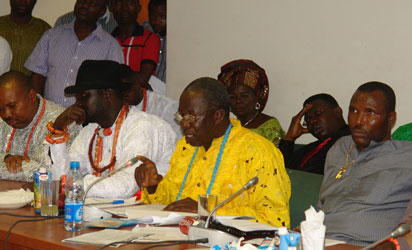
From left: Hon. Griftson Omatsuli; the Akulagba of Warri Chief Ayirimiemami ; Spokesman of INYC, Mr Akaruse; Hon. Michael Didem and David Tonwe, during Public Petition Hearing on the non inclusion of formally armed Itsekiri Youths in the Post-Amnesty Programme held at National Assembly Photos: Gbemiga Olamikan
BY EMMAN OVUAKPORIE
THE Presidential Amnesty Programme for militants among Niger Delta youths who laid down their weapons to give way to peace and development in the region, once again, took a centre-stage of activities at the House of Representatives on Thursday.
About 60 members of the Itsekiri National Youth Council, INYC, stormed the National Assembly, to give strength to an earlier petition to the federal legislators over the exclusion of former Itsekiri militants from the Amnesty Programme.
Their complaints was that over 2, 000 Itsekiri youths voluntarily surrendered their arms to the Federal Government on June 25, 2009 which was within the 60- day deadline, but were not invited to the programme.

From left: Hon. Griftson Omatsuli; the Akulagba of Warri Chief Ayirimiemami ; Spokesman of INYC, Mr Akaruse; Hon. Michael Didem and David Tonwe, during Public Petition Hearing on the non inclusion of formally armed Itsekiri Youths in the Post-Amnesty Programme held at National Assembly Photos: Gbemiga Olamikan
The youths, led by a patron of the council, Dr. Lucky Akuaruese were armed with a copy of their earlier petition, as well as, and a video showing clearly the affected youths surrendering their arms which included rocket launchers, AK 47s, Sub-Machine Guns, SMGs and several other automatic weapons, to buttress their claims.
The House Committee on Public Petitions prior to last Thursday’s public hearing had invited the Special Adviser to President Goodluck Jonathan on Niger Delta Affairs, Kingsley Kuku to appear before it.
Chairman of the House Committee on Public Petitions, Hon. Uzor Azubike who arrived the venue at about 1.45pm read all the necessary sections of the constitution which empowers the committee to issue a warrant of arrest and other sanctions on public officials who fail to honour the committee’s invitation. The sections include 88 and 89.
However, before presenting his paper, Hon. Kuku made an appeal to members of the committee to switch off the CD which displayed how the arms were surrendered saying:
“I have developed an emotional attachment to the whole exercise, watching this clip will definitely disturb my flow while making my presentation.”
Kuku in his presentation did not mince words when he declared that , “ I am just a boy who listens to his father once an instruction is given by his father. It is only the president who can include the Itsekiri youths in the Amnesty Programme. If I am asked to include them right now , I promise you that by 7am tomorrow, the youths will be included because they are qualified since they met the deadline.
“In the past, my office had written to the President on this issue that the Itsekiri youths should be included in the programme because we have a common problem bordering on poverty and suffer same deprivations”.
The Itsekiri youths, numbering over 60 had earlier that Thursday, stormed the National Assembly venue of the on-going House of Representatives investigative public hearing of the probe of President Goodluck Jonathan’s Special Adviser on Niger Delta Affairs over the non-inclusion of Itsekiri former armed youths in the Amnesty Programme.
Their demands included an immediate inclusion of over 2,000 Itsekiri youths in the Federal Government of Nigeria Amnesty Programme.
In a presentation read by a patron of INYC,Dr. Lucky Akuaruese titled: ‘Petition over the non-incluson of formerly armed Itsekiri youths who responded to the June 25, 2009 , Federal Government of Nigeria, FGN, Amnesty Proclamation into the Post Amnesty Programme’ , the aggrieved youths asked the Speaker of the House of Representatives, Alhaji Aminu Tambuwal to urgently look into the non-inclusion of their youths in the Amnesty Programme.
They argued in the petition that the Itsekiri youths who obeyed the FGN’s call for truce were deliberately and wickedly excluded from the programme for no just reason by the Office of the Special Adviser.
Sequel to this development, the House in plenary on Thursday March 29 had acknowledged the petition written by the president of INYC and subsequently mandated the House Committee on Public Petitions to institute an investigative hearing into the allegations by the council.
The INYC further stated in the letter that “ if we ask ourselves to individually define the different specifics that can be identified as constituting the Niger Delta crises-a phrase that now assumes the status of a universal, we shall discover that the various unpleasant events , the collectivity which are now categorised as ‘Niger Delta crises’ began in Warri in 1997.
The ‘constituents’ of the Niger Delta Crises as the Causal Factor of the Amnesty Proclamation:
According to INYC, “the Niger Delta Crises, even though a phrase , its conceptualisation and application have however given it the status of a ‘universal within which consists different ‘particulars’. In identifying these particulars , we must be quick to point out that we will reframe from beng judgmental, nor shall we bother ourselves with delving into their respective causal factors, that is, the different causes of the different crises, the collectivity of which are now being referred to and categorised as the Niger Delta Crises”.
He further explained that “without equivocation, what is being referred to as ‘Niger Delta Crises’ are the different events of destructive dimensions both in human and materials that took place in different parts of the region which started in Warri and its environs in march 1997 as manifested in the bloody inter-ethnic crises.
“The constituents of the Niger Delta Crises are concisely listed below and not in any particular order but all between 1997 and 2004.These include:
1.Itsekiri/Urhobo bloody confrontation in Warri urban.
2.Itsekiri /Ijaw blood bath in Warri and environs.
3. Ijaw/Ilaje/Yoruba) war in Ese-Odo Ilaje Local Government Council. Of Ondo State.
4. Ijaw/Bini confrontation in the riverine areas of Ovia South West axis of Edo state.
5. Ijaw/Ikwere confrontation in Rivers State
6. Ijaw/Ogoni confrontation in Rivers state.
7. The Ijaw/Ibibio battles in the Oquo-Ibeno areas of Akwa-Ibom State.
8. Ijaw/Urhobo bloody confrontations as manifested in the wars between Aladja and Ogbe-Ijo, Siama and Gbarigolor and Oboro and Olota.
9. Ijaw/Ilaja killings in the Binbioye axis of Burutu Local Government Council area of Delta state.
“Besides the above, there were other bloody incidences lagely of intra-ethnic pattern in the different communities of Bayelsa and Rivers State particularly in the Ijaw areas within this identified period. It was all these (among a few others) that are being categorised as the Niger Delta Crises.
“Let us briefly put forward two other constituents of the Niger Delta Crises, both of which are consequent on the collectivity of the above mentioned particulars. Briefly, when all these respective ‘wars’ due to several factors which include possible efforts of respective governments, federal inclusive and possibly the super ordinary of the principle of ‘balance terror’, there was no immediate defined visible effort from any quater (official or private ) to disarm members of the respective groups of ethnic militias.
“By 2006, some of these groups of ethnic militias introduced two new ‘particulars’ to the universal Niger Delta crises. They include breaking of crude oil pipes solely to get crude oil and other petroleum products for sale and kidnapping of foreign oil workers to obtain huge cash on ransoms.
“The second has significantly
experienced sub-phases such that all the states in the region are respectively reeling under kidnapping phenomenon such that an individual’s safety has significantly receded into the realm of dream”.
Hon Daniel Reyenieju representing Warri Federal constituency in a brief contribution praised Hon Kuku for admitting that the youths were eminently qualified to be part of the Amnesty Programme.
He said, “ when I met with Kuku in the past, it was always combative but today, I am really impressed with his presentation.”
Disclaimer
Comments expressed here do not reflect the opinions of Vanguard newspapers or any employee thereof.