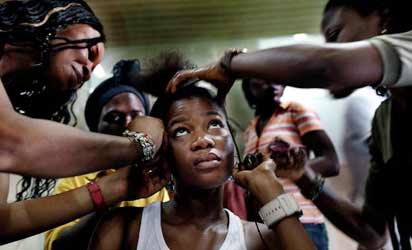
Student stylists
By GERALD NWOKOCHA (NYSC, Abuja)
The Poor Dad says, “Love of money is the root of evil” while for the Rich Dad,“Lack of money is the root of evil”. The above, coined by Robert Kiyosaki, author of Rich Dad, Poor Dad, has become a popular adage among students of the Federal University of Technology, Owerri (FUTO), Imo State, who claim the saying captures their life on campus. QuadLife examines what students do to survive.
There is a saying that not all fingers are equal. It is true that some people are born with a silver spoon while others are not. From findings, students engage in many activities on campus to survive. Some are sponsoring themselves; others depend wholly on their relations. Most students who do business on campus have to sell below the prices obtained outside as this is the only way they get other students patronise them.
There are those who push trucks during holidays to earn a living but when they come back to school, they live normal student life. Some other students engage in evil activities in the quest to make quick money. Quadlife spoke to some on the things they do to survive.
Chinyere Nnalue, in 500-Level Agricultural Extension, sells female underwears. She said she gets them at cheaper rates from Cotonou in Benin Republic and then sells at a price lower than what is obtainable in Aba, Abia State and other markets around.
Nnalue said: “Students are my immediate customers and they are good customers as my wares do not stay long before they are finished. Part of the profit I make, I plough back into the business while the rest I use to take care of myself on campus.”
Chima Kingsley Mbonu said he chose to reside in the hostel because of the business he does. He sells shirts, trousers and footwears. He carries the products from room to room. Most times, he takes them to offices for staff members to buy. He said his entrepreneurial ability has made his lecturers like him. According to him, he travels to Lagos from school almost on monthly basis to buy the goods.

Student stylists
There are students who own phone booths where other students make calls and buy recharge cards. They also make money, especially when there is power outage in school, as students queue to charge their phones. They pay N30 per hour spent in charging phones. Multiple sockets are provided.
Charles Ekeocha, in 200-Level Industrial Chemistry, is a part-time staff of Mbaitoli Local Government, Imo state. He said he combines his work and schooling. He is the eighth of nine children and has been responsible for his training since secondary school.
Michael Okoro and Charles Opara are friends and classmates. They said they make money by selling lecture notes they prepared for 100-Level students. “We also sell Engineering drawing materials and post-UTME past question papers to make money.”
Ben Okeke, a 400-Level student of Microbiology, makes money from his photography business. His studio is Beno Concept.
Chidiegwu Nmeri of Project Management Department said he does menial jobs wherever he can find one, especially during holidays.
He said: “While others rest or travel during the holidays, I use mine to do tedious work. It is from the proceeds of this labour that I eat and train myself. I have assisted builders; I do farm work for people like constructing ridges, weeding and clearing the farm with my friends.
“Initially, I used to pretend to my friends for fear they would laugh at me. But that changed the day one of our lecturers told us a story in class about his own student days. Since then, I stopped being shy. Most times, after the holidays, my friends would complain that I looked dry and stressed out, but I know that it is for a while.”

Male footwears being sold by a student on campus.
Ifeanyi Nkwoala, a fresh graduate of Civil Engineering, said he lived the ‘big boy’ life as an undergraduate not because his parents were rich but because he was proactive.
“Many students were involved in selling clothes,” he said “so I had to go into something else. With the little knowledge I had about printing, I went in and ended up doing many printing jobs like magazines, stickers and postcards, posters, souvenirs, almanacs, diaries etc.
I was well patronised by student politicians who I lobbied. With time, churches and fellowships started coming to me too. I don’t own a printing press. I’d collect jobs in bulk and push them to a printing press.”
Peter Nwafor, a final year student of Information Management Technology, is a software vendor. The fact that a large number of staff and students use laptops is good news for him. He also supplies laptops to whoever needs them “no matter the specification.”
Some other students said they make money by forming pressure groups. The group would pay courtesy calls on politicians, prominent personalities and establishments and, in return, they would be given money.
One of such students said sometimes they visit three places a day and always go home smiling. “Politicians like awards, we learnt that quickly, and we use that to get cash,” he added.
Some of these groups align themselves to particular politicians or aspirants.They are mobilised and are well paid. The truth is that the parents of these students may not really know what their children are doing on campus.
However, there are those students who engage in stealing, kidnapping and other vices. It was reported last year of a student of Imo State University, Owerri, who was arrested when he came to collect N5 million ransom for kidnapping a traditional ruler.
Many go into students union politics because they believe they will get money from it to train not only themselves but also their entire families. In FUTO, the union is called “oil well” because students believe that there is much to gain. They include the right to sell your own bed space as a union official. Every union official is entitled to a room.
The hostel governors have a greater advantage because they have access to sale of the rooms not allocated. The hostel governors also bring in more bed space to any room that is not choked and they collect money from the students. Sources say that “the activities of most hall governors have not been friendly as it has placed some students in a hard condition. They also make money from their annual hall week.”
Some others make money by being fellowship presidents and pastors. Cynthia Uchechi in 400-Level Public Health, said some of her friends have made money by being pastors. In FUTO, these pastors are given free accommodation, and sometimes official cars depending on the fellowship.
Disclaimer
Comments expressed here do not reflect the opinions of Vanguard newspapers or any employee thereof.