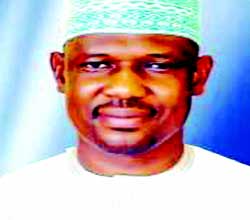
Hon. Jangebe, ZUBEB Boss
Hon. Murtala Adamu Jangebe, Chairman of Zamfara State Universal Basic Education Board, ZUBEB, in this interview with Abdallah el-Kurebe, speaks on the deteriorating state of education in Zamfara State and the intervention by the present administration of Governor Abdul Aziz Yari Abubakar. Excerpts:
Would you say the objective of the Universal Basic Education (UBE), which is to provide free and compulsory education to the Nigerian child, has been achieved in Zamfara State?
Not quite, though we have made some significant efforts in providing basic education for the Nigerian child in Zamfara State. We have recorded successes and we have also experienced challenges in the course of keeping to this mandate. Part of the problems is the issue of unqualified teachers. That is not peculiar to the state, but it is probably more pronounced in the north, particularly the northwest. But the fact remains that we have made some strides despite some pit-holes.
What are the objectives of the recently inaugurated State Primary Education Assessment Committee?
The objective is to enumerate and study the problems of education in the state and proffer solutions to these problems so as to provide a holistic approach to the problems of primary education in the state. We want to know how many teachers we have, how many of these teachers are qualified; how many boys and girls are enrolled in primary schools. We also want to know how many classrooms are in good learning conditions and how many are not.
To achieve this, we invited lecturers who are in education departments and are indigenes of Zamfara State from Usmanu Danfodiyo University, Sokoto; Bayero University, Kano and Ahmadu Bello University, Zaria. We invited them because we want to have an objective result as far as the data of education in the state is concerned so that we can plan with the information, set targets and measure our achievements.
One of the big challenges we have in the north is girl-child education. What is being done to improve on the present status?
Generally in the north, it is not the issue of girl-child but also the boy-child enrolment in school. It is a big problem really. You find that this is the part of the country where you find a high number of children who are out of school. It is with this in mind that we said, okay; let us know how many they are and their location – urban or rural areas.
What are the visible effects of Enhancing Girls Basic Education in Northern Nigeria, EGBEN, in the three local governments embarked upon by ActionAid International in the state?

Cross section of candidates during an exam
We are a participating state in the activities of ActionAid and the problem we have is if the girl-child does not go for Almajiri (begging), she hawks. The boy-child too may not even go for begging but he still does not go to school. ActionAid assisted in reducing this menace but we need concerted efforts to get to the desired stage.
Poverty is said to be partly responsible for poor enrolment in schools and, to some extent, withdrawal. What are you doing to balance the equation between this social problem and child education vis-à-vis parents’ willingness to allow their children to attend primary education?
One measure some states have taken is feeding the pupils at school but we are not yet in the position to do that now. The problem is not feeding them but earning income for the parents. So, unless if you are going to substitute the attendance with income to the parents, then we could say that the problem could be solved. That may also encourage a lot of the male children to go to school.
That is where you will be able to create some sort of acceptability. Say, come to school, we will give your parent N500, but that would be determined by the Committee. In any case, after we collate this information, it would be left for us to map out the strategies to correct the trend. We are not shying away from the problems because we know they exist but we want to know the quantum.

Hon. Jangebe, ZUBEB Boss
How does the state see the recent call by the Emir of Anka for a state of emergency to be declared on education as well as reintroduction of Teacher Training Colleges across the nation?
The problem with declaring state of emergency is that if you are not careful, it will be politicised. Also, if you did not make adequate plans and preparations, the objective for which you declared the state of emergency would not be met and there would be corruption. We are carrying out a kind of revolution in changing the way education was being delivered in the state in the past. We are focused and have achieved a lot. Let me give you an example.
This time around, we are spending nothing less than N5 billion on primary education, for the first six months of year 2012. I am sure that we are going to spend half or nearly that before the end of the year. So, if this money goes into primary education, I am sure that we would achieve a lot. There is more noise-making in declaring state of emergency than in what we are doing now. Even before you declare state of emergency, you must have to know what the problems of primary education in the state are.
On the reintroduction of Teacher Training Colleges, I know why the Emir was speaking in that sense. You see, if the Teacher Training Colleges still existed, the process of learning from JSS III would still be there. You will learn teaching observation from JSS III and in SSS I, you would do your first teaching practice. In SSS II, you would do another teaching practice where you would be evaluated by your teachers and assessed and be guided. By the time you graduate from the Teacher Training College and you move to NCE level, we expect a standard teaching from a trained and qualified teacher.
But for whatever reason, the National Council on Education and those that matter at the policy level said that the teacher training college should go because they saw it as more of wasting of time before you attain a degree. It was not necessarily that it was viewed as a bad system. They, however, under-estimated the role it would have continued to play in grooming teachers. In the present circumstance now, you are made to start from NCE level which has been so bastardised because of the semester system.
Before now in NCE programme, you learn a course for a particular year and you would be examined throughout the year on that particular course. So, you keep in touch with all the contents of the course. Whereas, now when you are through with a course in a semester, you are completely through with it; you would have nothing to do with it; you close your book and forget about it.
As a teacher and stakeholder in education, don’t you see that in order to have quality education, we need to have quality teachers who should actually go through this process?
There is no doubt that without quality teachers, there will never be quality education and that is one of the big problems we are facing right now. What I would advocate is for government to place emphasis on one of the factors that I believe has been militating against production of quality teachers, which is the learning of the English language. Since English is the official medium of communication in teaching and in writing exams in our schools in the country, then the learning of English should be a must.
Disclaimer
Comments expressed here do not reflect the opinions of Vanguard newspapers or any employee thereof.