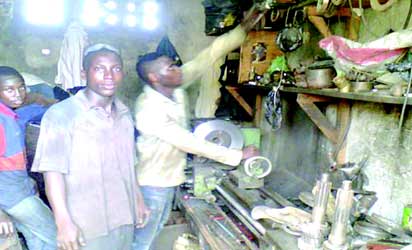
Apprentices at work
By Laju Arenyeka
Nigeria Education Data Survey (NEDS) recently revealed that the percentage of students attending secondary schools in the country within the official school age of 12 years to 17 years was still 44 per cent as at 2010. This year, admission spaces are available only to one third of applicants who wrote the Unified Tertiary Matriculation Examinations (UTME).
This, coupled with the abysmal failure in the O’ level qualifying exams, as well as the high rate of unemployment begs that attention be paid to apprenticeship.
A major section of the semi- skilled labour market has been left in the hands of this form of learning. Tailors, motor mechanics, technicians, businessmen, hair stylists, etc, in Nigeria today evolve from an independent system with its own rules, practices and outcomes.

Apprentices at work
Taiwo Ibrahim is a product of this system. As an automobile technician in Ajeromi Ifelodun Local Government Area of Lagos State, Ibrahim began as an apprentice under his master in 1982. Today, he has trained over five apprentices that have gained their freedom.
He said: “Before they can gain their freedom, they must know how to drive properly as well as fix cars. They must also satisfy the requirements of their master and gain his confidence. After the freedom, the apprentice has two options; he can either stay with his master until he locates a place that he can work on his own or he can start his own workshop immediately.”
Emeka Ume, who sells truck spare parts in Lagos, just gained his freedom from his master last year after five years of apprenticeship. “I stayed with my master for five years and he was the one taking care of me when I was learning. After my freedom, he opened a shop for me and gave me some money.”
Mrs. Maria Egbu who inherited her trade of auto electrical accessories from her late husband gave Vanguard Learning a glimpse of the workings of the apprenticeship system.
According to Egbu, “If it’s a young person who hasn’t finished secondary school, he would stay for about six years, after which his master will settle him. But if it’s an SSCE holder or a graduate that wants to learn, he would have to pay about N200,000 to learn. When he’s about to leave after about a year and he didn’t spoil anything, you would take 10 per cent of the money and use the rest to rent a shop or buy goods for him.”
Egbu’s knowledge of the spare parts apprenticeship system varies slightly from what Vanguard Learning was exposed to in the world of tailoring. Entrepreneur and tailor who referred to herself as Mama Miracle, is presently teaching over six young women how to sew.
She said: “Anyone that is coming to learn from me will stay for three years, and will pay N15,000 as well as bring two crates of soft drinks and a bottle of wine. I treat them as my own children, we play and we understand one another, but they stay with their parents.”
Gloria Nweke, who owns a salon, has her own apprentices stay for about a year. She however complained that this generation of apprentices seems to lack staying power: “They are not always very patient. They are supposed to stay for about a year, but some don’t stay that long.”
Nweke isn’t the only one with this opinion. When speaking to Vanguard Learning, Egbu said: “Nowadays, we don’t really have people who are patient enough to stay and learn.”
Taiwo Lateef who is learning to be an automobile technician does not fall into this class of impatient people as he has served his master for nearly eight years without gaining his freedom. “I haven’t got my freedom yet because I haven’t got someone that will help me buy all the necessary things,” he said. “I dropped out of school because I didn’t have enough money to take care of myself.
Sometimes, I would close from school and not have enough money to eat. That’s why I decided to just face one thing. Although I’m not getting paid, sometimes the customers give me something, and sometimes the person I’m working with will give me something. At least, I’m gaining a lot of experience. I would like to have my own workshop in the future.”
A future in the semi- skilled labour market is what Nneka Owualaka envisions for herself. After three years of apprenticeship under Mama Miracle, Nneka said: “I chose to learn handwork because I liked it from day one. Right now, I can sew skirts and blouses very well and cut them to the style that my customers want.”
Not all apprentices envision a future in the trade they are learning. Tunde Joshua who is a precision apprentice says that although he enjoys the work, he still looks forward to going back to school to study medicine.
Mr. Ernest Mba, who is the Chairman of the Berger Business Association in Lagos advised apprentices to be focused and obedient, saying that “how long an apprentice stays depends on how fast and cooperative he is.” Mba, however, sums up a stark reality that stakeholders in the education sector must take to heart, “Until the government or the people find another method, I think apprenticeship is the best way to learn so many trades.”
Disclaimer
Comments expressed here do not reflect the opinions of Vanguard newspapers or any employee thereof.