By Omoh Gabriel Business Editor
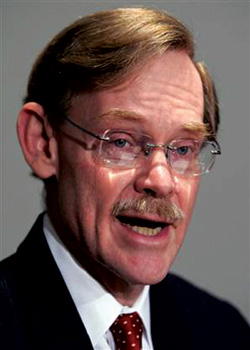
The retiring President of the World Bank Group, Robert Zoellick, had an opening media chat on Thursday, 19th April, in Washington. Here is excerpt of the discussion
Introductory remarks
This marks my last Spring Meetings as the President of the World Bank Group, so I would like to begin with a few words of thanks to the Ministers who have supported us and worked with us; to our Executive Board, who have labored hard to help our Management team to modernize the important multilateral institution; to the excellent Senior Management team that I have been proud to help build and to lead; and to the World Bank Group staff in Washington and around the world. They are motivated, they are committed, they want to make a difference, they are a tremendous asset, and we have been able to draw the best now from 170 countries.
This has been a pretty busy five years, so I suppose my tenure at the World Bank Group has had three phases—a turnaround from a time of some trouble; quickly moving into faster and more flexible, large-scale support for our client countries across the food, fuel and financial crises—in financial terms alone, about a quarter-of-a-trillion dollars; and the start of the modernization of the World Bank Group for the future.
That ongoing modernization effort will be a large part of my presentation to the Development Committee later this week and my discussions with our Governors. With the first large recapitalization of the IBRD in over 20 years and two record-breaking IDA replenishments totaling more than $90 billion, I am pleased to turn over a well-resourced Bank with a AAA rating.

*Robert Zoellick
Yet we always need to think ahead about how to mobilize resources—for the growing interest in IFC and private sector development, for the poorest, and for the changing needs of our middle-income clients, which are still home to three-quarters of those living on under $2 a day.
Our Modernization Agenda is driven by our focus on clients, listening to their priorities, as opposed to an old top-down approach, and modernization involves a rigorous focus on results, openness, and accountability.
So our initiatives for open information, open data, and open access to knowledge may turn out to be the most important legacy of the past five years. These steps are key to democratizing development, and these steps lay the foundation for expanding social accountability, fighting corruption, and building better governance.
Last year, I proposed that the World Bank and others should recognize that investments in civil society and good governance are as vital as investments in roads, factories, and clinics. So I will be pleased to announce later today the formation of a new Global Partnership for Social Accountability that will provide support to civil society organizations in their work on social accountability.
Now, much of what you will hear over the next few days will deal with the ongoing shock waves of the financial crisis—issues of macroeconomic stability, fiscal and monetary policies. That is certainly important, but it is not enough. Countries, both developing and developed, need to focus on the structural reforms that will be the drivers of future growth; otherwise, the world will keep stumbling along. The World Bank Group will be emphasizing the structural growth agenda.
Structural reforms and changing growth models fit with our recent major reports such as the China 2030 Report and the Golden Growth Report that looked at Europe. You will also encounter structural growth in our priorities for infrastructure, especially public-private partnerships; social safety nets, to protect human capital in a volatile and uncertain world; gender, so that countries can gain growth opportunities from empowering all of their people; and financial inclusion, including at these Meetings, a first-of-its-kind report on measurement to access financial services that will show that three-quarters of the 2.5 billion people living on less than $2 a day are shut out of access to banking.
Developing countries have provided two-thirds of global growth over the past five years. These are no longer charity cases; they are vital to the world economy. But of course, they face huge challenges, too. So it is the World Bank Group’s aim to keep focusing the world’s economic leaders on growth—not just stability; on human safety nets—not just financial safety nets; and on modernizing multilateralism so that all 188 of our shareholders can work together for their common interest.
Finally, I had an opportunity to talk to Jim Kim after his selection as my successor. We will have a chance to meet shortly after the Spring Meetings on the transition process. I think he will do a great job, and I wish him and all others associated with the World Bank Group every success.
I was hoping you could address the European crisis from two angles.
One, you previously noted that European countries had bought a lot of time with liquidity measures. I am curious what you think about how they have used that time and what they need to do next; and more broadly with emerging market countries, how are they faring with the shock waves from Europe, and is there anything in particular they should be doing now given the potential for another round with Spain?
Well, on the first one, I think the euro zone in particular and the European Union is going to be walking a very fine line. First, as you noted, with the anxieties late last year, I think the ECB’s extraordinary actions were appropriate, but I think some misled themselves because they only bought time, and the time has to be used.
I think that, as the IMF has pointed out, on the one hand, the future of the euro zone depends on actions of individual countries, particularly the steps they take for fiscal consolidation and, as I have emphasized, the steps they need to take for structural reforms and future growth. It is very difficult to take those steps in a no-growth environment, so it has to be balanced with steps that might be able to support demand and longer-term changes of growth.
So this week, I tried to make some suggestions on the supply side and ways in which the single market could also further deepen integration to support growth. Now, again, as the Fund has pointed out, the banking system also remains under significant stress, and at the one hand, you need the banks to build their capital; on the other hand, what we have seen is that if the banks build their equity ratios by shrinking, as they by and large have been doing, that is going to put a stress on credit contraction and undermine the basis of growth.
So I think the debate understandably reflects the fact of trying to balance these issues, but I think we are now in a phase where, after the ECB provided very attractive financial resources to a number of the banks to be able to buy government debt, as we have seen in various newspapers—I think your own today, as I saw one story—they are about at the end of that point and limit.
So I think further actions are going to be called for, and the point I keep emphasizing, wherever it is around the world, is not just to focus on the austerity and macroeconomic stability measures, but you need to do this in a context of growth, in part because we have to face the political economy issues.
As I have emphasized, the real countries that are critical because of size at this point are Italy and Spain. You have governments that are taking strong actions. It would certainly help if they got some support from some of the types of things that I and others have talked about so as to help with growth and the politics of reform.
As for the second question, the deleveraging process in European financial institutions has certainly begun. I tend to agree with I think the IMF report and others that said that there is more to go.
We have seen the effects, differential effects, around the world. I just came from East and South Asia. You have definitely had a pull-back in some of the project lending and sale of some of the assets in East Asia. A number of the Asian banks have stepped in, so it has not really had a significant contractionary effect.
Starting late last year, I again worked by my friends at the EBRD and EIB and EC to try to reactivate the Vienna Agenda because I have been most concerned about the Southeastern European and the Balkan countries. And there, working with the banks, we are seeing the contraction. So far it has been orderly, but it is a good example of trying to get ahead of the curb.
(cuts in) I was talking about this late last year, and people did not yet see the numbers, and as you saw the first quarter with the BIS numbers, you started to see this contraction. And I was actually pleased—through the IBRD, we were able to expand our commitment over the next couple years by about $4 billion, IFC another $2 billion, so our total, I think, is about $27 billion.
I think that is an example of the types of things you need to do, frankly, even in the months ahead to get ahead of some of these problems. North Africa has clearly been affected by this, and this is again the political implications, because for a number of the North African countries, Europe is a very important export market, so it is important. I was with the Tunisian Finance Minister yesterday, and I am going to meet them again—as they undertake these difficult reforms, they need to get support from us and others along the way.
This the area that Pascal Lamy of the WTO and I have been watching particularly closely is trade finance. A lot of the European banks were big players in trade finance, particularly the French banks, so you are seeing some shrinkage of that.
In the areas, what I am most concerned about—and by the way, this is where the new capital rules from Basel III are going to have to be watched very closely; the Basel Committee took some steps to alleviate some of the changes that they had put in, overly stringent, in my view, but now we are trying to gather some data with the WTO and others to make a stronger case for easing some of the strictures they have—because what I am most worried about is a place like Sub-Saharan Africa, where I suspect that the exporters of major commodities to the U.S. and Europe will still get trade finance, but if you are a small country, if you are a small bank, if you are a small client, if it is intra-African trade—which should be the future of growth—those are likely to get squeezed.
So, again, what I try to do in these meetings, Sudeep, with my G20 colleagues, because we see all these marketplaces, is to try to anticipate some of those issues, and those are some of the ones that I am focusing on.
And then, the last one, of course, which is implicit in your question, is that we are not out of this mess yet, so if you have a more seismic event because of failures of management, that is going to hit everybody hard. It is still a fragile economy, as we and the IMF have pointed out.
We would like to know how concerned are you with Argentina’s move to nationalize the country’s leading oil company, and if this somehow threatens to further isolate the country.
Well, I think it is a mistake, and I think it is a symptom that we have to watch out for of, under economic pressure, whether countries will move to more national, autarchic policies, respond more to populism, respond more to protectionism. So I think it was the wrong thing to do.
On the Arab Spring, I was just curious—Madame Lagarde laid out what is basically now a stalemate between the IMF and Egypt over support there, and I was wondering from your perspective, to what degree you think political uncertainty in those countries is holding up the type of support you feel needs to come from the outside to get their economies back on track.
And then, secondly, briefly, what is your advice to Kim on transition? What are the mechanics of that going to look like, and what are you going to be able to do to help him in the door?
Well, on the first one it varies a lot by country. So let’s take Tunisia, which I referenced with earlier. You know, Tunisia has gone through an election process. They have an Islamic-based government. The government seems to be stressing the continuation of the policies that the prior interim government focused on, and those are policies we are trying to do everything we can to support—not just basic financing, but policies of inclusion, because you have had sort of a growth model that didn’t pay enough attention to people in the west and central part of the country—trying to focus on some of the youth unemployment issue, and—very nicely with the agenda we are setting on openness and social accountability—when we did a Development Policy Loan, they accompanied it with a series of changes to try to open up their process. And I think it is not only good politics, it is good economics, obviously, to have the society feel that they are engaged in the process.
But the Tunisian economy is still under significant stress; it has lost tourism; it has lost some of the effects of exports to Europe. So IFC, our private sector team, has also been doing investments in there. So, in the case of Tunisia, this is not going to be done overnight.
They are going to face a tough year. But I think it is in everybody’s interest to try to support them if the government stays on the current path, because again, looking at this from a bit of an economic history point of view, I think the North African transformation is going to take a while, but what I saw happen in East Asia and elsewhere is that countries that undertook the reforms become models for others.
Morocco has had a fast-paced evolution as opposed to revolution. They are making a series of reforms, so we are trying to support them, again, on the openness side, the investment side, the private sector side. We are trying to support Jordan. Jordan is going through a combination of political and economic reform.
In a country like Libya, they have the resources. There, we have been trying to work with some partners in a difficult security environment to help create the capacity for basic financial management and other activities. The big one obviously is Egypt, which you referred to, and here, as I suspect from what you have said that Christine mentioned, they not only face an economic and financial challenge, but they are in the process of a political transition. And I understand that there will be a need to be able to base the legitimacy of whatever economic relationships they have on the Fund and the Bank with the people who will be exercising power under the new Constitutional arrangement.
I think that that does slow up the process. Life is full of twists and turns. That is kind of the facts of life and the reality. There are things that I think the interim government can do to create a better environment for this. We have kept doing investment lending, and we have tried to focus some of the investment lending in Egypt on some of the sectors in need, but the bigger policy loans that we would do would depend on the macroeconomic issues that the IMF is addressing; and frankly—at least it has been my guidance—they will also be based on some of the openness and social accountability issues that we have seen in Tunisia and other countries.
And that, I think—that is also important because I think you are going to be going through a political transition process, and the more open it is, then, whoever is elected in this year or next year or others I think will have a better sense of engagement with the economic changes in Egypt and the relationships with the World Bank.
This is one of the things, I think—we have also had to learn lessons from the Arab Spring. Economic growth alone is not enough. It has to be inclusive. And frankly, the more we can emphasize the things I have been talking about, about openness and social accountability, I think that is the future direction of the Bank as well as these countries.
You asked a second one—
oh, on Dr. Kim. Well, I have been through a lot of transitions in my life, so I have some experience with them. We tried to centralize a team to avoid the standard problem of the 500-page briefing book by focusing on some of the issues that will come up first.
I think these Spring Meetings are timely because we will get a sense from the Governors and the Board about some of the issues that would be of nature to be a continuation—some of the things that I have talked about in this Modernization Agenda which has both internal and external aspects.
And beyond that, I always think that as you are turning something over, you have to actually have some degrees of restraint. You know, he will be the person in charge. I happen to believe that change is good for institutions as well as me, and it is good to have a fresh person come in.
We will try to explain where we think some of the issues are. He certainly has a lot of perspectives, I am certain, from the tour that he took around the world and the discussion with the Board.
Disclaimer
Comments expressed here do not reflect the opinions of Vanguard newspapers or any employee thereof.