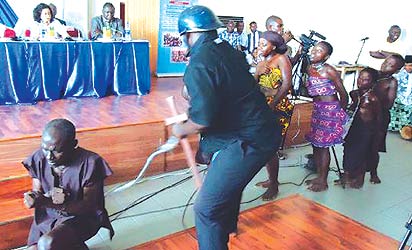
*Slavery enactment drama at the event
By MCPHILIPS NWACHUKWU
The clamour for the cancellation of Federal Government’s purported plan to merge some parastatals in the Federal Ministry of Tourism, Culture and National Orientation gathered renewed momentum at the just concluded one week international conference on Slavery and Slave Trade held in the Canaan city of Calabar Cross River State.
In the recent weeks, rumour mill had it that a report submitted to the Federal Government by the Steve Oronsaye Committee advises that government should merge some of the parastatals in the Ministry to allow for efficiency and cost reduction in governance
While many stakeholders buy into the thinking of the yet to be implemented report, a lot of concern are however being expressed in many quarters on the implication of the purported plan, especially as it has to do with the fate of some of the parastatals, whose activities impact meaningfully in not only re-branding the country’s image, but also, in working assiduously to erect structures for solid national economic improvement.
One of such parastatals is the Centre for Black African Arts and Civilisation, CBAAC at whose behest the conference was convoked. With theme, Slave Trade and Slavery in the Arab Islamic World: Untold Tragedy and Shared Heritage, scholars and stake holders from across the world came together not only to discuss the all important subject of slavery, but also, to commend the meaningful job being done by CBAAC in harnessing the creative resources of Africans at home and in Diaspora for meaningful and engagingly development of the black race.
Held at the beautiful Marine Resort Centre, Calabar, the event was hosted in conjunction with the United Nations Educational, Scientific and Cultural Organisation, UNESCO with the support of Cross River State government.
The choice of the ancient city of Calabar for the conference is symbolic. This symbolism lies in the historical connection of the then deflowered beautiful city with the tragic story of the inglorious human trade that left in its wake a very ugly scare in the psyche of the black man, the world over.
In the eyes of renowned historians and custodians of culture world over, the city of Calabar remains the nexus and placental thread that connects the slave merchants and the hinterland from where the human cargoes were captured, bonded and brought to be sold to the ready buyers for onward transportation to the new world of America and Europe. And that was why scholars from across the world converged in the beautiful Canaan city for seven days to discuss some of the important events that have helped to place the town on world map.
So, while scholars from all over the world settled down to discuss the slave routes as they concern Nigeria and Africa, what was upper most in the minds of participants was how to plow back the relics and historical heritage of the trans – Atlantic Slave Trade to help rebuild the world and create new cultural diversity for the benefit of humanity.
Even though scholars generally agreed that over 30% of the slaves shipped to the new world and different parts of Europe went through to the Calabar route, UNESCO officials have also deemed it necessary to consider the Calabar slave route as world heritage site.
In other words, the essence of the exercise is to find avenues to document and preserve all the historical materials for posterity and socio- economic relevance. Indeed, this international conference came at a time when the Cross River State Government has found it imperative to encourage UNESCO to open new vistas to locate and identify more routes in other to attract global attention to the State as a fore most tourist destination centre for the nation.
Addressing the conference, the Governor of the State, Senator Liyel Imoke said, “we know what this conference means to us- that over 30% f the slaves that left these shores did so from Calabar. Even though majority of them came from the hinter land, the Calabar route has been designated as one of the busiest and most vibrant while the inglorious trade lasted.”
Continuing, he added that, “For this and more, we give our support to UNESCO in its effort to make these relics a heritage site. We therefore declare this conference open with the hope that we get the necessary result at the end of the day.
“Hosting the representatives of UNESCO for this unique event is also an opportunity to showcase this State as the best tourist state in Nigeria.”
In the same vein, the Minister of Tourism, Culture and National Orientation, Edem Duke observed that : “ For me , we can not really discuss the Diaspora without first of all locating the places where our people are plying their cultural values in the new world. And for us here, we need to explore the opportunities offered by their presence all over the world to create the necessary impact needed to make culture a global phenomenon.
In his own contribution, Ali Moussa Iye, who stood in for UNESCO said: “part of what we are doing here today is to remember and commemorate the HAITIAN revolution and also use this opportunity to emphasise the need for inter- cultural relation among the nation’s of the world.
He went on to say that “this project is to encourage more researches and field works on the routes and how to guarantee the safety of the information already gathered. We are now working more on oral and traditional historical facts to build more dossiers on this topic.”
Scholar after scholar harped on the need to use the contacts with the local communities to make the UNESCO effort work. In his keynote address, Hillary Beckless, a professor of History from the Barbados described the local people as very critical in the exercise to pinpointing those issues that re-shaped the history of the world.
“Slave routes played pivotal roles in the onward movement and transportation of peoples of African descent to the WEST and the new world. Therefore, Nigeria should use her vintage position in Africa to project these issues so as to make us more proud and relevant as Africans in the Diaspora.”
Beckeless, who is the Vice Chair of the UNESCO international Scientific Committee for the slave routes project is also angry with the Nigerian government for not doing enough to rescuing the Diaspora.
According to him, “where we come from, we know those, who came from Calabar, those, who came from Yoruba land and so on. In Jamaica for instance, the settlers are Igbo and that is why, their pattern of life is Igbo. Even if you test Usain Bolt on a DNA now, he is likely to be an Igbo man.
In his welcome speech, Professor Tunde Babawale of CBAAC re-affirmed that since “the African Union has now considered the Diaspora as the sixth region of the world; we need to continue to promote the necessary ideals for African liberation and interest.”

*Slavery enactment drama at the event
In the recent weeks, rumour mill had it that a report submitted to the Federal Government by the Steve Oronsaye Committee advises that government should merge some of the parastatals in the Ministry to allow for efficiency and cost reduction in governance
While many stakeholders buy into the thinking of the yet to be implemented report, a lot of concern are however being expressed in many quarters on the implication of the purported plan, especially as it has to do with the fate of some of the parastatals, whose activities impact meaningfully in not only re-branding the country’s image, but also, in working assiduously to erect structures for solid national economic improvement.
One of such parastatals is the Centre for Black African Arts and Civilisation, CBAAC at whose behest the conference was convoked. With theme, Slave Trade and Slavery in the Arab Islamic World: Untold Tragedy and Shared Heritage, scholars and stake holders from across the world came together not only to discuss the all important subject of slavery, but also, to commend the meaningful job being done by CBAAC in harnessing the creative resources of Africans at home and in Diaspora for meaningful and engagingly development of the black race.
Held at the beautiful Marine Resort Centre, Calabar, the event was hosted in conjunction with the United Nations Educational, Scientific and Cultural Organisation, UNESCO with the support of Cross River State government.
The choice of the ancient city of Calabar for the conference is symbolic. This symbolism lies in the historical connection of the then deflowered beautiful city with the tragic story of the inglorious human trade that left in its wake a very ugly scare in the psyche of the black man, the world over.
In the eyes of renowned historians and custodians of culture world over, the city of Calabar remains the nexus and placental thread that connects the slave merchants and the hinterland from where the human cargoes were captured, bonded and brought to be sold to the ready buyers for onward transportation to the new world of America and Europe. And that was why scholars from across the world converged in the beautiful Canaan city for seven days to discuss some of the important events that have helped to place the town on world map.
So, while scholars from all over the world settled down to discuss the slave routes as they concern Nigeria and Africa, what was upper most in the minds of participants was how to plow back the relics and historical heritage of the trans – Atlantic Slave Trade to help rebuild the world and create new cultural diversity for the benefit of humanity.
Even though scholars generally agreed that over 30% of the slaves shipped to the new world and different parts of Europe went through to the Calabar route, UNESCO officials have also deemed it necessary to consider the Calabar slave route as world heritage site.
In other words, the essence of the exercise is to find avenues to document and preserve all the historical materials for posterity and socio- economic relevance. Indeed, this international conference came at a time when the Cross River State Government has found it imperative to encourage UNESCO to open new vistas to locate and identify more routes in other to attract global attention to the State as a fore most tourist destination centre for the nation.
Addressing the conference, the Governor of the State, Senator Liyel Imoke said, “we know what this conference means to us- that over 30% f the slaves that left these shores did so from Calabar. Even though majority of them came from the hinter land, the Calabar route has been designated as one of the busiest and most vibrant while the inglorious trade lasted.”
Continuing, he added that, “For this and more, we give our support to UNESCO in its effort to make these relics a heritage site. We therefore declare this conference open with the hope that we get the necessary result at the end of the day.
“Hosting the representatives of UNESCO for this unique event is also an opportunity to showcase this State as the best tourist state in Nigeria.”
In the same vein, the Minister of Tourism, Culture and National Orientation, Edem Duke observed that : “ For me , we can not really discuss the Diaspora without first of all locating the places where our people are plying their cultural values in the new world. And for us here, we need to explore the opportunities offered by their presence all over the world to create the necessary impact needed to make culture a global phenomenon.
In his own contribution, Ali Moussa Iye, who stood in for UNESCO said: “part of what we are doing here today is to remember and commemorate the HAITIAN revolution and also use this opportunity to emphasise the need for inter- cultural relation among the nation’s of the world.
He went on to say that “this project is to encourage more researches and field works on the routes and how to guarantee the safety of the information already gathered. We are now working more on oral and traditional historical facts to build more dossiers on this topic.”
Scholar after scholar harped on the need to use the contacts with the local communities to make the UNESCO effort work. In his keynote address, Hillary Beckless, a professor of History from the Barbados described the local people as very critical in the exercise to pinpointing those issues that re-shaped the history of the world.
“Slave routes played pivotal roles in the onward movement and transportation of peoples of African descent to the WEST and the new world. Therefore, Nigeria should use her vintage position in Africa to project these issues so as to make us more proud and relevant as Africans in the Diaspora.”
Beckeless, who is the Vice Chair of the UNESCO international Scientific Committee for the slave routes project is also angry with the Nigerian government for not doing enough to rescuing the Diaspora.
According to him, “where we come from, we know those, who came from Calabar, those, who came from Yoruba land and so on. In Jamaica for instance, the settlers are Igbo and that is why, their pattern of life is Igbo. Even if you test Usain Bolt on a DNA now, he is likely to be an Igbo man.
In his welcome speech, Professor Tunde Babawale of CBAAC re-affirmed that since “the African Union has now considered the Diaspora as the sixth region of the world; we need to continue to promote the necessary ideals for African liberation and interest.”
Disclaimer
Comments expressed here do not reflect the opinions of Vanguard newspapers or any employee thereof.