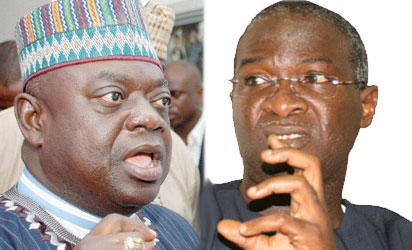
Gov Aliyu and Gov Fashola
AS OJUKWU GOES HOME TODAY: Never again to war, separation — Fashola, Aliyu

Gov Aliyu and Gov Fashola
En route to today’s interment of Dim Chukwuemeka Odumegwu-Ojukwu, activities and tribute sessions were held in Ojukwu’s honour in five of the nation’s six geo-political zones.
The only exception was the Boko Haram fortress of the Northeast. It was remarkable send off for the man who led a secessionist attempt against the country. Similar programmes were held abroad, the first of its kind for any Nigerian.
Essentially, speaker after speaker at the numerous ceremonies showered tributes on the late Eze Igbo Gburugburu, who came to national and international renown after his declaration of Biafra as an independent nation and waging war against his fatherland.
The 30-month civil war claimed about three million lives and cost the Federal Government about $1million dollar a day, to prosecute.
With hindsight, speakers at the fora had a fair and kind view of Ojukwu’s actions before, during and after the war. While some said he fought for justice and equity, others said if they were in his shoes they would have taken up arms, like he did, to defend their people.

Indeed, some of them feared that the country could face direr consequences if the issues and problems Ojukwu fought against beginning from 1966 till he died on November 26, 2011 were not urgently addressed.
Such issues include restructuring of the polity, devolution of powers to the constituent units of the country, ending inequity and injustice and treatment of all Nigerians as equal citizens irrespective of ethnic origin and religion. Without addressing these issues, especially through a National Conference, some of the speakers warned that the country might disintegrate.
We must say no to disintegration
However, Lagos State Governor, Babatunde Fashola (SAN) and his Niger State counterpart, Mu’azu Babangida Aliyu, urged Nigerians to perish the thought of Nigeria imploding and work hard to cement and entrench the country’s unity because it would be more beneficial for Nigerians to remain united than going their separate ways. The duo were among eminent citizens who have been eulogising Ojukwu since he expired.
Aliyu: Why do people talk about breaking away at slightest problem?
Delivering a lecture on “Governance, Social Conflict and the Imperatives of Communal Harmony organised by the Business Hallmark Newspaper in Lagos on Monday, Aliyu, who admitted that the country was operating a faulty federalism amid an avalanche of social unrest, injustice and increasing poverty, said he was disturbed by the penchant of some Nigerians to seek breaking away from the country in the face any problem instead of seeking for solutions.
“My major concern has been: why is that every little problem that comes to Nigeria, people will start talking of breaking away? Why is it that till date we have not been able to distinguish between genuine heroes we should appreciate and those who are temporary heroes?” he asked, saying that Nigerlites feel duty bound to protect the country’s unity.
“We from Niger State feel we are the Nigerians that should do everything to protect Nigeria because the name ‘Nigeria’ came from River Niger, Niger State; the 1914 amalgamation took place in Zungeru, Niger State; Niger is the only state that produced three heads of state if Dr Nnamdi Azikiwe was also a Nigerlite. Our late Ojukwu was born there. He was born in Niger State and by the time he grew up he was so fluent in Hausa that many people believed that his Hausa was more fluent than Igbo.”
During a funeral programme for Ojukwu in Zungeru, last week, Aliyu had absolved the Ikemba Nnewi of blames in the civil war saying, “if I were in the same situation that Ojukwu was, I will pick up arms to defend my people.”
To save the country from recurring socio-political and economic stability, the Niger State Governor urged operation of true federalism.
His words: “There is no doubt that our nation has been facing multiple socio-economic and political problems for a very long time; every nation does, as that is a fact of the dynamics of nation building.
However, we have a
responsibility to evolve suitable mechanisms for finding lasting solutions to our problems. Nigeria operates a federal system which by simple understanding has the advantage of providing for our unity and facilitating the integrative forces that allows for the plurality and diversity of our nationhood, while ensuring even development of the constituent units.
“We need to actually rethink our federalism, re-examine the powers, functions and resources available to all tiers of government, re-assert moral autonomy at individual and community levels and restore transparency and accountability in governance at every level. For instance, the federal government has no byusiness getting involved with certain things – education at the secondary and primary levels, with primary healthcare delivery or even with agriculture (importing fertilisers and awarding contracts for tractors and purchase of grains), since all these directly affect the people at the state and local government levels.”
Ojukwu wouldn’t ‘ve been happy if Igbos took visa to mourn him in Lagos — Fashola
Relatedly, Fashola, who spoke at the funeral programme the Lagos State Government funded at Tafawa Balewa Square, Lagos, said that Ojukwu fought for an egalitarian society.
Wondering if Nigerians learnt any lessons from the civil war and recounting his childhood observations during the war and imagining what the country lost, he prayed that Nigerians should never go to war again or disintegrate.
He said: “The first question I asked myself after deciding to talk about the war was this:‘what lessons did we learn? What would the Ikemba wish today if he were alive – a broken Nigeria or a stronger united one?’ There is no way to be sure what his wish would have been. But we have logic to guide us. Would Ojukwu have loved this massive turnout on Yoruba soil, to celebrate him as he makes a triumphant reunion with the one from whom he came? Would he have been happy if his people, the Ndigbo, my own brothers and sisters across the Niger, had needed diplomatic relations and possibly issuance of visas in order to celebrate him Lagos, simply because Nigeria had broken up and Lagos was in another country? I doubt it.”
He continued: I was barely
four years old when the civil war broke out. Even then and in spite of the fact that I did not ‘see’ the war, I still save my memories. Although it was much later as I grew up that I understood what the big lorries were doing; that Igbos were fleeing Lagos in their hundreds and thousands. As a four year old in Surulere, I used to be scared of those lorries.
“My late grandmother only needed to tell me that the big lorry was coming, for me to behave myself and stop whatever naughty behaviour I was engaged in. Those are my memories of the war. I can only imagine what the memories of those, who actually fought the war and lost loved ones and more, are. Even if it is only for the fear of big lorries, I say Never Again. And I am sure that every one of us here will say that with me. Never Again!
“I therefore understand the Ikemba’s cause as a pursuit of a just and egalitarian society, rather than the desire for violence and bloodshed. And my faith in the future of Nigeria remains re-enforced by the fact that my cousin, Ganiyu Louis Okafor and I will never be separated.
“My faith is re-enforced by a wedding ceremony I watched on TV where a proud Igbo father, standing next to his beaming Efix wife, gave their daughter away in marriage to a Yoruba man… I always think fondly of my big brother General and later Senator Ike Nwachukwu – born of an Igbo father and a mother of northern extraction; and happily married to his half Yoruba, half Rivers wife. That household is certainly a mini-Nigeria! That is the Nigeria that I wish to see. A Nigeria where how you are treated does not depend on what part you are from, a Nigeria where your choices are respected as long as they are permitted by law. That is the Nigeria that exists in my own family and in my own home.
That is why Ganiyu Louis Okafor – a Christian with Muslim siblings, is my cousin. That is why my wife, Abimbola, who is from Oyo State, is half-Urhobo and practices her Christian faith of Catholic denomination whilst married to a Muslim who has an Anglican mother, a Muslim father and many Christian siblings.
“It just goes to show that in all of this diversity, what is common, what is stronger, is our bond of unity rather than our language or how we worship God. The colour of our blood is the same; we drink the same water; we spend the same money and we eat the same meat, yam, pepper and bread.”
How to immortalize Ojukwu – Uko
Founder of the Igbo Youth Movement (IYM), Evang Elliot Uko, said the best way to immortalise Ojukwu was to emulate his virtues.
“As the people close shops in honour of our icon of all time, state governors declare public holidays and the old and young mourn him sincerely, it is important to remind us all that what would matter more is to search out those things that stood him out and to emulate them. He lived for others, he stood up for the truth, he defended the down trodden and fought for the common good. He was fearless, courageous, sincere and great lover of the masses. He hated filthy lucre. He did not amass wealth and never compromised his principles.
“If we close all the shops in West Africa and march on the streets all over Africa and refused to imbibe his virtues of selfless sacrifice, then we would all be hypocrites. He hated hypocrites in his lifetime.
Treachery, treasury looting and blackmail, which he detested, are incidentally the opium of today’s Nigeria and Igbo land. Our society would be a whole lot better when and if we sincerely imbibe the virtues Ojukwu espoused in his life time. There is no better way to immortalize him,” he said.
Disclaimer
Comments expressed here do not reflect the opinions of Vanguard newspapers or any employee thereof.