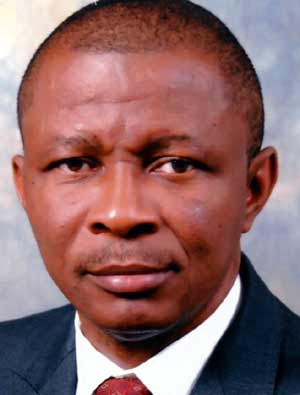
Mr. Emeka Eleh
By Jude Njoku
Come Saturday, March 24 in Abuja, Mr. Emeka Eleh 48, will mount the rostrum to be decorated as the new President of the Nigerian Institution of Estate Surveyors and Valuers, NIESV. In this interview, Mr. Eleh who is the founding partner of Ubosieleh & Co unveils the major plank of his two-year tenure. Excerpts:
Land reforms I am looking forward to such a time when my uncle or aunt in the village would be able to use the land they have to raise money for local business; until such a time, things wouldn’t work. Government has done a number of things, you have NEFUND, small and medium scale industries, but you see, any loan system requires a bit of guarantee.
Even when the church is giving it to you, somebody has to back it up. What we are saying is, review our land tenure laws, give title to people, let everybody have title to land and release the hidden capital in land because every land can lead parallel lines.
It can lead you to somebody, there can be mortgage on the same land, a mortgage company can securitize it. There can be three to four different things happening on this same property. Five different people can have different titles on this same property parallel to each other and nobody is disturbing anybody. But it would require a change in our land tenure law.
It would require people to be able to put an asset and have that asset deciphered by a title number in a place where it can be checked and verified. The same way you want to buy a car, you go to the licensing office and check that the car belongs to Okey, in the same way, if you want to buy a plot of land, you go and check and it should be straight forward.
In some countries, it takes one day, in some two or three days but you know how long it takes in Nigeria. Even the Lagos State 30 days consent, you can never get it in 30 days and the charges are too much. Lagos State, for instance, is 15 percent. You are looking at 15 percent of whatever amount the land is worth. That is too much; what it does is that it limits dealings in properties, it limits the rate at which people buy and sell property, which is not good.
Housing and land reforms
Housing is a major contributor to the GDP. In fact, what they call the mortgage ratio must be very high for that economy to be successful. In developed countries, that mortgage ratio can be as high as .75 to .80. Ours is still under .1, even Ghana is inching forward to .3.
So many things are wrong. So, what we want to do is not to champion housing as housing but the basic issue that underline housing, that can empower people to build the houses is land because land remains the major component of housing. Why is it difficult for people to own a home? It is easier if you own the land, you can phase your building project over five years.
If you already own the land, you can decide that this year, I will mould blocks, next year, I will do the design and so on, but you cannot do that if you don’t own the land. We feel that a land reform process will underpin the kind of wealth creation this country needs to go through for it to develop. Of course, there is the issue of mortgage. Even agriculture is still at its subsistent level because the people don’t have any money.
In Kwara State, they brought in foreigners, gave them land and title to the land and the guys went into massive production of agricultural products because they already have an advantage over the locals because they have the land and title to the land. With that title, they can go to the bank and ask for loans and the banks will give them. The same way, people must be able to have access to capital with what they have.

Mr. Emeka Eleh
Our major national advocacy would be on Land Reforms, reform our land tenure system so that people can have access to land and be able to use it for whatever they want to use it for.
National Assembly and land reforms
It is a measure of how our system is run that even an executive bill on land reforms sent to the National Assembly by Late President Yar’Adua. was not dealt with. The Senate dealt with everything else that came along with it but that was still not dealt with. As I speak, I am sure that there are over eight housing-related bills before the National Assembly that have not been attended to.
Yar’Adua realised that amending the Land Use Act is a very tedious process because it is part of the constitution, so, he did what somebody in his position will do – amend the sections that are the main issues.
For instance, the major bottleneck to housing provision in the country is the fact that a governor must grant you consent before you can make use of the land. I have been telling people that the law was bad from day one; what it means is that you have to get consent before you even sell.
But then, you don’t know whom you will sell to. When you put your property for sale, it is a notice to the whole world to come and buy, so how do you go and get consent when you don’t know who the buyer is and the price.
What late President Yar’Adua did was to send to the National Assembly a Bill to amend those sections to enable business on land to be transacted. In some states, getting consent can take from 30 days to eternity, that’s why a lot of people don’t bother.
There are land transactions all over the country but people don’t bother to look for consent; people don’t even bother to go and register because it costs so much money and takes so much time.
Recently, President Jonathan inaugurated another Land Reform Committee, you know that Yar’Adua inaugurated one. What I am saying is, let’s take action, there is no need having committees upon committees without anything being done.
In fact my idea is this: If the land reform act is going to be a long process, at least, do the basic ones; amend those sections of the Land Use Act that we consider the major problems like the consent provision so that if you buy land today, in one week you are able to change the ownership, at least for banks.
Some banks don’t even rely on property as collateral anymore and you don’t blame them because the process they go through trying to change an ownership from those that borrowed money from the bank is so tedious and the process of realizing or selling as the case may be, in case of foreclosures is so tedious. A man can hold you to ransom.
Sometimes, we don’t know that our laws are part of the problem. I will give you an example, because our foreclosure laws are very loose, our power of possession laws are very loose, a tenant can hold you (a landlord) to ransom. What it means is that people are discouraged from investing in real estate and unfortunately, it affects the low-income earners more. Everybody wants to come to Ikoyi and build because the quality of tenants will be a lot better.
Creation of a good mortgage system
Of course the next one would be creating a good mortgage system but I must say that the government is working hard at mortgages. By the time the raise the share capital of mortgage banks to N5 billion and create a discount window for them which happens abroad; the idea is look, if your share capital is N5 billion and you give mortgages of up to N1 billion and you are somewhere within the Central Banking rule where you can go and discount the N1 billion and release the capital to your business.
What it means is that they will buy back the mortgages you have and release cash to you at a discounted rate. It means that you are going to continue in business, that is what is done abroad. This happens with the banking industry, so why wouldn’t it happen in the with the mortgage sector.
After all, AMCON has just bought loans from banks; all they have done is that they have bought the loans at a discounted rate and given the banks money to continue their business. So, our national advocacy will rest on land reforms because we believe it is very vital to the growth and development of this country. It is a long term project but if it is done properly, this country will be a better place for all of us.
Quality of school leavers
We are also concerned about the quality of those who are leaving schools. When I was in school, I was privileged that I was not only taught by the teachers within the school, I was also taught by those who were coming from outside so that you can have a bit of private-sector influence on your training. We want to institute a volunteer culture among our members that every year, go and do five hours in schools. It is so easy.
You can go to UNILAG and spend one hour with the students every other month or every six months. Go and tell them what you do in practice which in a way, is different from what they are learning in their school. We are concerned about the quality of those who are coming out and we want to be able to encourage them. We will institute school-based programmes.
Instead of holding our seminars at Golden Gate for instance, we go to UNILAG and hold it with the students to be able to encourage them with regard to what they expect. We are also concerned about our number. Even though we are the leaders in the built environment, we appreciate the fact that we are not as many as we should to serve 150 million people. So, our members should deeply involved because we want to raise our membership without reducing our standard.
Code of ethics that have not been implemented
Part of our challenges is that we have rules or code of ethics that we have not really implemented. We have code of ethics and practice which should be implemented and enforced. We have what we call a branch development manual on how to develop our branches to make them more effective and efficient. These things are within our existing rules.
It is like Nigeria where you have a constitution that is not being implemented and people are clamouring for a new one. What we want to do is to first and foremost, ensure that we implement what we have because within our rules are manuals and rules that if implemented, will make our institution stronger and we intend, within the short time that we have, to ensure that it is done for the sake of our profession.
You remember that we had a retreat at Ada where we talked about mega practices and being able to create platforms through which our members can specialise. We have faculties that were resurrected two years ago, faculties that we now call business groups so that people can train and specialise in certain areas. The era of having what we call a one-man firm will soon end. It may not end completely but the idea is for people to see the benefits in partnerships.
I have been in a partnership for 20 years and I can assure you that it works because two heads are better than one, in the same way, three heads are better than two heads. If you get to England for instance, Knight Frank and Rutley may have up to 30 partners. You cut costs when you have partnerships because instead of having multiple offices all over the place, you have one good one.
Part of the challenge we have is being called an agent; when people call me an agent, I will always correct them and call the full names. Because we are more than agents; our training encompasses so much than agency. We appreciate the fact tthat agency requires a bit of control and there are plans in the pipeline to control it.
Disclaimer
Comments expressed here do not reflect the opinions of Vanguard newspapers or any employee thereof.