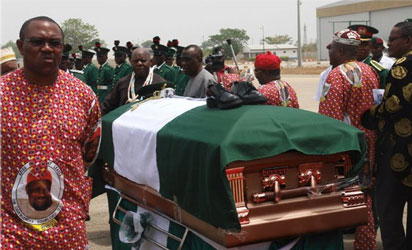
By CHARLES KUMOLU
BEFORE November 26, 2011, Emeka Odumegwu Ojukwu represented different things to different people, especially in Nigeria.
To a lot of people, he was a soldier, who rebelled against the country he who swore to protect and defend its territorial integrity.
Another section of the public, regarded him as an ethnic hero and a failed politician.

For this reason the late Ikemba of Nnewi remained the most misunderstood and discussed Nigerian until his death.
But the general misconception of his role in Nigeria’s history, appears to have suddenly vanished, leaving in its trail, tributes from erstwhile friends and foes.
In a country where a common voice on issues, events and personalities, is nearly absent, the passing on of Ikemba of Nnewi, has provided an unusual opportunity for principal actors in the polity to speak as one.
Indeed, this development would for a long time, remain a surprise to students of history and analysts alike.
Even though some have described this uncommon solidarity, as the hypocrisy of Nigerian elites, one thing that would not be buried with him today, is the fact that his death unusually united Nigerians.
A peep into the tributes of Gen Yakubu Gowon, Chief Olusegun Obasanjo, Gen. Mohammadu Buhari, Gen Ibrahim Babangida among others, speaks volumes about how friends and foes, found a common voice following Ojukwu’s death.
Ojukwu would have defended Nigeria — Gowon
For a former Head of State, Gen Yakubu Gowon, who was Nigeria’s leader, when Ojukwu led the Eastern region into secession, Ojukwu was a freind, who would have defended Nigeria with the same zeal he used in defending Biafra.
“I have never regarded or called Ojukwu an enemy. He had been my friend for a very long time when we used to crack jokes at the officers’mess. It was unfortunate that he took up arms against Nigeria, but I believed very strongly that if he were the one in my shoes, he would have defended Nigeria with the same zeal, I am also glad that he died as a very committed Nigerian who even tried to be president democratically; not once but twice. Now that he has ascended to glory, may his soul find peace,” Gowon said.
He further said, “Ojukwu loved Nigeria so much; he merely wanted to opt out over perceived injustice to his people.`But we said no because we felt we can resolve our differences as one family.”
He said that Ojukwu’s return to Nigeria after 13 years in exile and his bid to lead the nation by contesting the presidency several times was a testimony to his wish for a better and stronger Nigeria.
The former military leader lauded Ojukwu’s fighting spirit and ability to go all out to pursue his conviction but rejected suggestions that Ojukwu was an enemy.
He was a colleague and an opponent
He said that his death would naturally invoke memories of the civil war but he was simply a colleague and later an opponent.
“We merely disagreed over the fate of Nigeria. Also, we did not go to war as such, we merely had to use some force to enforce what majority of Nigerian wanted,” Gowon said.

From right; Chief Ojukwu, Chief Orji Uzor Kalu and Chief Onunaka Mbakwe.(Undated)
Gowon expressed happiness that Nigerians were able to reconcile their differences after the war, saying that the international community praised that ability to live together after the hostility.
“What we said before the war was that the Igbos needed Nigeria just as Nigeria needed the Igbos. I’m happy that we are all together up till today.”
Focused and frank negotiator — Buhari
Similarly, Gen. Buhari, who jailed Ojukwu during his time as Head of state, described Ojukwu as a forthright and honourable player.
He also described him as a tireless, intelligent, focused and frank negotiator, who would never give a word he wouldn’t keep and said by his demise, the nation has lost a leader of great humanity and a political actor of great colour and character and a voice for moderation.
“In his life, Dim Ojukwu had been many things to many people—a soldier, a leader, a rebel and a politician. It was in his role as rebel to the nation and a symbol to his people and fighter for their rights that he came to play a pivotal role in the tragic civil war in which we found ourselves in trenches facing each other as brother-enemies fighting to preserve the unity and territorial integrity of our fatherland. Later, we would still be fighting, this time together in the trenches of Nigeria’s politics, to finish the battle for unity and progress,” he stated.
He was a friend and a colleague — Obasanjo
In the same vein, former President Olusegun Obasanjo, who until Ojukwu’s death was not a huge fan of the late war lord, described Ojukwu as a friend.
Obasanjo said“it is with deep sadness that I received the news of the demise of my friend and colleague.“‘He and I were subalterns in the army at Nigeria’s independence in 1960.In a way, his death marks the end of an era in Nigeria. I condole with his family and pray for the repose of his soul.”
Obasanjo recalled particularly that at several times, he discussed the possibility of an expression of remorse from Ojukwu “on the Nigerian Civil War which in itself was a culmination of actions and reactions.
Seminal figure —ACF
On its part, the northern socio-political organisation, Arewa Consultative Forum, ACF, said it received the news of the death of the death with heavy heart and prayed God to grant his family, his friends and people and government of Anambra State the strength and courage to bear this heavy loss.
According to the ACF, Chief Ojukwu was a seminal figure in Nigeria. To some,he was a symbol of patriotic courage who went as far as efforts could go to fight for his people who wanted their burden lifted and barriers to realizing their rights broken.
Ojukwu: Obahiagbon Igodomigodo pays tribute
The invitation to the celestial lodge of the soul personality of the irrefrangible and Sui generics Ikemba himself,Dim Odimegwu Ojukwu brings again to focal hiceps and biceps the ephemerality of life.
Beyond the state of lachrymoseism his celestial ascension has righteously bestirred, I do hope however that we take immutable cognition of the sacrosanct fact that the fundamental issues which Ikemba confronted has even coagulated and ossified into gorgon Medusa.For Nigeria to progress we must apotheosize our centripetal proclivities over our centrifugal excrescence.
This is and would remain the aroma of Ikemba’s quintessential modus vivendi. All hail the Ikemba.”When beggars die,They are no comet seen,But heaven themselves,Blaze forth the death of Princes”(The Bard of Avon, William Shakespare)
Disclaimer
Comments expressed here do not reflect the opinions of Vanguard newspapers or any employee thereof.