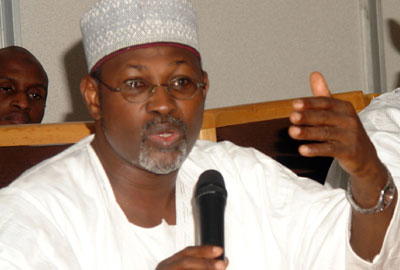
Jega…INEC boss
By CHARLES KUMOLU
Basking in the applause from its improved conduct of elections, the nation’s election management agency is now brushing itself up for even a cleaner image especially in its resource utilization functions. It is receiving the help of international democracy development stakeholders such as the UNDP in this regard.
THOUGH the Independent Electoral Commission of Nigeria, INEC has generally been praised for its conduct of the 2011 general elections it is still believed that the commission could even soar above its present standards.
It was with this in view that the United Nations Development Programme, UNDP and some of its democracy building partners facilitated a capacity building workshop for senior management staff of the commission in Lagos.
The training focused on Strategic and Financial Planning provided a critical platform for top management staff of the commission to garner knowledge on how to strengthen their capacity for effective electoral administration.
The week long forum ending today was convened under the aegis of the Democratic Governance for Development, DGD project and attracted over twenty INEC, directors, who are in charge of strategic departments in the commission.
Kick starting the intensive workshop on Monday, the Indonesian facilitator, Marenska Mantik, described the forum as a product of the BRIDGE Project for sustainable electoral administration.
BRIDGE stands for, Building Resources in Democracy, Governance and Elections which she said is a capacity development programme managed by a consortium of international election overseers.
Mantik said the need for capable and professional election administrators, prompted the International Institute of Democracy and Electoral Assistance, IDEA, the Australian Electoral Commission, AEC, the United Nations Development Programmes and International Foundation for Electoral Systems to come to come up with the concept of the Bridge project.

Jega...INEC boss
“Bridge is the most comprehensive professional development course available in election administration, it has been developed by electoral administrators themselves, it improves skills, knowledge and confidence both of election professionals,” she said.
While noting the need for financial prudence by election administrators, she admonished INEC to ensure that requests for funding have been rigorously examined internally to ensure that they represent cost effective solutions in elections.
“It is the responsibility of election administrators to ensure that requests for funding have been rigorously examined internally to ensure that they represent cost effective solutions to the legislative and service requirements for voting and that funding provided is spent wisely,” Mantik submitted.
Even beyond the release of funds, she submitted that the timely disbursement of the funds is necessary in order to achieve desired results.
“Not only certainty of funding, but also appropriate timing of release to the electoral management body of approved funding for voting operations is critical for ensuring effective operations. To ensure certainty of operations and the integrity of the electoral process election administrators must be assured in advance of the funding that will be available for voting operations.”
This Mantik said, “requires that known and preferably public mechanisms for submission of estimates to and approval of funds by the relevant legislatures are in place; election administrators ensure that voting operations budgets are developed and integrated into the normal governmental budgetary approval cycle; mechanisms for approval of additional voting operations funding by legislatures exist to cover unforeseen contingencies, such as late changes to legislative frameworks, and in systems where elections are not held at fixed intervals, are available and effective.”
“Governmental funds for voting operations should be part of funding specifically allocated for election purposes. This may be easier where a separate body is responsible for the conduct of elections, rather than elections being one responsibility of a state or local government department or agency.
Another facilitator Mr. Augustine Okrah, who is a member of Ghana Electoral Commission, GEC corroborated Mantick’s stance, noting that funds must be released in lump sum after legislative approval.
He said, “the practice in many countries is for the treasury to release the funds to the electoral commissions in a lump sum after legislative approval has been secured. This applies where the commissions have autonomy over its finances, and often its own banking account, as in The Gambia and Macedonia.”
Still citing contemporary examples, he said, “In some cases, election funds are kept and managed by the Ministry of Finance, with the commission making requisitions for the Ministry to pay its creditors and staff, mainly by cheque. Those in this category include Botswana and Namibia.
“In Russia, the electoral commission may obtain a loan from the private sector if there are delays in receiving state budget funding. The Georgian election agency has a procedure to ensure timely disbursement of funds by the Government: it can bring a claim before the Supreme Court if funds are not disbursed in a timely manner.
Charging the commission’s budget directly to the consolidated fund occurs in countries such as Barbados. There may be significant legal and administrative barriers to be dealt with before such an approach can be implemented in other countries.”
The first day of the training was an eye opener for many participants who confessed that they were now better prepared for the fiscal nitty-gritty in the preparation for elections.
Speaking on behalf of other participants, Mr. Mohammed Kuta, who is the Director of Audit, said lessons learnt, would impact on the conduct of 2015 general elections.
“We are trying to bring them together, especially the directorate level because they are the foot soldiers of the commission. We want to ensure that there is good quality electoral management. and we want to ensure that it is entrenched in order to align with the vision of the current chairman,” Kuta said.
Disclaimer
Comments expressed here do not reflect the opinions of Vanguard newspapers or any employee thereof.