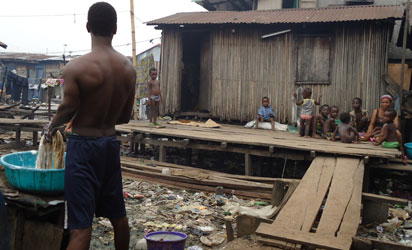
An abode in Lagos
Prologue
By Ikeddy ISIGUZO, Chairman Editorial Board
“There is enough for everyone’s need but not enough for everyone’s greed.” – Mahatma Gandhi.
THE tragedy of poverty in Nigeria hinges on three points. Some Nigerians because they have billions they stashed away in whatever currency believe they are not poor.
Those appointed to fight poverty are occupied with spending public resources liberating themselves from the scourge. Religious organisations are teaching that poverty is a disease, a curse from above, a punishment for the misdeed of the ancestors, thereby stigmatising the poor.

A ceaseless craze for amassing wealth (greed) at the public’s expense empties the treasury into pockets of a few who think they are living above poverty. The most that governments do is initiate imitative programmes that result in millions of Nigerian youth operating commercial motor cycles, their future, if they survive the accidents, ruined because they are uneducated, unskilled, and too poor to think beyond the next meal.
Religion teaches – these days – that you are not poor, for as long as you keep confessing that you are rich. It does not matter you have no job, have been squatting with relations five years after graduating from university and do not know if you will eat that day.
The little some of the poor have, they willingly give to conmen who pose as men of God who possess divine answers to poverty. These days curing people of poverty is a major source of income for motivation writers, teachers, preachers and scammers, all scrambling to escape poverty at the expense of the poor.
Poverty in Nigeria defies internationally recognisable trends. Nigerian poverty is unique ravaging generations and remains untreated which is what makes it a deadly disease. At international conferences, Nigerian poverty weighs outside all the possible scales.
David Gordon in, “Indicators of Poverty & Hunger,” a paper he prepared for the United Nations, defines absolute poverty as the absence of any two of the following eight basic needs – Food: Body Mass Index must be above 16.Safe drinking water: Water must not come from solely rivers and ponds, and must be available (less than 15 minutes’ walk each way).
Sanitation facilities: Toilets or latrines must be accessible in or near the home.
Health: Treatment must be received for serious illnesses and pregnancy.
Shelter: Homes must have fewer than four people living in each room. Floors must not be made of dirt, mud, or clay.Education: Everyone must attend school or otherwise learn to read.
Information: Everyone must have access to newspapers, radios, televisions, computers, or telephones at home.
Access to services: This item is undefined by Gordon, but normally is used to indicate the complete panoply of education, health, legal, social, and financial services.
It is clear that even the richest Nigerians are poor – they too fall below Gordon’s standards. They are wallowing in blissful ignorance. The ordinarily rich Nigerians are also poor. What then is the lot of the certified poor, those 100 million that the National Bureau of Statistics listed as poor? The Nigerian poor are trapped in cyclical economic decisions that drown them in further poverty.
They cannot afford children’ school fees, creating another generation of unschooled adults. They have no access to health facilities. Shelter is shanty.
A theory for the perpetual cycle of poverty, by Ruby K. Payne, in her book, A Framework for Understanding Poverty, states that poor people have their own culture with a different set of values and beliefs, which keep them trapped within that cycle generation to generation.
Payne describes these rules and how they affect the poor. Time is something, she said, that is treated differently by the poor; they generally do not plan but simply live in the moment, which keeps them from saving money, which will help their children escape poverty.
What this theory fails to consider is that those in excruciating poverty only thinking of survival, the next meal. How can they save when they cannot train their children?
Education, employment opportunities, improved health facilities, and something as important as safe drinking water (though neglected) are beyond the poor.
What is scary about poverty in Nigeria is that it is a buzzword. Governments, politicians, NGOs will talk about it for as long as it is news worthy. Once something more important breaks out, it is goodbye to poverty publicity.
Anyone concerned about Nigeria must worry about the burden of leading more than 100 million poor people (one and half times the population of Egypt) whose attention is on rumbling stomachs, illnesses, their illiterate children, no shelter and inability to access the global opportunities the digital world provides.
There are more reasons to worry. Nigeria’s thriving corruption has a tie to mass poverty. The few who earn barely sustaining incomes do not have enough to share with about six others – relations, schoolmates, colleagues who are unemployed, unpaid pensioners, children, old, ill, weak, and unskilled.
Neither the Millennium Development Goals, which Nigeria approaches with flagging enthusiasm or mouthing poverty alleviation programmes, will pull this mass out of doom.
Recent crushing economic policies will draw more into the drain.
Only concerted policies that appreciate the nexus between how the poor are left out of economic opportunities and how their poverty cripples Nigeria will redeem the situation. Nigerians are poor, but the country is poorer.
Disclaimer
Comments expressed here do not reflect the opinions of Vanguard newspapers or any employee thereof.