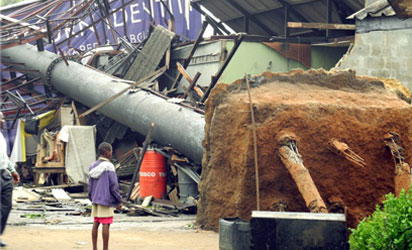
Rainstorm destroyed property worth millions in Lagos
By Ochereome Nnanna
HURRICANE Lagos”. That was the creative alias Vanguard Newspapers entitled its main photograph of the destruction caused by a freak storm that hit the nation’s commercial capital in its Tuesday, February 14, 2012 issue. How apt!
But, hurricane in these parts, you may ask. That’s the name that severe coastal storms that regularly buffet south eastern USA and north eastern Mexico go by. Their namesakes that smash into Asia off the Sea of China are called typhoons, compared to storms off the Indian Ocean which are called monsoons. These often trigger off other related natural disasters such as tsunamis, landslides, flooding and mudslides which create apprehension whenever the rainy season approaches in these exotic lands.
The entire African continent is blest in that no part of its coastal or inland areas needs to fear anything from destructive seasonal storms. But what happened in Lagos on Monday, February 13, 2012 had all the fingerprints of these severe storms. It came with the baleful surprise of an enemy assault. Travelling at the speed of about 65 kilometres per hour, it took off roofs, demolished electric polls, pulled down trees and even capsized ferries carrying children and workers at the peak of the morning rush hour (7.00am).
Reports of devastation were received from places such as Ebute Metta, Surulere, Sabo, Festac Town, Ikoyi, Victoria Island, Isolo, Lekki Phase One, Okokomaiko, Obalende and others. This is the month of February, and yet it feels more like May/June, with frequently overcast skies and actual heavy rains. The climate change threat is real.
The Lagos State Governor, Babatunde Fashola and the Nigerian Metrological Agency’s Abayomi Oyegoke, have already shouted themselves hoarse warning the residents of Lagos to brace up for an unusually challenging rainy season ahead. The state’s Commissioner for Environment, Mr Tunji Bello has been spreading the necessary word of caution, moving with his team from one spot to the other calling attention to the need to give environmental care and sanitation greater attention to minimise the impending disaster.
The state government, just two days after the February 13 storm, staged a town hall at the People’s Club premises, Surulere entitled: “Effective Environmental Sanitation for a Cleaner Lagos”. The Fashola regime started from day one to demonstrate its commitment to an improved Lagos in terms of environmental issues because as an offshoot of the Bola Tinubu administration and the flagship of its political movement (the Action Congress of Nigeria, ACN) it recognised the rapid growth of Lagos, the nation’s commercial capital and melting pot, as rapidly moving towards the status of one of the world’s mega cities.
It is either that a mega city is a successful and thriving one or a failed one. You will know a failed mega city when it is overrun by poverty, unmanageable slums, incurable traffic jams, inability to cope with sanitation challenges, poor infrastructure that cannot support the growth of business and its inability to attract tourists. These are environmental issues. By 1999, Lagos had already entered the alley of a failed mega city. The Fashola regime’s ability to clean up Oshodi and other similar impossible dark spots and reclaim open spaces for beautification as well as taking steps to move traffic more rapidly were evidence of his determination to put Lagos on the list of large cities the world can count on in doing business.
The Lagos State Government is left to fight the battle for a better environment all alone. It is supposed to be a combined effort of three stakeholders: the Lagos State Government, the Federal Government (as Lagos is still responsible for the highest non-oil revenue of the federation) and the residents.
The Federal and Lagos State governments have exhibited an uncanny inability to forge a synergic partnership to ensure that Abuja plays its part in taking Lagos to the Promised Land. The fault belongs to both sides equally because they have allowed unhealthy politicking to come between them and the greater public interest. Most of the major roads that are still bad and most of the parts of the city-state that have not been able to receive the magic touch of Fashola are invariably federal roads and federal zones. The Oshodi/Apapa Expressway and the two ports in Apapa easily come to mind.
Since the ruling party has not been able to add Lagos to its political repertoire, it has adopted an attitude of indifference to the former federal capital. The Federal Government during the era of Olusegun Obasanjo even resorted to illegally seizing federal allocations due to the state’s local government areas due to the creation of the development areas. Unless both sides put their political differences aside, the dream of an environmentally excellent Lagos will not be possible. It took the cooperation of both sides for the erosion of the Ahmadu Bellow Way to be arrested. By now, Victoria Island would probably be inside the Atlantic!
The residents of Lagos are not helping matters either. The state government is left to agonise on ways of raising the sanitation and environmental aesthetics of Lagos to international standards. Residents are simply not playing their own roles well enough. During the compulsory monthly environmental sanitation exercises most people seize the opportunity to rest or hold meetings while the youth play football in the streets. And on Thursday mornings which have been set aside to clean the markets, most traders simply stay home till the time expires. Those who do comply often leave heaps of silt lifted from the drains on the roadsides only for the rains to wash them back into the gutters.
And yet it is the same residents (especially the poorer classes) that suffer most when the rains come calling.
The only way out is for the Lagos State Government to push ahead with its environmental awareness programme without relenting. Ignorance is the basic problem. As soon as people realise the importance of compliance they will comply. The awareness drive should be taken to the media, especially radio, television and the social media. It should be taken to the schools. There is no alternative to awareness creation.
Let it never be said that government did not warn people enough to beware of the danger that comes when the rains come.
Disclaimer
Comments expressed here do not reflect the opinions of Vanguard newspapers or any employee thereof.