By Favour Nnabugwu
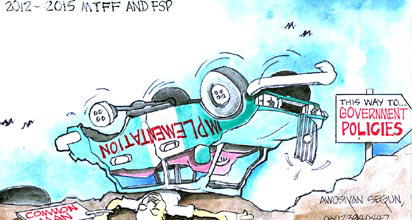
ABUJA—Piqued by the high cost of road construction in the country and the need to cut cost, the Federal Government has said it would no longer award contract without budgetary provision or adequate funding to execute such contract.
Minister of Works, Mr. Mike Onolememen, said in an interview with Vanguard in Abuja, yesterday, that government would only embark on road projects for which funds had been appropriated to moderate factors that cause high cost of contracts.
He said: “We will only embark upon projects we have funding for this year. Any project that has no adequate funding will not go to the Federal Executive Council, FEC, for approval.”
Though the principal actors in road construction in the country are the clients, consultants and contractors, the total cost of construction in normal circumstances is expected to be the sum of the materials, labour, site overheads and equipment/plant. Yet many other factors were allowed for in costing road contracts.
All that, the Works Minister assured, would no longer be permitted.
Onolememen, however, noted that one major factor that triggered high cost of road construction in the country was inadequate funding and insufficient budget provision.
He said: “One of the reasons for the high cost of construction in this country has to do with inadequate funding of projects, particularly at conception stage. I am a project manager and as a good project manager, I know that when a project is conceived, the budgetary outlay should be ready and implementable.
“But here, we are never able to implement projects because of inadequate budgetary provisions. Then what happens when you have inadequate funding for projects?
“Projects get abandoned for reason that interim certificate are not paid, contractors then lay off staff, vacate the site and works already done by them.” begin to deteriorate.
“Every time one comes back to that project, it is like starting afresh and mid-way augmentation sets in. Meaning the parameters used in setting that project would have changed hence there would be new parameters.
“The cost becomes frightening after going through augmentation. This has been the problem of project executions in this country. But what we are now saying is that any project that does not have adequate budgetary provision will not at all be embarked upon to avoid cost overrun and unnecessary cost increase.”
… targets 2nd Niger bridge, 5 other projects with subsidy removal proceeds
ABUJA—Federal Government has targeted six major road projects to be completed with proceeds from the fuel subsidy removal, Minister Works and Productivity, Mr. Mike Onolememen, said yesterday.
Onolememen, and Minister of State for Works, Ambassador Basir Yuguda, also pleaded with Nigerians for understanding on the overall gains of the removal.
The ministers during a media parley in Abuja, described deregulation as a woman in labour, who endured the pains of contraction and forgot it almost immediately after she gave birth. They said the gains of subsidy removal would wipe off the initial pains felt by Nigerians.
The six major road projects that had been delayed as a result of inadequate budgetary provision are: Shagamu-Ore-Benin road, Abuja-Lokoja dualisation project, Kano-Maiduguri Expressway, Onitsha-Enugu-PortHarcourt Expressway, 2nd Niger Bridge and Oweto Bridge.
Onolememen said: “Deregulation will benefit the road sector in that the projects that we have not been able to accomplish due to poor budgeting will be completed.
“The projects are the final completion of Shagamu-Ore-Benin road; the completion of the Abuja-Lokoja dualisation project; the completion of Kano/Maiduguri Expressway, the completion of Onitsha-Enugu-PortHarcourt Expressway; the building of the 2nd Niger Bridge and Oweto Bridge.
“These are the projects that will benefit from the deregulation policy which will have positive impact on Nigerians.”
Apart from the road projects, Onolelmemen stated that Federal Government had lined up other projects in the various sectors that would assuage the pains of Nigerians in the long run.
He added: “We have projects and programmes in the health and railway sectors that will drastically reduce the pains of deregulation.
“Before the end of this month, the rail transport system from Kano through Zaria, Kaduna to Minna will be in full operation and the same for Lagos to Ibadan up to Ilorin and Jebba.
“But we have a problem right now in Jebba axis where work is going on day and night to ensure that within the next 40 days the challenges of the Jebba bridge, the rail bridge across the Niger, is dealt with.”
Disclaimer
Comments expressed here do not reflect the opinions of Vanguard newspapers or any employee thereof.