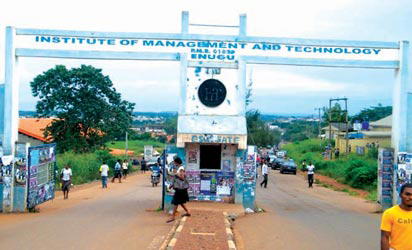
File: IMT entrance gate
BY TONY EDIKE, ENUGU
The Institute of Management and Technology (IMT), Enugu was established under the then East Central State of Nigeria Edict No. 10 of 1973 promulgated by the administrator of Ajie Ukpabi Asika. With excellent academic records, the IMT was then regarded highly as a very strong tertiary institution within the Eastern Region and many aspired to acquire technological education there.
But years after its establishment, there had been serious decay in the management and structure of the institution. Successive administrations made little progress in restoring the respect and academic excellence for which IMT was known.
Enugu State government under Governor Sullivan Chime, in its effort to restructure the institution, appointed, shortly on its assumption, Professor Edwin Onyeneje in 2007, but the challenges that had stagnated the IMT over the years escalated under the administration.
The IMT crises came to a head last September when the National Board for Technical Education (NBTE) withdrew the accreditation of all National Diploma (ND) and Higher National Diploma (HND) programmes offered by the institution and barred it from further admitting students till further notice.
As part of the sanction, students who had graduated from various departments had their call-up for the National Youth Service Corps suspended. The development generated tension in the institution. 
The hammer on the institution was the fallout of a petition from the National Youth Service Corps (NYSC). The Executive Secretary of NBTE, Dr. Masa’ud Kazaure, who gave reasons for the sanction later, said there was need to maintain standard within the system especially on academic carrying capacity.
Kazaure, who noted the complaint by NYSC over an unusual presentation of large numbers of graduates for mobilization by the polytechnic beginning 2010, said IMT presented about 15,000 graduates for the national service scheme. It was the complaint that led to the investigation carried out by the NBTE on the matter and the subsequent findings that led to the sanction.
But, following the Enugu State government’s plea and the assurance that it would restructure the management to strictly comply with the laid down rules on students’ enrolment and other requirements, the regulatory board reinstated the accreditation in the first week of December, 2011.
The state commissioner for education, Dr. Simon Ortuanya, who explained how the matter was resolved with the NBTE, said IMT is now back full on stream and attributed the success to the efforts of government and the new management of the institution.
At present, IMT has students’ population of over 30,000, a figure the NBTE described as alarming as it exceeded its approval. With the restoration of IMT’s accreditation, it is however expected that the much-needed sanity which, people say, the school requires most would also be restored. But the financial implications of adhering strictly to the directive of the NBTE to cut down the number of students, according to an insider, could further ground the institution’s activities owing to the expected drastic reduction in revenue hitherto raked in from students’ enrolment.
This has become a major concern for members of the academic community as the monthly subvention from the state government is far below the funds needed to run the programmes of IMT.
Apparently, to meet the demands of the NBTE, the state government sent Onyeneje on compulsory leave along with other top management staff and appointed Professor Mike U. Iloeje as acting rector. At the second extra-ordinary meeting of the school’s Academic Board, the second since his resumption of the acting rector, Iloeje bemoaned the situation in the school, according to a member of the council.
“The restoration of full accreditation to IMT implies that we would compulsorily follow and adhere to a 2-year drawdown in down-sizing our students’ enrollment from the current population of 35,321 in the 2010/2011 academic session to 7,080 in the 2012/2013 academic session,” the acting rector was quoted as saying.
He said the condition is achievable if only the school management would comply with the approved carrying capacity during admission of fresh students for the 2011/2012 session. Iloeje said this therefore necessitates that the management is allowed to admit only 1,200 students into the ND-1 class and same number into the HND-1 class in the 2011/2012 academic session. But he insisted that “IMT must adhere to the board’s carrying capacity.”
Reflecting on the financial implications of the new order, the acting rector said the reduced student enrollment will also drastically reduce the internal revenue “we generate from students’ fees and charges.” “In order to maintain our services at their present level, and also aspire to improve them, we must look beyond our present financial subvention strategy. I therefore, propose that we set up a task force to work out the financial implications and recommend strategies for a way forward,” Iloeje reportedly told the council members at the meeting.
Prior to recent development, IMT had suffered a major setback in 2009 when the Education Trust Fund (ETF) produced an adverse report on Iit and other institutions. ETF gave the affected institutions deadline to access their funds or forfeit respective allocations by the end of April 2009. Some management staff, however, revealed that the institution’s failure to access the ETF fund was detrimental to its progress.
They also disclosed that, as at 2007, IMT was not innocent of abuse of ETF funds. They made reference to the N50 million released at the time for the Industrial Centre which was never used for the purpose. Besides, they recalled the millions of naira released for the renovation of the Second Hostel, Mass Communication Complex and the construction of the ETF Female Hostel.
”All these projects were abandoned after the release of funds to contractors, “according to a senior staff. About N17 million was said to have been released from the treasury of IMT for the failed ETF hostel.
Disturbed by the report of IMT’s alleged non-compliance with the ETF’s projects, the Chime’s government had at its EXCO meeting, sometime ago, bemoaned the reported contribution of the Works Department between 2003 and 2006 in the matter.
Mindful of this problem which has raised dusts among members of the academic community, the acting rector had, in his maiden address to workers and students, declared that his management must do all that was feasible to make the staff happy enough to work efficiently.
Forgery of documents by some unqualified academic staff has also been raised by some concerned staff of IMT, who attributed the declining academic standard to the engagement of unqualified personnel. A source recalled that between 1996 and 2003, the NBTE warned IMT’s management against “indefensible infusion of lecturers” without the minimum requirement of a first degree in the teaching subject to the point that Igbo degree holders were reportedly allowed to teach English in IMT.
A senior lecturer recalled that the Enugu State government had, in 2007, approved voluntary relocation of all education degree holders who were teaching at IMT to the Enugu State College of Education (Technical) at Abakiliki Road, Enugu with a warning that whoever stayed back was doing so at his/ her own risk.
But, despite the government’s directive, about 50 of the teaching staff concerned stayed back including lecturers with degrees in adult education, geography education and guidance and counseling.
It was learnt that efforts by the immediate past management to sanitize the system forced it into a do-or-die fight with the affected staff to the point that incredible petitions were written against the management. Concerned members of the academic community have expressed the fears that the state government’s effort to restore the glory of IMT under the new leadership of Iloeje might be a mirage if the “strong cabal” that had held the institution down for years was not dismantled.
However, the ability of the government and the management to do this would go a long way to determine the level of progress IMT would make in the nation’s academic sector in the near future, otherwise the dream of the founding fathers to make the institute a centre of academic excellence will never be realized.
Disclaimer
Comments expressed here do not reflect the opinions of Vanguard newspapers or any employee thereof.