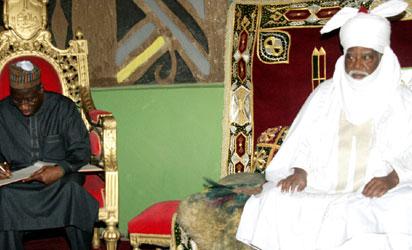
President Goodluck Jonathan signs Condolence Register at the Palace of the Emir of Kano Alhaji Ado Bayero (Right) during his visit to Kano State.
By Ochereome Nnanna
I WONDER how the average Muslim Northern Nigerian felt when the Emir of Kano, His Royal Highness Ado Bayero, burst into tears when President Goodluck Jonathan paid him a condolence and solidarity visit last Sunday.
The President and his entourage were there to commiserate with the 13th Fulani Emir of Nigeria’s second largest city in the wake of the orgy of explosions and shootings last week Friday, which claimed over 250 lives, the largest single casualty haul since Boko Haram started its demonic war on Nigeria.
For me, it was a very sobering and deeply saddening moment. Of all the traditional rulers in the North, especially the emirs, Ado Bayero ranks number one on my scale of admiration, followed by the current Sultan of Sokoto, Muhammadu Sa’ad Abubakar III.
These two gentlemen are true leaders and fathers of this country, going by their undisguised efforts to build bridges between the various ethnic and religious divides in the country. A sultan of Sokoto in the 1950s insisted that for Nigeria to be a united country all Nigerians must embrace the religion of the prophet of Islam. But the current Sultan is a lot more urbane and has done more than any traditional ruler to promote cross-cultural harmony.
Unlike in the past when sultans of Sokoto tended to expect other traditional rulers even from areas outside the Sokoto Caliphate to pay them homage in their palace, Sultan Sa’ad has opted to visit traditional rulers and religious leaders across the country making friends and reaching out, projecting the benign and noble face of his religion rather than the deviant aspect which Boko Haram and Al Qaeda are murderously propagating around the globe.

President Goodluck Jonathan signs Condolence Register at the Palace of the Emir of Kano Alhaji Ado Bayero (Right) during his visit to Kano State.
However, Sultan Abubakar III is still a newcomer, having been only enthroned on November 2, 2006. Ado Bayero, a lawyer, was crowned forty nine years ago. During his reign, Kano, more than any other emirate in the North, has (despite the frequent violent eruptions by Islamic extremists) offered indigenes and non-indigenes, Muslims and non-Muslims as well as foreigners the condusive opportunity to contribute to the commercial and industrial success of the metropolis while in pursuit of self-actualisation.
It was partly due to the emir’s fatherly disposition to all residents of his emirate, even as a young man, that Chukwuemeka Odumegwu Ojukwu, equally as a young military officer in command of the Nigerian Army Brigade in Kano, quelled Major Chukwuma Nzeogwu’s coup in the Kano area in 1966.
For decades, the Emir of Kano has been a soul mate and friend of the Ooni of Ife, Oba Sijuwade Okunade, Olubuse II. At a time the topic was regarded as taboo in the North and the Muslim world generally, Ado Bayero paired with Sijuwade to promote the restoration of diplomatic ties between Nigeria and the Jewish State of Israel and even once nearly got deposed for that (only for Nigeria, shortly after, to restore ties with Israel).
There is not enough space to say all the great things that I know about the contributions of Ado Bayero to forging a united nation out of our explosive diversity and always against the run of religious troublemakers promoting a quixotic agenda that has always failed and will continue to fail.
It is people like the current Sultan of Sokoto and Emir Ado Bayero, along with the many Muslim leaders and commoners we have all around us that convince me, beyond reasonable doubt, that Boko Haram and other extremists are neither good Muslims nor are they promoting true Islamic agenda.
The extremists who read the Koran out of context are usually a very tiny minority. I look at the entire West African region (which has more of the Muslim population) and I look at Western Nigeria (which has nearly half of the population as adherents of the religion) and I see people living peacefully with their neighbours, minding their business and their religion just like the rest of society. Even in the Muslim North of Nigeria, the vast majority of the people are peace-loving.
This is why I have always quarrelled with some of my colleagues in the opinion-hawking trade who give the impression that Boko Haram is fighting for Muslims and should be reckoned with. That cannot be true. In the first place, the North has been the theatre of operation of the Al Qaeda-funded terrorists. Even with the increasing targeting of Christians, churches and southerners, the majority of the casualties have been Muslims.
Secondly, it is the North that is bearing the brunt of their disruptive activities. For as long as Boko Haram continues to bomb, kill and maim, no meaningful development can take place in the areas of the North where they concentrate their activities. The governments of the endemic states of Borno, Yobe and Bauchi will have no choice but to devote the lion’s share of their federal allocations to security and rehabilitation efforts.
It is about time that those Muslims still trapped in the mistaken notion that Boko Haram is fighting for them snapped out of this deceit. I have noticed with increasing delight that more Muslim and Northern leaders are summoning the courage and good conscience to condemn Boko Haram’s lunatic nihilism.
During the recent petrol strike, the Chief Missioner of Ansar Ud Deen, Sheikh Abdur Rahaman Ahmad, addressed the protesters at the Gani Fawehinmi Square, Ojota, condemning Boko Haram as an instrument of oppression and vowing that nobody will be able to create a war between Christians and Muslims.
In the same Ado Bayero kingdom of Kano, Muslims and Christians were forging a united front against terrorism just before Boko Haram struck. No one needs any further convincing that this Boko Haram is nobody’s hero. We need to unite and eliminate it from our midst and resume our interrupted collective march to national greatness. We must not allow this group of foreign agents of destruction to force us to turn drawn daggers against one another other.
That is surely what will happen when this expensive provocation is taken too far.
Disclaimer
Comments expressed here do not reflect the opinions of Vanguard newspapers or any employee thereof.