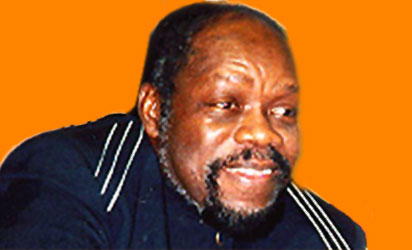
Ojukwu
Ojukwu’s Return from Self-exile
“When you returned from the Ivory Coast, the crowds that received you at the Murtala Mohammed Airport, then at the Aba Stadium and at Nnewi have never been equaled in the political history of Nigeria. It was the return of the Peoples’ Great Hero, the return of their Eze, their King”.
Ojukwu as Member of the NPN
“Very shortly after that, you joined the National Party of Nigeria (NPN). Just like the railway Punch Aturuatu, you were instantly demystified.
It was not just because the other side wanted you to be so demystified.
The Nigerian Peoples Party, NPP was the platform on which they expected to find their King, if he must go into partisan politics at that point in time. The conditions that led them to war and which threw you up as their King had not changed by the time you came back from exile. Consequently, it was difficult for you to win an election, even in a small Constituency”.

Ojukwu
I said to him, Sir,” what do all these episodes tell us?” “Simply, that the issue is not Igbo Enwe Eze. Rather the question is – Who is an Igbo Eze or King? Who is an Igbo Hero?
In summary, I told the Ikemba that “the Igbo Leader, Hero, Eze or King is not the person who commands them Quick march!, Right turn!, Left turn!, Right About Turn! or Jump up! Jump Down! No, such a man will be seen as an imposter and the people, sooner or later, will consign him to the dust-bin of history”.
An Eze in Igbo society is a democratic creation. He is the man who is part of the people, who communes with them, shares in their sorrows and their aspirations, who eloquently and courageously espouses and defends them; who is ready to die in defense of the peoples’ interests and aspirations. Thus, the Eze is not just an institution; it is a role.
Ojukwu did not invent Biafra
He had no hand in the making of the tragic circumstances that led to the Igbo predicament or the unhealthy inter-ethnic rivalries that ushered in the holocaust. He found himself, out of circumstances beyond his control, at the leadership of a people whose very physical, economic and social existence were threatened with extinction.
He rose to the occasion by identifying himself with the suffering of the people, with their aspirations. The people saw him as the most eloquent, courageous, articulate and charismatic leader of their struggle. He became their universally accepted leader, their hero, their Eze, their King.
This is the way Ezes emerge in Igbo Community and the very essence of their being. Any such Eze loses his throne the very moment he seizes to be the symbol of their aspirations, or abandons, or betrays their trust.
Let us turn our attention momentarily to the other folk hero among the Igbos, I mean Zik of Africa: the very moment Zik left Biafra and went over to the Federal side, he became not only ordinary among the Igbos, in fact he became a villain.
But the very moment he assumed leadership of the Nigerian Peoples Party (NPP), a party the bulk of the Igbos saw as their party, he instantly became once more their Hero and King. His most faithful follower, Sam Onunaka Mbakwe, remains a folk hero among Ndigbo till today, many years after his death.
Indeed, Igbo leadership is a democratic institution, not a military command structure. Even in those areas of Igboland where hereditary Ezeship exists, what you have is still a democratic role within a democratic structure in which the Eze is just the Chairman of the Council of Elders.
He is their spokes-man who must speak what they have all agreed upon through a democratic debate. Just watch such a scene in any typical Nollywood Film. We are dealing with a society in which individualism and communalism are dialectically interwoven.
Ojukwu’s attempt and eventual recovery of his throne as Igbo King—Eze Igbo
After the Constitutional Conference, Chief Dim Odumegwu Ojukwu set out to recover his throne, and reverted back to fill a vacuum that still existed in Igboland – the absence of a universally accepted Igbo Leader.
First, Ojukwu set out to have himself crowned as Igbo King and assumed the title of DIM CHUKWUENEKA ODUMEGWU OJUKWU, EZE IGBO GBURUGBURU.
That first step was an abstract step. It was stoutly resisted by many. He was yet to play the role that would earn for him such a title. Those who resisted his attempt to answer Eze Igbo Gburugburu, enjoyed a lot of sympathy. Many regarded what Ojukwu did as preposterous.
Eventually, and very soon too, Ojukwu did what some of the spineless people claiming Igbo leadership do not have the courage to do. He provided spiritual leadership to the organization of angry Igbo youths called Movement for the Actualization of the Sovereign State of Biafra (MASSOB). Who else in Igboland has that courage to identify himself with those angry youths?
Prof. T. Uzodinma Nwala (Ikenga), is a Professor of Social and Political Philosophy, Nasarawa State University.
Disclaimer
Comments expressed here do not reflect the opinions of Vanguard newspapers or any employee thereof.