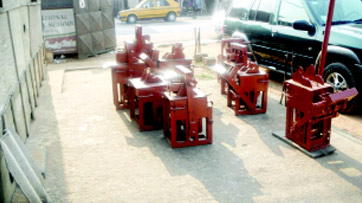
*Brick and interlocking presses
By Ebele Orakpo
The Managing Director/Chief Executive Officer of Bolyn Constructions Company Limited, makers of low-cost housing equipment based in Lagos with offices in Kaduna and Abuja, Elder Rufus Bamgbola Akinrolabu, in a recent chat with Vanguard, said Nigeria’s housing problem can become a thing of the past if only the government and people will look inwards and use the local materials that God has blessed them with. Excerpts:
Elder Rufus Bamgbola Akinrolabu worked with the Nigerian Ports Authority in Lagos as a clerical officer for four years after his school certificate before going back to school. He got admission into Madras College of Engineering in South India.
“It was an Associate Membership of the London Society of Engineers’ civil engineering course. That school was actually preparing us for it and the Nigerian Government rated that particular course as equivalent to HND and it was compulsory for us to serve in the Youth Service after graduation,” he stated.
After his Youth Service at Bendel Water Board in Benin in 1978, he got a job with Bendel Steel Structures Limited in Warri as an Engineer-in-Training. Six months later, he was promoted as his employers discovered he had mastered his job as a design engineer. Two years later, he relocated to Lagos where he felt all the action was taking place.
“In Lagos, I got a job with Neptune Construction Company Limited as Structural Engineer/Estimator, in charge of designing and estimating the cost of producing the designs. I also supervised the workshop where the designs were put to practical use. After two years, I became the Technical Manager and in another two years, I advanced to the highest position that any Nigerian could attain in that company – General Manager,” he said.
Realising that he could not grow beyond his employer’s vision, he decided to leave paid employment to establish his own business. “Most people in paid employment are short-changing themselves because you have to report at a particular time in the morning and cannot leave until a particular time in the evening.
The seat you are sitting on,the table you are using, even the biro are not your own and at the end of the day, you know they cannot pay you more than one/tenth of your production while the 90 per cent goes to the man who owns the place. He is the entrepreneur.

*Brick and interlocking presses
He gives you your daily bread so that you will not die and continue to work. So I realised it and told myself that if I can get one tenth of the worth that this man gets, I’ll be better off. It won’t be easy initially but with determination, you’ll make it.”
And so in June 1987, he established his own outfit. “First, I was running after the big companies and somehow, something said to me: ‘Sorry, you are missing your step. Go and start small. Rome was not built in a day, whereas I wanted to be like my former boss.’
When they invite him for interview for a job, they invite me too and while I’m still waiting at the reception, he will just burst into the office of the highest man there, get the job and leave. That was what was happening to me so I decided to start small. Small is beautiful. You will fall but you can easily pick yourself up and start all over again,” he stated.
Narrating how he started the manufacturing business, he said it came from reading a book. He registered with the British Council Library as a member and began researching. “It was there I found a book that did something on block-making machine. I looked at it and it looked so simple.
I have designed more fantastic machines in Bendel Steel. I read so much about it. It is a machine that turns our local soil to bricks for building. I then began to search for the design and the Nigerian Road and Building Research Institute (NiBRI) had something like what I was looking for.
I approached them and asked them to give me the design but they said no, that the government had asked them to generate their own funds. I thank God they did not give me because it would have been a different story today.”
Eventually, Akinrolabu got his own original design from German Appropriate Technology Exchange from the Federal Republic of Germany. Said he: “They gave me the design for $100. Since then, I have made over 20 designs and today, I have become a reference point in Nigeria in this local brick machine-making.”
The engineer who was on the Standards Organisation of Nigeria’s Technical Committee that wrote the standards for this brick for Nigeria said: “It is only by looking inward, using that which is your own, that which you did not import, that you can bring down the cost of building.
When the Federal Government realised that, they set up a committee which met and wrote a white paper. Then they started looking for those who are into this business and they took us to Abuja. After all the talks, I was opportune to speak to the gathering.
I asked them if they will live in a house built with local materials? Do they use it to build their houses? They are not the right people to talk about using local materials to build. The truth is that they will not let it work. I told them the hard truth because I had nothing to lose. I wasn’t looking for contract from them.”
On how he raised money to start the business, he said: “Some people will tell you they need N1 million. You don’t need that. You don’t need N100,000. Start with what you have. I started very small. When I made the first machine, I couldn’t even finish it but I struggled until the person that bought it came to my aid and paid me some money, then I was able to finish it.
When I collected money for one, I started making two and somebody paid for the two. When I collected the money, I started making three. One day, somebody came and said ‘oh, this is beautiful, take this money. I started making 10. Today, I am known all over Nigeria for this small thing.”
The machine is made from scrap metal. Nigeria is abundantly blessed but we lack good leadership; leadership by example.I think ex-President Obasanjo tried but the obstacles were too many. He was the one who said that only fruit juices made by Nigerians should be served in the State House and instructed two Housing ministers to ensure local materials are used in building and they contacted me. At the end of the day, it was just talk and more talk.”
He spoke on the need to always start small, saying it is small businesses that drive the economy. “Small businesses have ever been the backbone for the development of any economy. So many times, America does something to palliate the sufferings of the small businesses because they create employment.”
He said he will continue to educate, inform, guide and act like consultant to people who want to use the local material to achieve their housing needs, adding that, “Houses built with this local material are beautiful, stronger than the conventional block houses.
Thieves cannot break into them. They are bullet-proof. Because the material is very dense, if you shoot at it, the bullet is not able to go through. It is fire and heat-resistant so it is very cool in summer and warm in winter.
“I have found this God-given material that our fore-fathers built with. It has been discovered to be very effective and can cause reduction in building cost. I built my houses in Lagos and home town with this material. My workshop and office were also built with the material.
I made the roofing sheet. I am a technocrat. Thank God for my Indian background because we have so many engineers in Nigeria that are not engineering anything. I won’t blame them because you have to be really down-to-earth before you can achieve,” he said.
The one-time member of the Presidential Committee on Alleviation of Housing Deficit in Nigeria said the government cannot meet the housing needs of Nigerians as that will encourage corruption. Rather, “government should provide the land and let individuals build using local materials which are cheaper. We are really blessed in Nigeria.
The only thing we lack is the willpower.” He noted that the world has become a global village “and there is no way Nigerian products can compete with all these advances in technology. It’s like we have not started and even the little I am doing now is like a drop of water in a mighty ocean.”
Disclaimer
Comments expressed here do not reflect the opinions of Vanguard newspapers or any employee thereof.