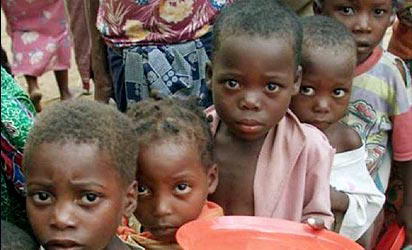
*File photo: Malnourished children
By Chioma Obinna
With prices of foods skyrocketing, more hard times await Nigerian children as statistics available have shown that two out of every five Nigerian children are chronically malnourished.
This and other revelations emerged last week at a customer forum tagged; “Vitamins and Minerals: Applications to processed foods and beverages and for flour, sugar and vegetable oil industries”
According to 2011 World Global Hunger Index, Nigeria contributes 58 per cent in the global hunger problem. Unfortunately, little or nothing is being done to reverse the trend.
With recent news about population explosion, 30 percent of African countries will double and Nigeria may be hitting about 400 million. A situation, experts at the well-attended Customer Forum expressed fears that if urgent steps are not taking, may have a huge negative impact on the nutritional health of vulnerable population, (pregnant women and children).
According to the Country Manager Nigeria & Regional Representative West Africa, Global Alliance for Improved Nutrition, GAIN, Dr. Larry Umunna at the forum organised Limited in Lagos, said malnutrition has become a public health concern in Nigeria as micronutrients were absent in staple foods.
Umunna who declared that lots of efforts were needed to reduce the scourge, regretted that there have been more policies than action.
There should be policies which would ensure that micronutrients are included in foods manufactured in Nigeria to ensure healthy living as proper human development was an indispensable tool in a nation’s economic development.
Expressing fear that children who were malnourished in the first two years of life could lose 11cm of potential height, he disclosed that malnutrition as represented in Nigeria contributes up to 12 percent of child deaths in the world.
Calling on government to begin to actively tackle the silent emergency, he said, “It is time to begin to look at bio-organic products. Over two- third of African countries are net importer of agricultural products”.
Umunna who noted that Nigeria ranked among countries with serious hunger problems stressed the need for Nigeria to focus more on the first two years of a child’s life as significant rise in the country’s GDP did not reflect on the country’s stunting level of 40 percent.
He dismissed the general belief that malnutrition only occurs in the northern part of the country as recent study showed that Ebonyi and Ogun states have high malnutrition cases. “With all the intervention in Lagos, it has up to 2 per cent. “Malnutrition is a big problem in Nigeria.
According to a World Bank report, GDP loss to malnutrition is between 2 and 3 per cent. Regulating agencies such as NAFDAC and SON should be strengthened. Breast feeding should be encouraged among mothers”.
Speaking, Prof Laolu Akinyele, Department of Human Nutrition, University of Ibadan, called for the fortification of food products with micronutrients to reduce high rate of malnutrition induced diseases.
Akinyele who described micronutrients as nutrients needed only in minuscule amounts but which absence in the body had severe consequences said the importance of micronutrients in the body could not be overemphasised as their absence affects every stage of the lifecycle from embryo to the adult stage.
“The lack of micronutrients in foods could cause delayed growth and intellectual development in babies, blindness and anemia in adolescents, night blindness and maternal anemia in pregnant women and diabetes and cancer in adults”,he said.
The Regional Fortification Coordinator, Helen Keller International, Burkina Faso, Mr. Mawuli Sablah, disclosed that Nigeria alone represents five percent of global underweight problem. Sablah noted that the World Health Organisation, WHO, recommended micro nutrients such as iron, folic acid, Vitamin A, Vitamin B12 and zinc to be included in every consumed food.
Disclaimer
Comments expressed here do not reflect the opinions of Vanguard newspapers or any employee thereof.