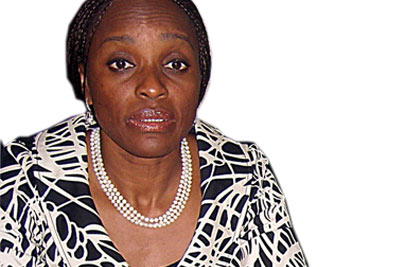
Communications & Tech Minister, Omobola Johnson
After a hectic schedule at the ITU Telecoms World 2011, the Minister of Communications & Technology, Mrs. Omobola Johnson, who also represented the President Goodluck Jonathan in some of the events, spared some time with the media to do a recap on her experience at the global event in Geneva.
Experiences at ITU World 2011
I had a number of bilateral meetings with governments, with companies like Intel, CISCO, Research in Motion. Basically the reasons for these meetings are two things. First of all, knowledge sharing and experience sharing, as many of these companies and countries in particular have been through what we are going through as a country right now. It is useful to find out what they have learnt as they traverse this journey of ICT as backbone for development.
It is useful to share from what they have learnt, the mistakes they have made and that will help in actually developing a policy and a roadmap by which we will use ICT to facilitate development. For the companies, it is more of their interest in Nigeria. Nigeria is a big market, as you well know for telecoms and IT, and so many international companies have a great interest in Nigeria. Many of them are already present in Nigeria.
They are looking for ways to increase that presence. Some of them are looking for ways to enter into the market, and the discussions have really been around how best to increase that presence for the benefit of Nigeria and Nigerians, and what we see as our needs going forward to collaborate with these organizations. If you recall, one of the greatest reasons for having the group participate in the dinner that we had and in the lunch that we sponsored is to present Nigeria as a great investment opportunity for ICT.
What is your take away from here?
I have been excited and energized by what I have seen over the last three days. From my point of view of what other countries are doing and what technology is capable of doing, technology has evolved so much that it is capable of doing almost anything. My biggest take away is that, it is a shame; we are nowhere near where we should be in terms of technology.

Communications & Tech Minister, Omobola Johnson
Big shame
When I look at other countries that are not as blessed in terms of natural resources, human resources, in any way at all, that are nowhere near how blessed Nigeria is and when you look at the products they have made: well it is actually quite a shame.
When I say I am energized because I know that the creation of the ministry has put a greater focus on ICTs and I think that that single act and the support we have from Mr President and the rest of the Federal Government just gives me the ability to think about the possibilities and to think that over the next three or four years, we can actually lift up and we can be the ICT hub for Africa: I can see it happening very easily. Like I said we had a lot of bilateral meetings; everybody is interested in Nigeria and if you tap that interest creatively, positively, we can do a lot of things within the next two to four years.
Any encumbrances on translating mobile dream to broadband miracle?
I think the biggest encumbrance really is the imperfection that is responsible for mobile broadband, which is the fibre optics network that we have. That I think will be the biggest impediment for us to be able to activate broadband and access broadband in the way that we would have liked. It’s a big impediment and like any project of this nature there will be challenges along the way.
But I think that in working closely with the NCC we can actually turn this impediment or obstacle, we find a way around it and look at how we develop a broadband policy or broadband strategy that addresses the fact that we don’t have fibre optics to the semi-urban and the rural areas; whether it’s going to be fibre optics or satellite or microwave, we are in the process of thinking through that and looking at the challenges we have and how to overcome these challenges.
The place of ICT in the transformational agenda
ICT is at the centre of every development programme. As a point of fact one of the bilateral meetings I didn’t mention was with the WHO. We were looking at e-Health programme and the e-Health toolkit they have and they can use that toolkit to help many more Nigerians.
ICT is for devt
You know ICT is both a tool for economic development as well as social development. If I may just take four areas that are priority for us going forward: it’s financial inclusion, agriculture, education and health. Using ICT to increase productivity in agriculture, increase access of every Nigerian to health services, financial inclusion to ensure more people have bank accounts and can actually do online transactions, and of course access to health. One of the things the WHO gentlemen showed us was a recent survey in terms of e-Health readiness that was done for Nigeria.
When you look at nurses per capita, doctors per capita, one of the lowest in the world, it shows you that while we are waiting to see the number of doctors we need we can actually we can actually use the few doctors we have through technology – telepresence, telemedicine and all those kind of things. So ITC is right at the centre of making all these things available to every single Nigerian as opposed to the things being available to those in the urban area. ICT is actually central to development.
Policies restricted to urban areas, rural areas left out
The ICT policy is being drafted but there is a key emphasis on the rural areas particularly for roll out of broadband: we have fibre optic in our key economic centre: Lagos, Port Harcourt, Abuja but what the policy needs to address is: how do we get that fibre optics, that access to the rural areas. So the policy would definitely address that.
There is no point in making these fairly significant investments in ICTs if you are not going to capture the majority of the population. So for sure we are looking at not only access to urban areas but access to rural areas as well. We are also thinking of what they going to use that access for, so the rural areas and the rural dwellers are very important to us going forward.
Overlaps between NCC, NBC
It is not so much an overlap of functions; it is the separation of functions that could come together. I know there has been a lot of discussion as to whether the NBC and the NCC should merge and the foundation of that discussion is around the convergence of technology.
So technology has progressed to the point where the devices that you have, you can broadcast: so you have a smart phone, you can broadcast from your blackberry, you can download films on the internet so the advent of technology has made the separation of broadcast and telephones quite irrelevant. In Nigeria right now, the debate is still going on. I know there are several committees that looked at the pros and cons of merging or separating the NBC from the NCC.
Where we are right now is that a decision has been taken with this new ministry that NBC would remain with the Ministry of Information but I think it is not a final decision, I think these are things that would just continue to be discussed as technology evolves, as we see that convergence get tighter and tighter. Frequency is a very scarce resource; it doesn’t make sense for us to be allocating frequency to agencies but to be managing that very scarce resource within one agency.
Those are questions that we have to answer as a nation so I don’t think that the fact that NBC is still under the Ministry of Information; I don’t think that is a permanent decision. The jury is still out but I think the two agencies would continue to exist but the National Frequency Management Council would continue to allocate frequencies to these agencies that would now retail it.
Link between national economic strategy and the Transformation agenda as it relates to ICT
I had the privilege of working with the Ministry of National Planning on the formulation of a National economic transformation blueprint and I can say for a fact that Vision 2020 took the NEEDS document greatly into consideration. So a lot of the elements that were in NEEDS were not thrown away, they were actually incorporated into Vision 2020. Mr. President’s transformation agenda is derived from that Vision 2020, so there is a very strong link between all those three documents.
When you read them you may say that they are distinct because they were prepared at different times but in terms of the content of these plans, they are very similar because they were all derived from each other, so there is some level of continuity in these long term country plans that you are seeing.
I think again the ICT link is very consistent in every single one of those plans and that link is that we need to begin to recognize the importance of ICT as a tool for national development. So when you look at NEEDS when you look at Vision 2020, when you look at the Transformation Agenda, it is saying the same thing, it is all about connectivity, it is all about access to the internet, it is all about using that connectivity to improve the lives of Nigerians, so it’s fairly consistent all the way through.
Disclaimer
Comments expressed here do not reflect the opinions of Vanguard newspapers or any employee thereof.