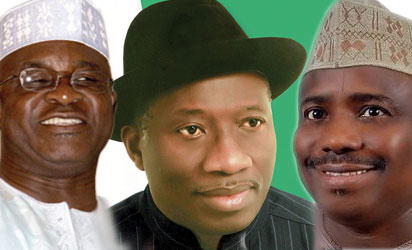
David Mark, President Goodluck Jonathan and Aminu Tambuwal
Stakeholders oppose new states, seek mergers
By CLIFFORD NDUJIHE, Deputy Political Editor
THE recent N18,000 minimum wage brouhaha exposed the under bellies of most states of the country as economically unviable entities. Without mincing words, most of the states said they could not pay and had to endure maximum war from Organised Labour before they shaped up.
The issue led the governors to ask for more revenues from the Federation Account and to oppose the Federal Government-inspired Sovereign Wealth Fund (SWF), which in the interim would reduce the states’ allocations.
As if acting on cue, Governor of the Central Bank of Nigeria (CBN), Sanusi Lamido Sanusi and Senator Olubunmi A. Adetunmbi (Ekiti North), penultimate week, decried the weak financial base of most of the 36 states of the country and canvassed drastic actions to prevent a looming danger.

David Mark, President Goodluck Jonathan and Aminu Tambuwal
If the comments of the duo and other eminent Nigerians are anything to go buy, agitators for new states in the country have an avalanche of hurdles to surmount to realise their quest. And this is in spite of assurances by the National Assembly leadership that new states would be created. Currently, there are about 42 demands for new states across the six geo-political zones of the country.
Sanusi, who spoke as guest speaker at the presentation of Professor Adamu Baike’s book: “Against All Odds” in Kaduna, said that the present political structure of Nigeria was too cumbersome and economically wasteful to guarantee rapid development of the country.
Lamenting that the states were spending 96 percent of their revenues to pay salaries of their respective civil servants, he queried, “Do we need 36 states. Do we need the number of ministries that we have?”
If the country was desirous of development, tough decisions had to be taken. “Ultimately, we will have to be confronted with the task of taking very difficult steps in looking at the political structures that we have. Do we need 36 States? Do we need the number of ministries that we have? Is an economy in which states spend 96 percent of their revenues to pay their civil servants, an economy that is likely to be developed in the long term.?
These are difficult questions that we need to ask. We have created States and local governments and ministry structures that are economically unviable, and the result is that we do not have funding for infrastructures, we do not have funding for education, we do not have funding for health,” he said.
In like manner, Senator Adetunmi sponsored a motion on “Looming danger of bankruptcy in states: The need for fiscal evaluation,” to save the states.
Noting that a recent research by the Nigeria Governors’ Forum revealed that 20 states face the prospect of unstable and unfavorable financial standing, given the high percentage of their wage bill to the total revenue accruable to them, he said that 32 states were spending between 30-127 per cent of their gross revenue on wages of civil servants, who constitute less than four per cent of their populations. According to him, only Abia, Akwa Ibom, Anambra and Jigawa will spend less than 15 per cent of their revenues on personnel.
Worried that most state governments now rush to the Capital market to raise long term bonds to finance development projects, he feared that without an appropriate frame work, misuse of such funds could spell doom for the future of the states.
State governments that have raised funds via bonds between 2002 to 2011 are Lagos (Series 1_ N50bn; Series II_ N57.5bn); Imo (N18.5bn); Kwara (N17bn); Niger (N6bn); Bayelsa (N50bn); Kaduna (N8.5bn); Ebonyi (N16.5bn), Ogun (N50bn); Delta (N5bn); Kebbi (N3.5bn); and Yobe (N2.5bn) among others.
As way out of the worsening financial quagmire, the motion canvassed among others expeditious review of the Revenue Formula in favour of states and LGA’s in the spirit of a true federalism and establishment of a State Economy Stabilization Fund (SESF) in line with the provision of Section 164(1) of the 1999 constitution of the Federal Republic of Nigeria (as amended) which states: “The Federation may make grants to a State to supplement the revenue of that State in such sum and subject to such terms and conditions as may be prescribed by the National Assembly.”
Some proposed states and their viability
However, at a time concerned stakeholders are urging bailouts for existing states to prevent them from becoming insolvent, agitators of new states are insistent on their demands.
Some of the fresh demands include Igboezue, Adada, Aba, Njaba, Orlu, Orimili, Orashi, Anioma, Oil Rivers, Ogoja, Afemaiesan, Toru_Ebe, and New Delta.
There are also Ibadan, Oduduwa, Ijebu, New Oyo, Oke_Ogun, Apa, Idoma, Edu, Okun, Oya, Amana and Savannah, Katagum and Gurara. The rest include Southern Kaduna, Ghari, Tiga, Okura, Ugwuaku and Karaduwa
Ibadan State
Agitation for Ibadan State is being led by immediate past Senate Leader, Teslim Folarin. Proponents said the proposed state would comprise11 Local Councils within Ibadan land as well as some parts of Ibarapa area.The population of the proposed state stands at 2.5 million, about half the population of the present Oyo State. Specifically, the proposed state is to be comprised of about half of the present Oyo South Senatorial District and equally about half of the present Oyo Central Senatorial District.
They also argued that Ibadan deserved a state because in terms of human resources, the proposed state has adequate manpower to man all its services. “We make bold to claim that currently, in terms of number, the Ibadan, as a sub_ethnic Yoruba group of the South West, has the largest number of youths in all strata of education. It is our goal and we strongly believe that this is achievable, that our IGR should be enough to pay the salaries, allowances and other overheads of the new state.”
Southern Kaduna State
Formerly called Southern Zaria under the then Zaria District (which runs into current day Plateau and Nasarawa states) during the era of colonial administration, the Southern Kaduna District comprises 10 of the current 23 Local Councils in the state. These are Chikun and Kajuru local government areas within Kaduna Central Senatorial Zone and Jema’a, Jaba, Zangon Kataf, Kaura, Sanga, Kagarko, Kachia and Kauru local government councils in Southern Kaduna Senatorial Zone.
The Southern Kaduna people’s agitation for the creation of a state is reportedly anchored on inadequacies of the current arrangement as typified by poor development, lack of leadership opportunities and inability to fully access dividends of democracy among others. Until recently when Ibrahim Yakowa became governor following the elevation of Namadi Sambo as vice president, the area was yet to produce a governor or speaker of the state’s House of Assembly.
The agitations variously called Gurara State and Southern Kaduna State, have however failed to materialise as it were jettisoned in 1987 and 1995/96 when the agitation for Gurara State was considered but later jettisoned due to bickering, disunity and disagreement over the location of the capital among other interests.
Savannah State
The diverse ethnic groups in Southern Borno are also rooting for the creation of Savannah State. The request is from nine Local Councils – Askira/Uba, Bayo, Biu, Chibok, Damboa, Gwoza Hawul, Kwaya_Kusar and Shani. Besides ensuring equal opportunities and expanded frontiers for political participation, Savannah State agitators are prominent indigenes of Borno State. The northern minorities of the North-East are irrevocably committed to a state of their own. Leading the movement is Senator Omar Hambagda, all the five emirs from the zone and all chairmen of the nine councils among others.
Apart from the political relegation that has been their lot, promoters of Savannah State are of the belief that the creation of the state will usher in abundant political and economic returns for the people. For now, the southern part continues to be the intellectual fulcrum but still suffers from lack of leadership opportunities.
Katagum State
The people of Katagum, Jama’are and Misau emirates in present day Bauchi State are among those clamouring for a state of their own. The Movement for the Creation of Katagum State has been in existence since the early 1980s during the Second Republic. Both Katagum in the Northern part of Bauchi State and Gombe on its eastern part were agitating for state creation since the 1980s. Gombe was luckier and was made a state during the regime of late Military Head of State, General Sani Abacha on October 1, 1996. If created, Katagum State will have nine of the 20 councils of Bauchi, namely, Dambam, Giade, Katagum, Itas Gadau, Misau, Jama’are, Gamawa, Shira and Zaki.
The clamour for an additional state from Bauchi recently received a boost from Governor Isa Yuguda, who set up a committee for the creation of Katagum State in July, 2008.
Ghari State
The proposed Ghari State comprises 12 Local Councils that include Bagwai, Bichi, Dambatta, Dawakin-Tofa, Gwarzo, Kabo, Rimin-Gado, Shanono, Tofa, Tsanyawa, Kunchi and Makoda.
Chairman of Ghari State Creation Committee, Dr. Habibu Mohammed Gwarzo said recently that developments in Kano State were only centred on the six metropolitan councils of the present Kano State. Gwarzo reaffirmed that the population of the 12 local governments carved for Ghari state is more than the population of both the Republic of Gambia and Equatorial Guinea. He added further that back in Nigeria, the area is far ahead of Nasarawa and Bayelsa states in terms of population. “We have adequate dams that can boost agriculture in the area. We also have abundant mineral resources like gold, tin; zinc livestock among others, which if utilised can generate revenue that can develop the area as a state,” he stated.
Tiga
Tiga on the other hand, comprises 16 local governments out of the 44 local governments of the present Kano State. The councils are Karaye, Rogo, Kiru, Bebeji, Tudun_Wada, Doguwa, Rano, Kibiya, Bunkure, Garko, Sumaila, Takai, Albasu, Gaya, Ajingi and Wdil.
Chairman of the creation of Tiga State, Alhaji Baffa Sani Gaya, said recently that if created Tiga State would promote positive developments not only to the newly created state, but also to the old Kano, noting that more job opportunities would be provided for the communities affected.
Sardauna or Amana State
The clamour for the carving of Adamawa North into a state is being championed by some groups in the zone, including traditional rulers and retired army generals. The various groups are yet to agree on an acceptable name. While a group is rooting for the adoption of Sardauna, another insists on Amana. Both groups have been meeting to harmonise their positions.
Okun/Ebira State
There seems to be a consensus among the minorities of Kogi State on the need to restructure the state in such a way that those regarded as “disadvantaged groups”, such as the Okun, Ebira Mozun, Ebira Koto, Lokoja, Oworo, Ogori Magongo, Ajaokuta and other sub_ethnic groups spread across Kogi West and Central Senatorial Districts, will go together as one state.
Secretary, Okun Peoples Forum (OPF), Chief J .O Yusuf, anchored the demand on prevailing inequity in present Kogi. State. According to him, “there is nothing wrong with Kogi as it is presently constituted if those at the helm of affairs give equal treatment to each section, but in a situation where one section lords it over the rest, people are bound to ask for a better deal and if they cannot get a better deal in that particular state, they want to get it from another state. If that is the case, the people are right to agitate.”
Okura State
In like manner, the Igala people of Kogi East Senatorial District agitating for Okura State.
Ijesa and Oduduwa states
The proposed capital of Ijesa State is Ilesa. The proposed state is made up of six Local Councils – Atakumosa East, Atakumosa West, Obokun, Oriade, Ilesa East and Ilesa West. Proponents submitted a request to the Sixth National Assembly and the request was backed with sworn affidavits by three traditional rulers and signed by two_thirds of elected members from the area, including the two House of Representatives Members, five state House of Assembly lawmakers and 64 councilors from the six councils.
However, the Osun State Government, Osun State Council of Obas and other stakeholders had earlier endorsed another document for the creation of Oduduwa State with the capital at Ile-Ife.
Anioma State
The agitation for Anioma State by the Igbo-speaking areas of Delta North Senatorial District such as Aniocha, Ndokwa/Ukwuani, Ika and Oshimili has been in force since 1951 and remains the oldest agitation for state creation in the country. Currently, the proposed state has nine of the 25 Councils of Delta and is rich in mineral resources, especially crude oil.
Adada State
Adada is to be carved out of Enugu State. It is proposed that it will have seven Councilsl including Uzo_Uwani, Nsukka, Igbo_Etiti, Igbo_Eze North, Igbo_Eze South, Udenu and Isi_Uzo.
Njaba, Equity states
Njaba, on the other hand, is to be carved out of Imo and Anambra states, and Equity State is to emerge from the existing five states of Imo, Ebonyi, Enugu, Anambra and Abia.
Ugwuaku State
The proposed Ugwuaku State would have about 17 councils, a population of over 2.34 million persons and a landmass of 3,024 square kilometres.
Ugwuaku State is located at the epicentre of the Southeast geo_political zone of Nigeria. It is bounded in the Northwest by Awka and Onueke; in the South by Ahiazu and Ezinihitte Mbaise; in the East by Afikpo, Bende and Umuahia and in the West by Njaba, Orsu and Nnewi. Okigwe is proposed as the capital, with the 17 councils coming from Abia State, Isuikwuato and Umunneochi councils; Anambra State _ Orumba North and Orumba South; Enugu State _ Awgu, Aniri and Oji River; Imo_ Okigwe, Onuimo, Ehime Mbano, Obowo, Ihitte/Uboma, Ideato North and Ideato South councils; while Ebonyi State will contribute Ivo and Ohaozara councils.
Aba State
The forces behind Aba State. are hinging their demand on historical records of the Senate of the Second Republic. The Senate then had recommended the creation of Aba State. Former Abia State deputy governor_turned senator, Senator Enyinnaya Abaribe is a pointsman in the National Assembly for the creation of Aba State.
The proposed new state is to comprise nine of the 17 Councils of Abia State, namely: Aba North, Aba South, Ukwa East, Ukwa West, Ugwunagbo, Osisioma Ngwa, Obingwa, Isiala Ngwa North and Isiala Ngwa South.
Apa State
According to its agitators, the expediency for the creation of Apa State out of the present Benue State is also based on the existing conditions within the state, adding: “The people of the Benue South Senatorial District that would constitute the proposed Apa State are already disenfranchised from the headship of Benue State which is totally under the control of the Tiv people.
President of the Idoma National Forum, Mr. Aju Ameh, has declared that the proposed Apa State to be created out of the present Benue State would be a viable one if the National Assembly makes the dream a reality.
Karaduwa State
To be carved out of Katsina State, proponents of the proposed state led by former Speaker of the House of Representatives, Aminu Masari, said the proposed area holds 11 Councils out of the state’s 34. According to Masari, the area is endowed with human, material and agricultural resources, and would be economically and politically viable.
The constitutional hurdle
To sail through, each demand has to meet the constitutional provision as contained in Section 8 of the 1999 Constitution, which provides that those seeking for a state must have the support of 2/3 majority of members representing the area in the Senate, Federal House of Representatives, State Houses of Assembly and Local Councils.
Stakeholders kick against new states
However, citing high cost of governance, rising graft, insolvency of states, non-viability of the proposed states and worsening economic fortunes of the citizenry among others, some eminent citizens, have asked the National Assembly to put a lid on the requests for new states.
In fact, some of them asked for pruning down of the current 36 states to a manageable size and scrapping of the local council structure.
Former National Chairmanship Candidate of the PDP, Chief Sonny Iroche wants the states pruned down. “I think we should reduce the number of states. The problem in Nigeria now is not state creation but failure of leadership through massive corruption.
The states are too many. Creating more states means governments will become too large, more governors, ministers, senators, etc and more money spent on them to the detriment of the desired development. The government is too large. Money budgeted go into pockets of government officials. Nigeria is bleeding from all offices of all tiers of government. Look at the salaries of our Federal Lawmakers, and they want to add more.”
However, the PDP chieftain said his suggestion was not unmindful of the injustice done to the South East geo_political zone, which has been short_changed on the issue. “Every other zone has seven or six states except the South East that has five. What should be done is to collapse the states in other zones to five, to ensure equity,” he added.
Speaking recently on the issue, former Transport Minister, Chief Ebenezer Babatope, warned against turning the states into glorified local councils.
“Since we have started creating states, you cannot stop people from agitating for more states. The way we are going, we may end up with Pa Obafemi Awolowo’s warning that we may reduce states in Nigeria to glorified local government councils. Now, most of the states have no money to operate. Most states can’t pay salaries. If they have money to operate, no problem but we have to be careful not to turn the states into glorified local councils,” he said.
Most states unsustainable
Saturday Vanguard checks show that more than two_thirds of the 36 states out of which 35 new states may be created are not economically sustainable. Every year, these states reel out budgetary figures running into billions that are funded from statutory allocation from the Federation Account. Over 80 per cent of the Federation Account comes from crude oil exploited from nine states _ Akwa Ibom, Delta, Rivers, Bayelsa, Imo, Ondo, Abia, Edo and Cross River.
Going by their last appropriations, only Lagos, Rivers and Ogun will generate sufficient revenues internally to cater for their recurrent expenditures. In other words, 33 states will depend on statutory allocation to pay salaries. Most of the states generate less than N500 million monthly as IGR.
How it all began
In 1914, when the Southern and Northern protectorates were brought together, the North was just a protectorate without divisions. At independence in 1960, there were three regions _ Northern, Eastern and Western.
In 1963, the civilian regime created a fourth region, Midwestern, out of the Western Region. Then Northern Region had 14 provinces; Western Region (7 provinces), Midwestern (2) and Eastern Region (12). In essence, the North had one region and 14 provinces while the South had three regions and 21 provinces.
However, things started tilting in favour of the North when in 1967, and by military fiat, the regions were replaced with 12 states; six in the North, and six in the South.
All through the military era, series of state and local council creations were made such that by 1996, the North, which trailed the South in terms of number of regions, provinces and divisions, was further divided into 20 states and 414 local councils.
Conversely, the South that had six states and 55 divisions in 1967, was divided into 17 states and 355 local councils.
More states less derivation
As more states were created, the derivation formula plummeted. Strategic efforts, as it were, were to made to ‘feed’ the emerging ‘dependent’ states.
For instance, in 1953, the derivation formula was 100% and every area catered for its needs. The formula was reduced to 50 % at independence in 1960 and by 1970, it was 45 %. Thereafter, we had 1975 (20 %), 1982 (2%), 1984 (1.5 %), 1992 (3 %) and 1999 (13 %).
But for dependence on Abuja (the centre) for allocation, military rule, distorted derivation formula and faulty presidential system, the demands for states would have been lean.
Disclaimer
Comments expressed here do not reflect the opinions of Vanguard newspapers or any employee thereof.