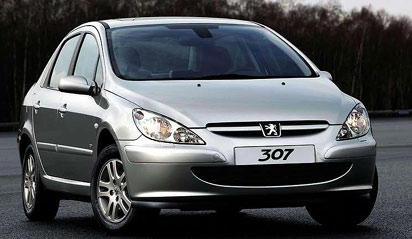
*Peugeot 307 Sedan assembled in PAN Nigeria Plant in Kaduna.
By THEODORE OPARA
For the local assembly plants to survive and create jobs for Nigerians, the National Automotive Council (NAC), has proposed a 35 per cent duty differentials between imported fully built unit (FBU) and locally assembled cars.
The National Automotive Council also recommended that government patronage of the local assembly plants would go a long way in ensuring that the local assembly plants survives, adding that this has always been the case in many developing countries with thriving automotive industries.
The Director General of the National Automotive Council made this disclosure at the 2011 symposium on Automobile and Allied Products Sectoral Group, organised by the Lagos Chamber of Commerce and Industry at Sheraton Hotel, Lagos.

*Peugeot 307 Sedan assembled in PAN Nigeria Plant in Kaduna.
According to the NAC Director General, Engr. Aminu Jalal who was represented at the occasion by his Director of Planning, Mr. Lukman Mamud, “Nigeria is losing so much due to its inability to protect and patronise its auto assembly plants.
Putting the annual installed capacity of the local assembly/manufacturing plants at 150,000 units, valued at N550 billion, the director general explained that at full capacity, 70,000 skilled and semi-skilled staff will be directly employed along with 210,000 indirect employment.
He regretted that the total current operating capacity for local assembly plants by value is N30 billion. Rather than the plants functioning, the NAC boss said a total of 80,000 new and 200,000 used vehicles valued at N400 billion are imported annually, a development he said would not encourage investors to invest in the sector. To this end, he suggested the enabling environment should be created to further encourage assembly/manufacturing of vehicles in the country.
He suggested that government at all levels should direct all ministries, departments, agencies, its local and multinational contractors in all sectors of the economy including banks with which it has relationship to source their automotive needs from local assembly plants as in line with government policy and new patronage circular No. SF OP/1/S.3/VIII/250 of 12 April 2011, (annex V) adding that developing economies with thriving automotive industry like Brazil, China, India, Malaysia, Thailand and South Africa had taken similar steps.
Among the countries mentioned, the Director General said their duty differentials ranges from 40 to 115 per cent. While India is 115 per cent, Malaysia 165 per cent. China and Thailand are 63 and 100 per cent respectively, while South Africa is the least with 40 per cent.
Continuing he said, since Nigeria has a policy to develop its automotive industry, it should consider and jettison all contradictory trade policies. “Of particular reference is the unjustifiably low import duty for semi-knocked down (SKD) and fully built units (FBU).This has virtually made Nigeria a dumping ground for fully built units at the expense of is industries, denying us the opportunity to create jobs, acquire technology, create wealth etc.”
“This situation defies reason as countries that export vehicles to Nigeria at 10 per cent import duty, charge 30 per cent import duty on similar import into the country. This is exemplified by the import of Toyota vehicles from South Africa,” he said.
Another example he said was the closing down of tyre manufacturing operations in Nigeria by tyre giants, Michelin and Dunlop. They now import tyres from Algeria and South Africa, export rubber for tyre making from Nigeria and obtain export expansion grant.
He however, noted that the reduction in tariff on FBU vehicles was one of the factors that led to the divestment by Peugeot AP France, Volkswagen AG of Germany and Daimler-Benz of Germany from their Nigerian subsidiaries in 2005/2006.
Engr. Jalal, however disclosed that so far, seven foreign companies had approached the National Automotive Council, indicating interest to set up assembly plants in Nigeria but could not do much due to the investment environment in the country.
The companies according to him are Anhull Motors of China, Chagan Motors China, Alliance Auto (Nissan and Renault representative in Nigeria), Iran Khodro Motors, Zhonda Motors of China, Zhengzhou Yutong Group China and Geely Motors of China.
Disclaimer
Comments expressed here do not reflect the opinions of Vanguard newspapers or any employee thereof.