By Adisa Adeleye
DEMOCRACY, as a concept would be described as a government of the people, for the people and for the people. It was invented by the Greeks to find a way for people to be governed by their own people for the common good. Thus, democracy could be accepted as one of the best ways to govern a community.
Democracy in many civilized environment has been refined and improved upon to make governance practicable and progressive. Good governance would require political parties with different ideas how governance could be beneficial to all through the introduction of party politics.
A party with progressive policies, fully explained to the people and endorsed by a greater number of people, would represent the government. The other party with less convincing policies and supported by fewer people would constitute the opposition. While the government elected by popular votes would be recognized by the people to rule, the less popular party or parties would be expected to propose alternatives on some crucial issues.
In a genuine democracy, multi_party system would be enthroned and electoral processes would be simplified so that the wishes of the majority of people will prevail. The government would be allowed to have its way on crucial matters while the opposition would be respected for its views. In a democratic state, it is possible for the opposition which is well organized to form a government when majority of the people feel so. We are now talking of a situation in which election is free and fair.
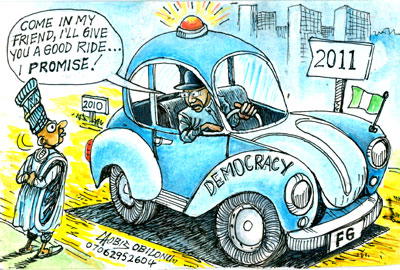
Unfortunately in Nigeria since independence, democracy has failed to take its roots because of lack of knowledge of democratic principles, and also because military interventions had affected negatively the growth of democracy. It would also be recognized where religious, tribal or ethnic considerations predominates, it is highly improbable that democracy would take root. Perhaps the military politicians of those years could not solve some of Nigeria‘s complex problems because they themselves were part of the problems to be solved.
Military dictators of the past which suppress principles of democracy also curtailed the growth of opposition. The counter_coups of the military era were the direct results of stifled opposition within their ranks. The civilian governments which followed the military dictators were not different in the methods of suppressing opposition. The advocates of dictatorship (whether military or civilian) believe sincerely that decisions affecting the destiny of a nation would be resolved with a fiat i.e. ‘with immediate effect‘. And things would change dramatically.
Is it possible to follow the tenets of democracy without opposition in a state? Or could progress be achieved and stability is maintained by a government in a state where opposition is oppressed? The present state of Nigeria shows a panoramic view of ruling parties sharing all the booties and the good things of offices, but wishing opposition dead or stifled. The tendencies are for the state government to capture all the legislative seats and all the local government councils in order to be in total control. It is believed that there is no state anywhere in the world where everybody sees or feels every matter in the same light. The past and present party politics in Nigeria has neither solved nor promised to prevent problems of insecurity, political instability and widespread poverty. Also the opposition, terribly divided is without any coherent alternative strategy to govern, could not appeal to any serious minded people. Unfortunate saga seems to be enduring inspite of stunted economic growth and insecurity to life and property.
Can there be a way out? Many European democracies are now experimenting with the idea of a coalition of two or more parties to run an effective government. Germany is already doing that and Britain has followed. In the 18th and 19th century Britain, a government was either Tory (Conservatives) or Liberal. It was often remarked that in Britain, any baby born in the 19th century would either be Tory or Liberal which showed strong entrenchment of party politics. However, the 20th century saw the birth of the Labour Party – a party of workers but led by intellectuals, to change the political scenery. Since then, Labour Party has ruled Britain for several times until the British Electorate had now decided to do away with one_party rule. The present British Government is a coalition of two parties, Conservatives and Liberal.
Also, during the period of political uncertainty and economic instability of the 1930s, Britain had formed a National Government to save the country and the Pound. Even the Greek who invented the theory of democracy are now facing economic crisis wrought upon the country by the ruling party and are now seeking solace in a coalition to put an end to a crisis which has threatened the political stability of the country.
In Nigeria today, there are signs of political uncertainty and economic instability fuelled by large unemployment of University graduates who are now turning into crime. Before the April elections, many promises of transformations – political, economic and security – were made. Also, many Ministers, Advisers, Senior Assistants had been appointed and many offices with juicy allowances are still being shared while nothing substantial is seen to have been done. Our Universities keep on turning out graduates without any hope of jobs, Honorary Doctorate Degrees are being lavishly awarded and high National Honours were recently awarded by the Federal Government to ‘good‘ Nigerians. All these are happening in a country where the bombs of Boko Haram are no longer threats.
Is it not possible to create an atmosphere where there is security, peace, progress and prosperity, where opposition is not stifled but active and cooperative? It may be necessary to formulate another concept of democracy where good governance is possible without the unruly interference of the opposition.
Disclaimer
Comments expressed here do not reflect the opinions of Vanguard newspapers or any employee thereof.