By Ochereome Nnanna
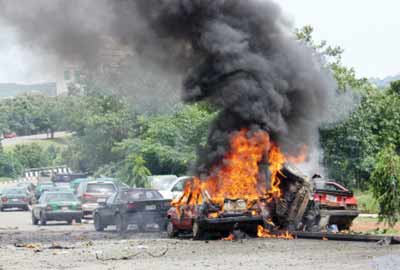
THE latest gruesome harvest by the Islamist terrorist group, Boko Haram, had the exact outlines of the opening gambit deployed by Front de Liberation Nationale, FNL, to snatch independence from colonial powers, France . Just as in our case where Friday, November 4, 2011 was chosen by our local terrorists, the FNL opted for November 1, 1954 , a day usually set aside by the French colonial establishment to celebrate their All Saints Day.
Again, Boko Haram chose a similar religious holiday eve, when Muslims all over the world were getting ready for the festival of sacrifice, the Id El Kabir Sallah for 2011. Religious festivals offer a period of euphoria and relaxation of vigilance by all and sundry, and the French colonists, military personnel and gendarmes were caught napping in the celebratory mood.

That rendered them wide open for well targeted offensives on government facilities, private property of the rich and famous French lords of Algeria and, of course, the usual local “collaborators”, who were then referred to derisively as the beni oui-oui.
In our own case, Boko Haram also targeted Christian places of worship for unprovoked attacks in total contradiction of Islamic injunctions, thus calling to further question whether these murderous anarchists are actually pursuing a genuine religious cause.
Both attacks were perfected and launched in simultaneous fashions. However, in the case of colonial Algeria, it was the very first shot being fired in what turned out as easily the bloodiest independence struggles in Africa, in that it consumed over one million Algerian lives (an eighth of the total population) and also 100,000 French lives (a fifth of their population in Algeria).
Sense of security
If the French could be forgiven for their false sense of security after 124 years of colonial oppression almost similar in style to the Apartheid system in South Africa in terms of dehumanisation of the local Arab and Kabyle-speaking Muslim population, ours could not.
Boko Haram made a fierce, bloody comeback early this year after it was beheaded by the Umaru Yar’Adua regime in 2009 and its leader, Mohammed Yusuf and some of his followers captured and handed over to the police, were summarily executed.
This time, it has staged a series of bombing raids with the Independent National Electoral Commission, INEC, office in Suleija, the Nigeria Police headquarters and the United Nations House in Abuja as juicy targets. In the north eastern section of Nigeria, particularly Borno, Bauchi, Gombe and Yobe states, Boko Haram, in the main, chose military, police and security facilities and personnel for hits. They also targeted individuals for assassination.
The scale of destruction mounted by this group, which enjoys a lot of support from foreign sources, triggered mass desertion of Maiduguri about two months ago, thus occasioning the deployment of the Joint Military Task Force, JTF.
The JTF and security agencies made a lot of impact. They were able to bring down the frequency of Boko Haram attacks. In fact, when they recently embarked on a house search for weapons in the Maiduguri metropolis they reportedly pulled in large quantities of arms and ammunition.
Already, there was a growing sense of being lulled back to sleep; a sense of winning, when Boko Haram stepped away from Maiduguri and struck in neighbouring Damaturu and Potiskum in Yobe State .It should have been pretty obvious that with the heat the military is piling in Maiduguri, the terrorists, in the true tradition of all cancers, would spread to neighbouring vicinities.
It should also have been predicted that, just like all other anarchist groups, Boko Haram would like to exploit the festive atmosphere of Sallah to its advantage.
That was the period that security and vigilance should have been beefed up around police, military, security posts, government institutions and places frequented by the public, including churches and mosques. It was due to the vigilance of the police that it was discovered on time that Boko Haram was planning to send bombs as Sallah gifts to well targeted individuals.
But apparently, this sense of vigilance was not evenly shared among the security agencies, which made it possible for Boko Haram to eliminate over a hundred souls in an organised orgy of bombing and shootings, the highest casualty rate so far since they started.
The Boko Haram challenge has not been approached with all the requirements of containment thrown in. There are clear evidences that the terror masterminds use their brains more productively than our paid agents of state, hence they remain several steps ahead of the law.
Compared with our security agencies, Boko Haram is still the underdog. It is still a rag-tag force made up of few very determined operatives. Do we have people in our security forces who are equally (let alone more) determined to stop them?
Do we have trained security experts always at the drawing board, thinking out what Boko Haram is likely to do next? Famous Kung fu legend, Bruce Lee said: “If you want to overcome your obstacles, be water, my friend”. Put water in a cup it will take the shape of the cup.
Put it on the ground it will follow the lay of the land, searching out its lowest points and growing in size until it overflows. Do we have people in the forces who understand Boko Haram enough to “be Boko Haram” with a view to overcoming it? The answers to these questions are evident in our success or failure rate in tackling this menace.
My own understanding of these Jihadist groups is that when you drive them out of “ Mecca ” they always look for a “Medina” to flee to with a view to staging a comeback, much in keeping with an old tradition of their religion.
Dislodging Boko Haram from Maiduguri means you should expect them to regroup elsewhere in the vicinity. Jihadists are highly traditional ideologues who rely a lot on their ancient history of battles to approach obstacles such as faced by Boko Haram at the hands of the JTF.
We should have history, psychology and warfare (especially guerrilla warfare) profilers whose jobs it is to consider what strategy the enemy is likely to consider from its long martial history.
In spite of few and far between evidences of sporadic success, the reports we get about lack of cooperation among our security agencies are, to say the least, very demoralising, not just for members of the public but even more so for the security forces whose members are the primary targets of the enemy.
There is very little in the carryings-on of the authorities and political leaders to reassure the ordinary citizens that we will soon put this long-drawn nightmare behind us. When the US warned its citizens in Nigeria that three prominent hotels in Abuja had been marked for bombing by these terrorists, General Owoye Azazi, the National Security Adviser, decided to engage in an exchange of verbal missiles.
Even the least discerning of individuals would know that Boko Haram would consider it another major “victory” if they succeed in bombing such strategic targets as the five star hotels, the Federal Secretariat, the National Assembly and even the Presidential Villa (as they were able to succeed in hitting the Police and UN buildings).
America only warned its citizens about a threat that was obvious. What we expect is that Azazi should organise our security agencies to ensure that this never happens.
Nigerians not only expect better efforts made by the security agencies of the state to protect them. They demand it. Our people whom we pay to protect us should apply themselves more to the job.
Bracing for Israeli strike on Iran?
IT has been a long time coming. Since the Islamic Republic of Iran’s revolution took place in 1979 and promptly declared its commitment to the destruction the Jewish State of Israel, many watchers of history knew that one day a showdown might ensue.
The emergence of ultra-rightist and nationalist, Mahmood Ahmedinejan, as the President of Iran in 2005 raised the stakes towards an eventual blow-out between the two countries and their allies. The Iranian leader has, at every single opportune moment, reiterated the fact that Israel would be destroyed whenever it had the capability to do so.
Iran had put its nuclear project at a furious fast-forward since 2006. Even though it maintains that the nuclear programme is for “peaceful” purposes to give the Islamic country self-sufficiency in electric power, there are now more startling signals to show that Iran is closer than ever to developing a nuclear bomb.
The International Atomic Energy Agency,IAEA, has reported to the United Nations that Iran had developed nuclear warheads that could be deployed on medium range missiles(enough to target Israel ) and also carried out computer simulation of detonations.
The President of Israel, Mr Shimon Perez, has already warned that an Israeli attack on Iran ’s nuke sites is getting closer by the day. The US is also worried that Israel might want to carry out pre-emptive strikes without first informing it; the reason being that the US might want to deter Israel and thus give Iran the opportunity to develop and deploy a nuclear bomb targeted at Israel .
History teaches us that whenever Israel had to go after its enemies without US support they throw caution to the wind.
If Israel and Iran should go to war, the world would never be the same again, quote me.
Disclaimer
Comments expressed here do not reflect the opinions of Vanguard newspapers or any employee thereof.