BY JIDE AJANI
Between political stability and economic prosperity, one must come first!
The two are not mutually exclusive.
In Nigeria’s case, the puzzle is whether we should pursue economic prosperity with a long term view of enthroning political stability; or vice versa!
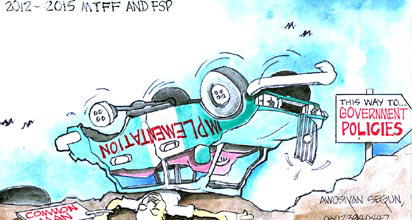
And whereas the buzz word today is President Goodluck Jonathan’s Transformation Agenda, the Finance Minister, Ngozi Okonjo-Iweala, has presented a 2012 – 2015 MEDIUM TERM FISCAL FRAMEWORK (Medium-Term Revenue Framework & Medium Term Expenditure Framework) And FISCAL STRATEGY PAPER. This, in simple, plain English Language, translates to the fact that the Jonathan administration plans to structurally adjust – there was Structural Adjustment Programme, SAP, sometime ago.
What that also means is that the government of the day is planning big,, really big, for its people – economically that is.
But that question rears its head again: Which one comes first: Political stability or economic prosperity?
At the risk of being taken on a wild goose impression, Nigerians should not misconstrue the April 2011 general elections as proof-positive that all is now well. Even President Jonathan knows this and that is why he is pushing for amendments to the 1999 Constitution, the amendment-in-chief being the proposed single tenure of seven years. So, he wants to pursue economic prosperity and political stability at the same time. But is this doable? Does he have what it takes?
A little over two decades ago, following the immediate times in the wake of the collapse of the Berlin Wall on November 9, 1989, many nation states were caught in the mire of guaranteeing which one to pursue in the very immediate term – a prosperous economy or a stable polity.

And it was at about that same time that the Berlin Wall was brought down, that Francis Fukuyama wrote his famous book THE END OF HISTORY and The Last Man. The precursor to the book was an article written in the summer of 1989, THE END OF HISTORY? And it was published in The National Interest.
Basically, Fukuyama argues that “liberal democracy may constitute the “end point of mankind’s ideological evolution” and the “final form of human government,” and as such constituted the “end of history.” That is, while earlier forms of government were characterised by grave defects and irrationalities that led to their eventual collapse, liberal democracy was arguably free from such fundamental internal contradictions.
This was not to say that today’s stable democracies, like the United States, France, or Switzerland, were not without injustice or serious social problems. But these problems were ones of incomplete implementation of the twin principles of liberty and equality on which modern democracy is founded, rather than of flaws in the principles themselves. While some present_day countries might fail to achieve stable liberal democracy, and others might lapse back into other, more primitive forms of rule like theocracy or military dictatorship, the ideal of liberal democracy could not be improved on”.
Back to Nigeria! The import of this is that democracy as a form of government answers the one leg of the question regarding the imperative of stability in the polity, which in turn creates wealth, in a manner of speaking.
For Nigerians who have been subjected to an overdose of crass insincerity and disappointment regarding government policies, they deserve better than what they have been and are being served.
To now make matters worse – in the absence of meeting the basic needs – the MTFF and the FSP proposition would have been a magic wand were Nigeria a truly politically stable nation. But with the Boko Haram menace, the cumulus of political tension hanging and waiting to send down rains of discontent once the debate on constitution amendment kicks off again, the image issue that Mr. President has, the possible jostle for presidential power in 2015 and the shambolic investment climate in the country, is Nigeria stable?
Even using Greece as an example, wahala dey! A European country, the government of Greece is being forced to structurally adjust; but the adjustment (so that its debt crisis does not create a contagion) is bound to create a cocktail of hardships for its people – that, in the face of its level of development and provision of basic needs to its people, the level of which Nigeria can not , from all indices, to measure up to 40%. Yet, Nigeria is expected to march on. March Nigeria will.
What Sunday Vanguard has decided to do is to engage our own economist to do a breakdown of what Okonjo-Iweala is trying to say in plain language regarding 2012 – 2015 MEDIUM TERM FISCAL FRAMEWORK (Medium-Term Revenue Framework & Medium Term Expenditure Framework) And FISCAL STRATEGY PAPER.
But beyond explanation, we go back in time, taking a look at where we are coming from regarding budgetary matters as a nation, where we got it wrong and why budgets continue to under perform.
For, at the end of the day, it is about the people. Any economic policy that short changes a majority of the people is a failed concept. For instance, one of the poles on which this administration is hoisting its hopes that it can turn things around is the funds that it would generate from the subsidy it plans to remove from petroleum products.
That is why this time, both President Jonathan and his finance Minister are taking a big gamble in the belief that their 2012 – 2015 MEDIUM TERM FISCAL FRAMEWORK (Medium Term Revenue Framework & Medium Term Expenditure Framework) And FISCAL STRATEGY PAPER would work. But would it? How would this plan capture yearly budgetary choices? What would be the impact on Nigerians? These and many questions we seek to answer today and in the coming weeks. Today, the march begins in the direction of structural adjustment!
Meanwhile, the 2011 budget presented in December was caught up in the race for elections. The President had no time to monitor its progress; the NASS leadership was also busy; several committees of both houses could not form quorum to discuss their portions of the bill and it took the threat of a shut down of government operations before a budget was hurriedly patched together for the President’s signature. That in itself was the first guarantee of disaster. Nobody really thought through the implications of the 2011 budget.
No sooner had the President appended his signature than he sent a message to the NASS that he wanted the budget amended; mainly; he requested for a downward review of the estimates for the NASS and an upward review for the Executive branch. Somebody, notably, the Minister for Justice and Attorney-General of the Federation, must have forgotten to remind the President that, the legislature, in a democracy has the power of the purse and the Executive branch can only spend whatever they choose to allow. Meanwhile, voices in the Presidency were warning that the budget passed by the NASS could not be implemented. Till today, nobody knows which budget the government is executing at the moment and how any achievement, or lack of it, this year, can be a basis for next year’s budget – talk less of a MTFF. Clearly whatever is built on this year’s budget would amount to building sand castles on a turbulent beach.
Although this is not, and cannot be, a full review of the 2011 budget, two other items from the original documents, sent by the President, deserve remark, because it has been announced that the economic Transformation Agenda has job creation as its cardinal objective. Three million, five million jobs have been promised by officials of government who have no track record of delivering on their promises.
The 2011 Budget thrust had four items:
· Job creation.
· Optimisation of capital spending.
·Accelerate the implementation of reforms.
·Reinstate greater prudence in the management of the nation’s financial resources.
Information from government is so scanty, and there are no metrics generally acceptable to economists for the assessment of the last three items. But, job creation was specific. Indeed, so specific that the President announced the establishment of a National Job Creation Scheme, NJCS, to be funded to the tune of N50 billion. Certainly, the 2012 budget presentation and the MTFF cannot be complete without a report informing Nigerians about the progress of NJCS. Specifically, government should answer the following questions:
·Was N50 billion released for NJCS?
·How much has been drawn down out of the amount?
· Who is in charge?
· How many jobs have been created so far?
· How can the media verify the claims?
Although it can be argued, with some justification, that N50 billion, to create jobs, in a country where close to 50 million are totally unemployed or under-employed, at least it is a step in the right direction – if the scheme has not suffered from the usual politicians’ election time promise; promises made to be broken. It should be clear to everyone that a government which claims to place job creation at the centre of its Transformation Agenda should demonstrate it by actually fulfilling promises made regarding employment.
Poser: Why couldn’t prudence in the management of financial resources start with reparation? Over N1.5 trillion vanished from the Federal governments accounts from 1999 to 2005. This is no WikkiLeaks stuff; the documentation is available locally. Why can’t the government move to retrieve the funds? The recent National Assembly probe into the operations of NITEL was a sham. The records of major misdeeds are available – if the government wants them.
NEXT WEEK: MTFF: PROSPECTS AND PROBLEMS.
Disclaimer
Comments expressed here do not reflect the opinions of Vanguard newspapers or any employee thereof.