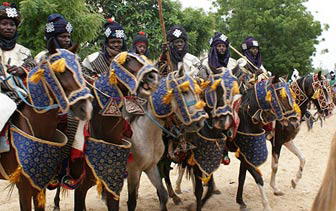
Durbar in one of the emirates.
Jimoh Babatunde with agency report
JIGAWA State was carved out from the Kano State on August 27, 1991 by the administration of former Head of State, General Ibrahim Babaginda.
Jigawa State is located to the North and East of Kano. It shares its northern border with the Republic of Niger, its north-west border with Katsina State, while north-eastern border is shared with Yobe State.
Kano State occupies most of the southern border of Jigawa State, but it also shares its south-eastern border with Bauchi State.
The state has a population of four million, six hundred and forty eight thousand people, according to the 2006 National Population Census. It has a land mass of 22,140 square kilometres which lies between latitude 12 degree to 13 degree north.
The state is linked by air through Kano, but this might change soon as the Sule Lamido administration is planning to have an airport in the state. Jigawa is also linked to Kaduna by rail that traverses the state from Kano to Nguru in Yobe.
The existing road network is fairly extensive and there is an ongoing rehabilitation programme meant to improve the condition of feeder roads to enhance accessibility.
The people: Majority of the people of Jigawa State could be classified into three tribes: Hausa, Fulani and Kanuri.
Highest concentration
The minorities, who are the latest arrivals include Arabs, Yoruba, Igbo and other minority Nigerian tribes inhabiting almost all the local government areas of the state with the highest concentration in Dutse, the state capital.
Culture: The rich cultural heritage of the people is reflected in their mode of dressing, music, dance, craftsmanship and hospitality. Hausa culture and tradition have overshadowed others but the Fulani, Mangawa, Ngizimawa and Badawa still maintain their culture and tradition in their areas of concentration.
These are mostly seen through their mode of dressing, food processing and pattern of settlement.
Festivals: Tourism is all about what is unique in a place and its people. Some of the key areas of interest in Jigawa State include cultural, natural places of significance and special events like Eid-el-fitr and Eid-el-Kabir.

Durbar in one of the emirates.
As practicing Muslims, the Eid-el-fitr and Eid-el-Kabir celebrations are main festivals of the people and these cut across ethnic barriers being a period of celebration for Muslims all over the world. The celebration of the birth of Prophet Muhammad in Hadejia and Gumel emirates, called the Sallar Gani, has become very popular because of its fanfare.
The Gani (Durbar) festival is an annual celebration and dates back to 14th century when horses assumed an important role in the history of Hausa states.
Sharo cultural festival is another festival that attracts tourists’. It is an annual whipping game to celebrate new harvest and demonstrate courage and endurance expected of Fulani young herdsmen in the jungle.
Music is an integral part of Sharo. About 10 pairs of large drums accompanied by congas and a wailing mouth organ are used to produce the desired rhythm so as to put the young men in the right mood.
Rock painting: The paintings on Birnin Kudu rocks indicate the work of early man who lived in mountain and caves around the rock and inselbergs. The paintings portray the activities of the ancient settlers; the occupation and other means of lively hood— hunting and fruits collection.
In the cave, tourists can see the drawings of cattle herds, herdsmen and antelopes beautifully carved on the rocks. The rock painting showed that the settlers of those days were cattle rearers, hunters and fruits collectors.
Looking at Birnin Kudu town from the top of the rock gives tourist a nice view typical of the European countries, especially during the raining rainy season with different inselbergs ranges, ponds and streams.
Hadejia Wetland: Jigawa State is blessed with the largest tract of undisturbed wetland in the country which is the Baturiya Game Reserve and the Baturiya Birds Sanctuary which play host to over 3,000 species of migratory birds.
This is a greenish wet and beautiful vast area of land that is annually inhabited by thousands of migrating birds from Europe, especially during winter periods and migrates back to Europe during the hot season.
The sceneric beauty of the Baturiya area and the colourful migrating birds present a unique attraction only to be found in this place throughout sub-Sahara Africa.
The bird sanctuary is located at Baturiya, Kiri Kassama and Guri local governments. It is internationally noted and visited by conservationists. It attracts between 1,500 to 2,000 tourists yearly from all over the world.
This vast land serves as a wintering ground for the paleatric birds from Europe and other parts of the world.
Disclaimer
Comments expressed here do not reflect the opinions of Vanguard newspapers or any employee thereof.