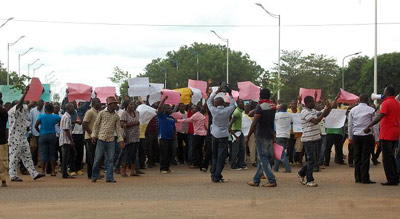
Protester in Asaba, Thursday.
By Samuel Oyadongha, Yenagoa
Most motorists plying the East-West road straddling the Niger Delta states of Delta, Bayelsa, Rivers and Akwa Ibom will not forget Tuesday September 6, 2011 in a hurry.
It was a day they were stranded for hours between the Bayelsa and Rivers stretch of the road in what could be described as the worst gridlock ever witnessed on the ailing road due to no fault of their theirs or their vehicles.
For about five hours vehicular movement on the usually busy road came to a chaotic standstill. But it must also be noted that commuters had on several occasions in the past suffered untold hardship on the route, especially at the peak of the rainy season when some sections are completely cut off due to erosion.
During such period, the bad spots were referred to as ‘Angola’ by the youths who capitalised on the deplorable state of the road to make brisk business by assisting vehicles to navigate through the failed and muddy portion whose owners in return appreciate their effort by way of paying for the services rendered.
But this was not to be the case on that fateful Tuesday when about 3000 aggrieved ex-militants drawn from Delta, Bayelsa and Rivers states converged on the East- West road and barricaded the strategic Mbiama section of the route in Rivers in protest over what they described as the refusal of the Federal Government to include them in the amnesty programme after laying down their arms.
The protesters who termed themselves third batch Niger Delta Development Ex-militants caught security operatives napping when they stormed the road as early as 5.30am to mount the barricade which effectively paralyzed vehicular movement on the route.
7-day ultimatum
Interestingly the aggrieved ex-militants who the previous week issued a seven-day ultimatum to the Federal Government to integrate them into the amnesty programme or risk breaching the existing peace in the region did not wait until the expiration of the ultimatum before they took to the federal highway.
It was not only commuters that were stranded, heavy duty trucks conveying petroleum products and heavy duty machineries for the nation oil and gas industry were also affected as well as security vehicles conveying huge cash to Yenagoa for banks operating in the Bayelsa State capital.
The blockade caused serious gridlock spanning to Kaiama on the Bayelsa axis and Ahoada on the Rivers flank with some of the stranded commuters forced to call off their journey due to the chaotic situation on the route.
Most of the passengers and traders going to the weekly Tuesday Mbiama Market were forced to trek long distances with loads on their head so as to pass through the troubled spot.
Not even the large deployment of armed solders from the JTF and policemen from Bayelsa and Rivers states backed by armoured tanks could scare away the army of protesters who laid siege to the only route linking the states of the South-South.
It was a trying moment for residents of Yenagoa as unfounded bulk SMS text messages alleging violent skirmishes between men of the Joint Task Force and the protesters were being circulated in the Bayelsa State capital.
Contrary to the alarming text messages being circulated, the battle-ready military personnel led by the Commander of the Sector 2 command of the Joint Task Force, Colonel M Lasisi exhibited high level decorum and prevented the tensed atmosphere from degenerating into blood bath. Col Lasisi adopted dialogue in persuading the unwilling protesters to vacate the federal highway to ensure free flow of traffic.
Stranded commuters
While the stranded commuters were praying to God to imbue the security operatives the wisdom to appeal to the conscience of the protesters to vacate the road, it was the prayer of sachet water hawkers and food vendors that the siege lingers given the large patronage from the hungry and thirsty commuters.
Hide-and-seek game
The protesters who grudgingly left the highway following the diplomacy adopted by the military authorities lamented what they described as the hide-and-seek game some officials of the amnesty programme have been playing with them since they laid down their arms.
One of the protesters who identified himself as General Ramsey Umokoro said: “We are out here on a peaceful protest against how the Federal Government has deprived us of our rights. We have been denied and deprived by the government after receiving our arms/guns from us. The Federal Government should return our guns because it is unjust to make us surrender our arms and treat us the way they are treating us; we want to go back to the creek”.
But a resident of Yenagoa, Ebidowei Kingsley, who witnessed some of the arms surrendered by the protesters, dismissed their agitation for inclusion saying: “These youths have no basis for barricading the East-West Road. What we saw they brought to the police and the JTF could best be described as large cache of locally- made guns used by hunters. Does that qualify them for freedom fighters? Where were they when others came out to surrender their arms when the Federal Government declared amnesty for all freedom fighters to surrender their arms in exchange for the amnesty?
“What we are witnessing here is nothing but lawlessness and I must commend the patience of the security operatives in ensuring that the matter was resolved without bloodshed in spite of the tensed situation on the road”.
In his reaction, the JTF spokesman, Lt. Col Timothy Antigha, said the special security outfit had to apply dialogue and not force in dislodging the protesters in line with democratic tenets of respecting their right so long they were not violent.
He, however, reminded the aggrieved ex-militants that the Federal Government had since declared the amnesty closed and as such their demand was illegal and would not be condoned in future.
Protesters as criminals
Also speaking on the protest, the member representing Bayelsa State on the Presidential Committee on Amnesty, Mr. Selekaye Victor-Ben, described the blockade by the protesters as a criminal act and an attempt by those involved to bend the provisions of the Amnesty programme of the Federal Government.
Mr. Victor-Ben said though the protesting militants had written to the office of the Special Adviser to the President on Niger Delta, Mr. Kingsley Kuku on their demands, the records with the Amnesty office showed that the protesting youths were not ex-agitators and weapons purportedly submitted were not recognised.
Mr. Victor-Ben, in a statement issued to newsmen in Yenagoa, said the protesting youths are a creation of hunger and a confirmation that due to the successes recorded by the Amnesty programme, many non ex-agitators, such as those involved in the blockade of the East-West Road, are seeking every available means to be involved.
On the issues of weapons submitted by the protesting youths, Mr. Victor-Ben said the arms submitted by the youths were far below the levels of those submitted by true agitators involved in the peace deal and amnesty.
Victor-Ben, who was also the Secretary of the State Peace and Conflict Resolution Committee during the talks with ex-agitators on submission of arms, said those agitating and blocking roads in the Niger Delta were not in the creeks when the Federal Government engaged in talks with ex-freedom fighters.
He advised the protesting youths to refrain from engaging in direct violation of the law and urged the law enforcement officers to come out strongly against youths engaged in such acts.
Meanwhile the office of the Special Adviser to the President on Niger Delta and facilitator of the Amnesty Programme, Mr. Kingsley Kuku said the Amnesty Programme does not have a “Third Phase”.
A statement issued by Head, Media and Communication, Amnesty Office, Henry Ugbolue, said the office had not been directed by Mr. President to admit new entrants into the amnesty programme for former agitators in the Niger Delta adding: “It is the firm view of Hon. Kuku that this clamour for the inclusion of more persons in the Niger Delta Amnesty Programme is unhealthy and clearly offends the letter and spirit of the 2009 Amnesty Proclamation.
End of Amnesty Programme
“The terms of the amnesty included the willingness and readiness of agitators to surrender their arms, unconditionally renounce militancy and sign an undertaking to this effect. In return, the government pledged its commitment to institute programmes to assist the disarmament, demobilization, rehabilitation and reintegration of the former agitators.
“A closure has since been achieved in the disarmament phase of the Niger Delta Amnesty Programme and very soon, the demobilisation component of the Programme shall come to an end. A total of 26,358 persons (in two phases) accepted the offer of amnesty at the expiration of the stipulated deadline. In pursuant to the commitment made to the former agitators, the Federal Government through the Amnesty Office is currently demobilising, rehabilitating and reintegrating the Niger Delta amnesty beneficiaries”.
Disclaimer
Comments expressed here do not reflect the opinions of Vanguard newspapers or any employee thereof.