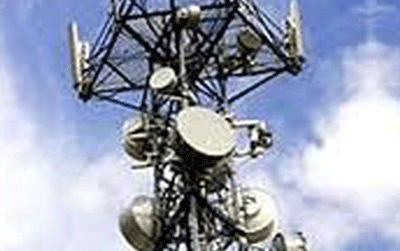
*mast
By PRINCE OSUAGWU
Telecom infrastructure vendors and their chip making counterparts last week reacted to the rumour that the GSM technology and the Code Division Multiple Access, CDMA would be phased out in about five years to come.
For them, the records should be straightened in order not to create panic among operators and users. Both the GSM, CDMA and LTE Technologies are core business areas of these vendors and so their inputs would assuage the building tension emanating from the rumour.
Going by the massive investments made by the operators in terms of deploying facilities, particularly in emerging markets like Nigeria, coupled with the transformation the GSM and CDMA technologies ushered in these markets, the news almost gave heart attack
But speaking to Hi-Tech on the issue, Qualcomm’s Managing Director for West Africa, Mr Alex Dadson, said there was no cause for alarm
According to Dadson,”there must have been a mis-understanding of the issue somewhere. Both GSM and CDMA will likely co-exist as we do not expect any operator to roll-out LTE nationwide on day 1.
In fact our chipset strategies anticipates this reality which is why we will have dual mode LTE/UMTS and LTE/UMTS/CDMA chips.
Vendors will have to prepare for the more likely scenario that all these technologies will co-exist in the short term. That applies to chipset vendors like us and infrastructure providers like Huawei and Ericsson among others.
For Dadson, Qualcomm is in Nigeria to assist the operators with their deployment of all these new technologies. “We will help with network design, optimization, trouble-shooting, technical training among others.Our expertise in the various technologies is going to be helpful to them also as they try to get all these technologies to work together in their networks.
“In any case, the evolution to LTE will have to be gradual, starting with urban areas where the operators can get a premium on the data connectivity services required by the customer. Gradually, as infrastructure pricing comes down, LTE will be deployed in all the major cities and towns”
Also Nokia Siemens’ Chief Technology Officer, Africa Region, Mr Karri Kuoppamaki, informed Hi-Tech that the global mobile market place today, consists of roughly 5 billion mobile subscriptions out of which, the GSM family including GSM and EDGE, WCDMA and HSPA, and LTE has over 90% share..
Kuoppamaki also said that GSM/EDGE serves the largest portion of this by far, claiming roughly 4billion subscriptions, while WCDMA/HSPA is the second biggest, claiming roughly 700M out of which, maybe, half already on HSPA.
For him, CDMA is, serving about 500M subscriptions today, with biggest markets in the U.S with Sprint and Verizon. Overall, mobile technologies have been deployed in over 500 GSM/EDGE networks and almost 400 WCDMA/HSPA networks globally.
He however admitted that LTE is very much reality today as 25 networks have been commercially launched, and many operators are moving towards LTE. NSN today has 40 commercial references worldwide, the highest number as compared to all other telecom infrastructure vendors.
This is about 10% of the 465 radio customers we have across all technologies. Various LTE adoption forecasts exist today, and it is expected that about 300M LTE subscriptions will exist by 2015 globally.
Having said that, he also noted that it will take a while before GSM and CDMA technologies will be replaced with LTE globally because both technologies will still exist till second half of this decade.
He supported his argument with the fact that “the demand for mobile broadband is driven by growing mobility, increasing use of data and applications and smarter devices. We aim to improve efficiency and experience in mobile connectivity, enabling better customer experience and increasing operators’ share of wallet”.
He added that what that demand translated in practice is that companies like the Nokia Siemens Network will provide smart networks, which offer the best user experience for smartphones, innovative design and architectures, and high capacity combined with a compact size and scalability.
He prided his company as the leader in mobile technologies. “We deliver radio access to 472 radio customers in 159 countries and our networks supply more than half of all mobile subscriptions worldwide”.
Nokia Siemens said it has 366 GSM customers in 143 countries and is supplying 3G radio access to 205 operator networks in 124 countries. This is in addition to a wide range of services it provides for its customers that allow them to get the most out of their networks.
Solution for operators
He did not see any problem with migration to LTE even if that was to be in the next five years. “As I said we provide services and products that help our customers evolve their networks in a manner that makes sense for them.
Our Single RAN Advanced solution provides evolving multiradio networks with added capacity and support of four radio technologies (GSM, HSPA, LTE and LTE-Advanced). It includes the Flexi Base Station family and the Multicontroller platform, a common hardware for Base Station Controller and Radio Network Controller.
“In addition to having a solution that serves multiple technologies, our solution adapts to the changing network usage. In the past the usage was pretty stationary, or nomadic but nowadays full mobility for data is required. People are connected all the time and expect ubiquitous access to their services.
In practice this means that in the morning the traffic hot spots may be in the residential areas where as during the day in the business district.
Our Liquid Radio architecture ensures consistent user experience across mobile broadband networks sharing and distributing capacity based on user demand.
The key components of Liquid Radio are optimized network utilization through baseband pooling (cost-efficient resource sharing across the network), active antenna technology (65% increased cell capacity due to beamforming) and SON-enabled interworking of heterogeneous networks using different frequency bands, cell sizes and technologies”
He said that for the operators to understand better the application and device aspects, his company cooperates with device, OS vendors and application developers, and study application behavior in a real environment tagged Smart Labs.
Business models
“We see that in the mobile domain, as far as business models are concerned one size does not fit all. Operators will have different business models depending on their strategy and customer base.
Having an end to end networks solution that provides a seamless migration to next generation technologies, such as NSN’s Single Radio Advanced combined with NSN’s transport, core networks and network and service management solutions will provide a basis for this.
We help our customers understand what strategies, solutions and migration paths make sense for them utilizing our global knowledge in the mobile domain”.
Understanding the technologies
The GSM family of technologies, GSM/EDGE, WCDMA and HSPA Evolution, LTE and its evolution is defined by a global standardization organization 3GPP. The scope of 3GPP is to produce Technical Specifications for 3G Mobile System based on evolved GSM, including LTE and its evolution and covers Radio access, Core and Service architecture.
The 3GPP ecosystem has been designed for seamless interworking and transitioning of its technologies enabling the coexistence of GSM, WCDMA/HSPA and LTE. GSM was in a nutshell developed for efficient digital voice delivery, and GPRS/EDGE enhanced the data aspects of the technology.
WCDMA/HSPA and its evolution adopted the circuit switched architecture for voice and enhanced the data capabilities well beyond what GSM/EDGE can provide. The latest standardization edition that is being worked on at the moment will enhance the HSPA capabilities to reach 672Mbps peak data rates.
LTE is about optimized network architecture, designed for efficient data delivery and it is solely based on packet switched networks with evolution to peak data rates hitting 1Gbps and beyond with LTE-Advanced. It still provides seamless interworking with previous generations 3GPP technologies though.
CDMA was developed by another standardization organization, but it has lot of similarities with WCDMA and its evolution. LTE standards also take CDMA interworking into account enabling operators with CDMA networks to evolve into LTE.
Disclaimer
Comments expressed here do not reflect the opinions of Vanguard newspapers or any employee thereof.