By CHARLES KUMOLU
In a society where being a widow in most cases, translates to extreme poverty, Ugonma Lebechi does not see widowhood as a barrier. Her dreams do not in any way equate with her economic and social status. Having lost her husband, who was a motor mechanic in 2004, the burden of taking care of their family of six, fell on her. Since then, her local restaurant popularly called Mama Put has served as the family’s only source of income.
Ugonna who holds a First School Leaving Certificate, FSLC, augments her food business with groceries, which she displays at the front of her shop. Unlike others who lament their state, Mrs. Lebechi whose surname in Igbo means ‘look up to God’, believes that she would someday conquer the hardship which had held her down since the death of her husband.

Education Minister, Prof Ruqayyatu Rufai
Her hope of escaping the pangs of poverty was hinged on her resolve to give her children the best education available. For someone, who is barely literate, this determination is highly commendable. Today, that resolve is paying off. One of children is already an undergraduate while the others are still in secondary schools.
The most astonishing thing is that in a society where people abhor sending their children to public schools, the 51-year old lady professes love for such schools. She is not perturbed that people regard those who attend such schools as children of the poor. As far as Lebechi is concerned, public schools remain the best in Nigeria.
“I would rather prefer my children going to public schools to attending all these schools which parade themselves as private schools. It is not because I am scared of their school fees; I just see their owners as businessmen who are out to make money from people.
My children told me that they don’t repeat students in most private schools, because if a student is made to repeat a class, the tendency is for them to leave for a nearby school that would be willing to absorb them.
I prefer government schools because despite their flaws, they still adhere to the rules. M son was lucky to have escaped the recent mass failure in the West African School Certificate Examination, WASCE. I am really very happy with his success.
The number of those who failed is enough for our leaders think twice because the standard of education has fallen badly,” she told VanguardFeatures,VF.
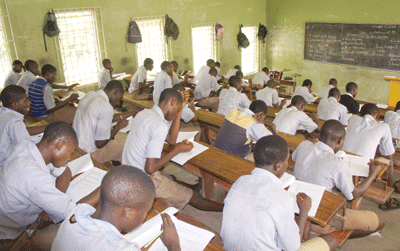
Lebechi’s views aptly capture the mood of many Nigerians following the massive failure of students who sat for the just released WASCE. The mass failure is believed to be a reflection of the poor state of education in the country.
The West African Examinations Council, WAEC, said that only about 31 percent of those who sat for the May/June 2011 exams made up to five credits, English Language and Mathematics inclusive.
The Head of National Office (HNO), Dr. Iyi Uwadiae who announced the results, explained that out of the 1, 540, 250 candidates who sat for the exams in Nigeria, only 472, 906 candidates obtained five credits and above, including English Language and Mathematics.
The implication of the results according to Dr Uwadiae is that only 31 per cent would be eligible for admissions into tertiary institutions.
His words: “The percentage of students that made five credits with English and Mathematics is better than last year. This year like other years, the candidates have not done well. Many of them do ‘cut and paste’. For this year, 472, 906 candidates (30.99 per cent) obtained five credits and above including English and others as against last year of 23 per cent.”
Failure reflects poor state of the education sector
The release of the results is already generating mixed reactions from Nigerians with many expressing fears that the education sector is heading for the worst unless something drastic is done to stem the falling standard.
“Some people will wonder and wrongly believe that this is a reflection of something wrong with WAEC. But no! It is a reflection of something going wrong in the education sector. We are giving the details so that everybody who is a stakeholder in the education sector will sit back and ask the question: Is what we are putting into education an expenditure or an investment? ” Registrar of WAEC, Mulikat Bello said.
“If it is an expenditure, you expend whatever resources without looking for results. But if it is an investment, you expect some results, some dividends. That is what we want everybody to ask. Are we getting from education enough dividends from the resources invested in it? That is why we are asking that every stakeholder should now ask what actually has gone wrong.
Why are the candidates performing woefully? And the answers are obvious. A lot has gone wrong. The school environment is no longer as conducive to teaching and learning as it was in the past. The structures are not there. The infrastructure is not there,” she said.
Although Bello made these assertions before the release of the current WASCE results, her views present a clue on why failure in WASCE is becoming a yearly occurrence.
Further investigations by VF shows that the recurring failure is a direct consequence of the decadence in the sector.
Students will continue to fail
A former Permanent Secretary in the Lagos Sate Ministry of Education Mrs. Bakare Maureen told this Vanguard Features that students will continue to fail, given the poor state of education in the country.
“Children will continue to fail because of the situation on ground. We have a situation where the teachers, who had training in the Colleges of Education and Universities, do not get better training that would equip them adequately for the job of teaching.
You will be ashamed when you listen to some them (teachers) speak English. And these are people who are expected to teach students. Since their education is standing on a faulty foundation, they would not be able to give their student sound knowledge,” she noted.

Teachers should be trained in such institutions
For Bakare who is the immediate past Chairman of UNILAG Parents Forum, the rot in the education sector could be traced to the politicizstion of education by governments at all levels.
This, she said, resulted to the scrapping of Teachers Training Colleges and the near absence of education Inspectors.
Restore teachers training colleges, inspectors
“We found ourselves in this problem because the government politicised education and deviated from the traditional way of teachers’ training, which was handed over to us by the colonial masters. That arrangement provided for a teacher’s training college.
These colleges have hostels and boarding houses for aspiring teachers and that afforded them the opportunity of acquiring moral education. But we longer have that. So, the government should go back to the basics because the system is faulty,”Mrs Bakere said.
Still identifying the factors that contributed to the growing rate of failure in examinations, Bakare said: “ The Ministry of Education at all levels no longer pay attention to the inspectorate arm. In the 1960’s when we were teaching, inspectors come around to inspect the teachers at school.
We no longer have that. Inspectors ensure that teachers do their job in accordance with the stipulated standards. Government should bring inspectorate to ensure that Principals and teachers adhere to teaching standards. Teachers’ welfare should also be improved because teachers are not well paid. Teachers deserve good salaries in order to give their best”.
E- learning has not helped education
Continuing, she insisted that: “Children must be made to read, because they no longer read especially now that there are E-learning centres. That is not reading, they should bring back te reading culture in students.
If you don’t read, you will not get true knowledge. For instance WAEC is currently withholding some results because teachers allegedly helped the students,”
Another person, who is saddened by the mass failure syndrome is the Chairman Nigeria Union of Teachers, NUT, Lagos State chapter, Mr. Samuel Idowu.
Although Idowu, noted that the performance in this year’s examination, dwarfed that of 2010, he stated tat a lot needs to be done in order to put an end to the recurring lackluster performance.
Policy somersault constitutes a problem
To achieve this, Idowu stated tat the bar would be raised and solutions found when the government and relevant stakeholders acknowledge that there are problems bedeviling the sector.
“The solution to the failures is not immediate, but we must admit that the sector has problems. And the remedy will take many years to come. We are experiencing the effect of corruption and bad leadership,” he opined.
As far as the NUT boss is concerned, the poor outing in examinations, is not unconnected with infrastructural decay, poor teachers welfare, attitude of students and policy somersault.
Having identified all these, he told VF that, “there is need to come up with a roadmap, which will address infrastructural decay, teachers welfare, attitude of students and Policy somersault.”
Need for roadmap on education
In addition Idowu said: “ These things I mentioned are so important if we must produce good students. We are used to inconsistent policies in Education here in Nigerian and it does not help in anyway, hence any government or Minister that comes, will introduce new policies thereby jettisoning the existing ones. That is why we need to have a roadmap which might take us 15 years before we get results.”
Convinced that if his suggestions will provide the needed solutions to the problems facing education, Idowu cited Lagos as a state that has set up a roadmap towards making the education sector better.
“Today the Lagos State government has identified the problems and is setting up a roadmap on how to solve them,” he added.
Another source of mass failure, according to Idowu is the fact the internet which should have aided learning and research , is now a means of distraction to most students.
“On the issue of e-learning, I will concur with others, who have argued that it also contributes to the attitude of students. Some of them can no longer recite multiplication tables because of e-learning. They don’t use their brains anymore because they can go to the internet almost all the time. It does not give them time to learn and I can say that it has not really helped the situation,”Idowu noted.
Continuing, he counseled parents to “always monitor their children at home, because by so doing, they would be able to determine their progress and ensure that they don’t imbibe wrong values.
Statistical revelations on state of education
Further checks by VF indicated that poor budgetary allocation contribute to te dwindling state of education in the country.
For instance, it was gathered the severe decline of the oil market in the early 1980’s, combined with the Structural Adjustment Programme (SAP), led to drastic reductions in spending on education.
This led to unpaid teachers salaries, degradation of education facilities at all levels and strikes in post -primary and tertiary institutions. The resultant effect is today’s declining literacy rates.
The Nigeria Millennium Development Goals, MDGs, 2005 report stated that literacy level in the country has steadily and gradually deteriorated, especially within the 15-24 years group. It noted that by 1999, the overall literacy rate had declined to 64.1 percent from 71.9 percent in 1991.
The trend was in the same direction for male and female members of the 15-24 years age bracket. Among the male, the rate declined from 81.35 percent in 1991 to 69.8 percent in 1999. The decline among the female was from 62.49 percent to 59.3 percent during the same period.
These scaring statistics according to analysts indicate that the sector is poorly funded.
This was supported by a Central Bank of Nigeria, CBN report, which noted that “poor financial investment has been the bane of Nigerian education system to the extent to which the budgeting allocation has been very low compared to others. the federal government allocation to education has declined steadily since 1999 and is much lower than the average in the last five years of military rule. This is particularly important in view of huge increase in number of intake at all levels of education – primary, secondary and tertiary.”
Perhaps, the implication of not substantially funding education and its impact in Nigeria, prompted UNESCO recommendation of 25% of budgetary allocation. But the realization of that stipulation, is still yet to be seen.
Disclaimer
Comments expressed here do not reflect the opinions of Vanguard newspapers or any employee thereof.