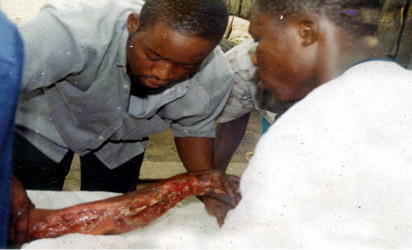
Frank Biere at work
By Ishola Balogun and Florence Amagiya
The name B P Frank Trado Medical Orthopaedic Clinic rings bell in Ajegunle area, Ikorodu road, of Lagos state. Every Okada operator in the neighbourhood knows the clinic no thanks to the unabated motor-bike accident in most parts of the state.
It was nick-named local orthopaedic. Of course, patrons are not only limited to residents of that area, people come from far and near, even from outside the country for various kinds of bone injuries, sores, partial spinal cord ,among others.

Frank Biere at work
Saturday Vanguard gathered that among prominent people who sought healing at the native clinic include an aide to an ex military head of state, a retired army captain, a close aide to a formerKwara State governor, two family members of a popular activist in the Niger Delta, among others.
The clinic, located in the remote area on Tosin Arogundade Street, Bako estate, Irawo, was not an eye-catching house but introduced by a mini sign post hanging on the rooftop of the bungalow. The small empty waiting room welcomes visitors without a seat and adjacent to it is the ward with six beds sparing no further space. It has a consulting room, and a room called theatre, and other attachments.
Frank, a 34- year old native physiotherapist, owner of the clinic, who was trained by his grandfather at the age of 12, said he it was his own contribution to the service of humanity. “Most accident victims with major bone injuries end up being amputated and if you provide alternative solution for not losing your leg or hand, then it is a huge service,” he said.
“We treat bone injuries, early stage of spinal cord injury, minor and major fracture among others. We use strictly native means to treat patient through leaves, herbs and roots. Not many people know there are leaves as antibiotics for tetanus infection. We have them locally, in our surroundings, we have leaves that make bone injuries heal fast,” he added
Narrating how he started the business, he said, “I started doing this at the age of 12 years under my grandfather before I proceeded for training in Port-Harcourt. After several years, I attended Lagos state Traditional Medical Board, Lagos for further training. That was 18 years ago.
I did not really plan to do this. When I was growing up, I was a swimmer, I thought I was going to be in sports. But I enjoy doing this because, beyond any material gain, I feel it is a service to humanity.
“Right from my early secondary school age, I used to get called every morning that patients were not being treated very well, asking me to assist my aged grandfather. The way I handled the cases, especially the one with spinal cord injuries, made patients recover very fast. From there, my grandfather developed interest in me and he would ask that I should be around with him always. Later, he left the work for me and I became a specialist in it. After five years, my grandfather was referring patients to me and that was the beginning of Trado-Medical clinic.”
On his innovation to what he learnt from his grandfather, Frank said his education helped him in doing differently what used to be the norm those days. “With formal education, I can explain a lot of things we used to do ignorantly then. Like the Blood Pressure, when the BP is low we know what to give and if high, we know what to give. Same with the sugar level. We know how to control it with appropriate medication without any complication. These are what make the healing process very easy. You can’t treat a bone injury on a patient with high sugar level. What we do is that we ask them to carry out a test and if positive, we control it first before embarking on the healing process, bring it down to 100/120 before commencing treatment on fracture. But in those days, it was not like that.”
On some of the things he uses, he said, “We have what we use in place of paracetamol, ampiclox and others. So, instead of giving the patient ampiclox, we’ll give leaves that are anti-biotic. We take care of any infection and we have even the anti-tetanus leaves, we have various herbs, leaves and roots we use for various types of ailment. These are some of the basics we learned at the Traditional Medical Board.”
He continued: “We test the patient on sugar level and other ailments, as well as know the Blood Pressure, BP before we apply anything, to avoid any complication. S far, we have not had any case that we can not handle. There is no bone injury we cannot treat.”
He noted that he only rejects patients if the pulse becomes low, whether as a result of accident or other ailment. “The pulse of a patient should be within 82 to 72 per minute but when it is low to like 40 per minute, we outrightly reject such patient. We don’t take that risk. Again, if the diastolic and systolic is about 50/90, we don’t take such cases. But outside that, no matter the level of the injury or fracture, we treat it.
“After ascertaining whether the body can be adaptable to the treatment, we admit. If it is fracture, for instance, we request for x-ray to know the extent of damage before we admit. Minor fracture takes about six weeks. During the period on admittance, bone marrow will form and it will in turn help callcium to form; the patience will begin to do exercise, using clutches and thereafter standing on his two legs and begin to walk and from there we will discharge.
“A woman was knocked down on December 13, 2011, and I just returned from my late father’s burial when she was brought in here around 10pm. My house is very close to the clinic and I immediately rushed down. But on seeing the woman, the case was worse than they portrayed, she was badly injured. I examined her and I found out that her PVC and the pulse were still okay, including the BP. So, she was admitted but when I opened the leg and I discover it was a five day wound untreated scattered bones and bleeding. We didn’t stop the bleeding at once because if you stopped it at once, it might decay. The blood that should come out will be eating the tissue. We were told she was rejected at one private hospital and from General Hospital she was told the leg would be amputated before she was brought in here. She was treated here and today the woman is walking. I was so happy that we treated her; it was one case I always refer to. Pieces of bones were gathered together and given to her. She said she would use it as chain.”
Speaking on why they preferred treatment in the native clinic, some of the patients who spoke to us said they don’t want to take the risk of going to orthopaedics where little fracture will lead to amputation.
In the ward where four patients are receiving treatment when Saturday Vanguard visited the clinic, Omar, President of the ward, who came all the way from Edo state, said he had an accident on Benin-Lagos road and after spending some few days in one hospital, he was brought to the clinic by his family members,” adding that the injury was so severe that he feared it was going to be amputated. Omar who disclosed that the right leg was badly damaged, disclosed that a surgery was done on two places, cut and joined together and is now healing. He has been there for more than nine weeks with the hope of walking to his home soon. On the title of President, he said he was brought in when the last person was being discharged, hence the title. As the president, he stated that he takes complaints of inpatients to the authorities and ensure they are addressed.
Disclaimer
Comments expressed here do not reflect the opinions of Vanguard newspapers or any employee thereof.