By Adekunle Adekoya
Mr Deji Sasegbon, SAN, is Chairman/Editor-in-chief of dsc Publishers Limited. A law alumnus of the University of Ife, later Obafemi Awolowo University (OAU), he took the silk in 2004, becoming a Senior Advocate of Nigeria (SAN).
Before then, however, he cut his legal teeth as a prosecutor, and in 1986, established dsc Publishers and also opened his law firm, Deji Sasegbon & Co. While growing and nurturing dsc Publishers, Sasegbon brought information technology to bear on his operations.

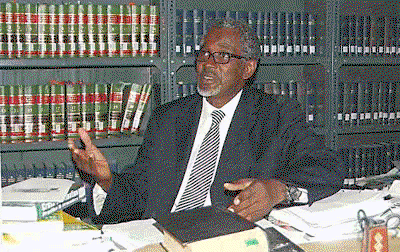
Mr Deji Sasegbon, SAN:
Using IT made Sasegbon a pioneer; recently he introduced legal electronic publishing which entails using the computer to serve the law, and now, decisions of the highest court in Nigeria, the Supreme Court are available on the internet.
Thus, millions of internet users worldwide are now exposed to Nigeria’s legal life. In the interview below, Sasegbon speaks about the penetration of IT into the legal profession. Excerpts:
Between the time you took the silk and now, how will you assess the impact of IT on your profession?
Certainly there has been a lot of changes. From the time I took the silk, information technology has already started to develop here. That was in 2004, almost seven years now.
Information technology was there but it was still in infancy. When I published NSCC (Nigeria Supreme Court Cases) in 1990 there was a particular computer software called Ventura.
Before then publishing was very labourious; you had to print in strips, paste on a board, take into a dark room and then the films come out, negatives come out and all that. But the Ventura came and broke all that. You could actually publish a book with your computer — put the pages together, manipulate in a way that you didn’t have to print page one and then print two until you now get to eight hundred and something pages.
With the Ventura you could actually print the whole book; you know print it all out and from the Ventura it goes straight to press. Over ten years ago that had developed. We also had the PageMaker and you know the PageMaker was very popular with everybody, and then the Microsoft Word.
So things had started to move then, but I can tell you that things have gone almost nuclear now. We now have scanners that are so good that its OCR software can in fact pick any character almost to the point in which you do not have to do proof reading.
How will you then rate the impact of IT on the nation’s judicial system?
I must say that as far as information technology (IT) is concerned, apart from Lagos every other state in Nigeria has not touched IT because in almost every court in Lagos State now you have these equipment that are more or less like typing in short hand. That is being done in almost every court.
You have the benefit of getting the proceedings of that day — the one taken in long hand by the court or the one taken down in short hand which eventually comes out fuller than the one that is from long hand and that is basically ICT. That is what is being used at the Lagos high court, I do not know if any other state in Nigeria has been doing it.
I know the Senate has something like that. What I’m saying is that in Lagos State, at the end of each day you can actually call for the proceedings of that day.
Before, if you call or you write an application to the judge or to the registrar asking for the proceedings of the day, it will have to be hand typed and after it had been typed it will now be sent to the judge asking for correction because the judge would not want the situation whereby he or she will be misstated. After going through it and it is retyped, it is signed and then you now get it.
But with the new system in Lagos state now, you can actually get it that day. If you wait after you finish your case on that day, you can actually approach the registrar and ask for the proceedings for the day and you’ll be given, fast.
What has been the impact of ICT on the practice itself in terms of researching and preparing for a case, that is, when you get a brief?
ICT has helped lawyers
Well, IT has also helped in the sense that a lot of lawyers or some firm today have been able to work out a system whereby they assemble a lot of these cases and they are assembled in a way that they can actually have access to it. They are assembled in a way that it has been divided into the different parts of the law like criminal law, criminal procedure, torts, land law, etc.
So if you had a problem say with land law, you just go straight because there are software and you could just go inside to look for what will help your case. It makes things much more faster. Now we have Nigeria Supreme Court cases on CD and we also have it on the flash drive. A lot of lawyers today use their laptops in court.
When I was a handling a case in Osogbo, while I was there almost all the senior lawyers had their laptops. I’m sure it must have been very intimidating to the judges just sitting there. So we are able to quickly call cases; you can even call one of your colleagues in Lagos and say please quickly email it to me.
How about the internet and online legal resources?
There is a portal on the internet, it has Supreme Court cases, it has court of appeal cases, Nigerian cases essentially if you can actually go into it and use. You can use it sometimes in court especially when you are in a very tight corner. It is just that our internet is not as fast as you’d like it to be; it’s a little bit slow.
So in court you can use the search engine?
Of course you can use the search engine. You could use your laptop in court. Judges do; in fact I know many years ago that judges were supplied with laptops. And some are so efficient with it that it’s almost unbelievable. You could assume they are IT super stars now.
Now, a bit about legal education. In the universities are there IT courses specifically tailored for the legal profession?
Really I must be honest. I’m not aware of that. The faculties of law have not really understood how it could help lawyers; it takes a bit of understanding and I think the only way you could know it helps lawyers is for some personnel of the faculty of law to go for coursein IT that could relate to law in America in different universities because that country seem to be in the fore front of these IT things.
They should send them on these courses and I’m sure they’ll come back well educated to help the faculties of law.
There is the issue of cyber crime and there doesn’t seem to be any law that seeks to prosecute cyber criminals in the country. What’s your take on that?
The reason why cyber crime is on the back seat if you like, as far as the government is concerned and the reason why it would seem these cyber cafes are bringing this country disrepute especially these yahoo boys is because the government it self has not really woken up to the fact that it seriously affects the image of the country. They know it does, but they do not put this on their list of priorities.
Priority perhaps is good water, education so they do not have time yet for cyber crime but this is something that has to do with the image of the country and should be taken seriously.
Evidence Act should be reworked
About the Evidence Act, shouldn’t it be amended so that it can explicitly admit electronic evidence, given the rampant cases of IT scams, and problems associated with citizen identity management?
Yes I agree with you that the evidence act should be amended, but then it is always so difficult for government to decide or deal with issues of this nature. The problem is that many of these laws were inherited from our colonial masters and it’s usually difficult to overturn these laws.
The evidence act is an act of government but they don’t see it as important. What government should do now is throw it down to the Ministry of Justice to look at, let the ministry come out with a recommendation, and take that to the National Assembly.
On electronic data that is not in the Evidence Act, I do not understand. Some courts manipulate the act to accept evidence with electronic data but that is actually over stretching it. There is nothing, no specific part of the act that deals with it.
Disclaimer
Comments expressed here do not reflect the opinions of Vanguard newspapers or any employee thereof.