By BEN AGANDE, EMMAN OVUAKPORIE, INALEGWU SHAIBU& OBIORA EKWEM
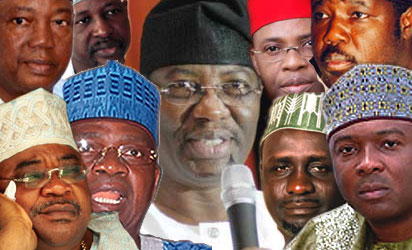
ABUJA—FORMER Attorney General of the Federation and Minister of Justice, Mr. Mohammed Adoke, yesterday, explained that the majority of corruption cases filed against high profile Nigerians lacked substance.
Adoke who spoke at his ministerial screening at the Senate made the assertions against the background of claims that he facilitated the withdrawal of many of the high profile corruption cases investigated by the Economic and Financial Crimes Commission, EFCC, and other investigative agencies of the Federal Government.
The assertions against Adoke nonetheless, he was confirmed by the Senate alongside six other ministerial nominees that appeared before the Senate. Yesterday’s confirmation hearing was the second day of the confirmation hearings of the 34 ministerial nominees presented by President Goodluck Jonathan last Tuesday.
The others screened and confirmed by the Senate were Dr. Shamsudeen Usman, Kano; Arc. Mohammed Musa Sada, Katsina; Mr. Labaran Maku, Nasarawa; Alhaji Yusuf Suleiman, Sokoto; Hajia Zainab Maina, Adamawa; and Mrs. Stella Odia Ogiemwonyi, Anambra.
Also yesterday, the House of Representatives demanded an explanation from President Goodluck Jonathan over his bid to appoint twenty special advisers without making a request to the House.
Asked on his assessment of the corruption cases raised against some politically exposed persons, Adoke explained that a number of the cases raised against the individuals were built on sentiments and lacked substance. He said the pursuit of the cases were sometimes diversionary and costly in both time and resources.
Adoke said that he did not pursue the prosecution of former military leaders allegedly indicted in the infamous Halliburton bribery scandal as canvassed by many Nigerians because “there was no sufficient evidence” that would have warranted a successful prosecution of the leaders in court.
The former attorney general also spoke on the withdrawal of cases against the former chairman of the Economic and Financial Crimes Commission, Mallam Nuhu Ribadu, the Vaswani Brothers, Chief Kenny Martins, Julius Berger and Nigeria Electricity Regulatory Agency.
Vaswani brothers’ case
Speaking on the case of the Vaswani Brothers, Adoke said even before he took over as the AGF, there had been an outstanding judgment against the EFCC saying that the deportation of the Vaswani brothers was illegal, null and void. He said: “When I came to office there were series of cases both at their instance and the instance of the EFCC in court.
And in fact one of the courts even awarded damages to the tune of N10 million against the EFCC for malicious prosecution. What I did was to ask that the regulatory agencies fighting corruption should obey court orders and I think this hallowed chamber will agree with me that respect for rule of law is one of the cardinal points of this administration.”
Former Minister of National Planning, Dr. Shamsudeen Usman who kicked started yesterday’s session spoke on the unemployment in the country, the proposal to commence Islamic Banking, the problem of Ajaokuta steel complex and other issues.
On the high rate of unemployment in the country especially among the youthful population, Usman warned that unemployment was like a time bomb waiting to explode.
Describing the controversy surrounding the planned introduction of Islamic Banking by the Central Bank of Nigeria as misplaced, Usman said: “The issue of Islamic (Jahid) bank is a storm in a tea cup; I don’t know why the Central Bank has not come out to enlighten people. There are Islamic banks in some of the Christian countries. Britain has an Islamic bank operating. There are Islamic banks all over the place.
The issue is the law allows you to establish main interest banking and Islamic banking is one form of main interest banking. If the Jahid bank had met the capital requirement we would have given them a licence a long time ago, but they couldn’t. Even the Islamic bank that is based in Saudi Arabia, you will not believe that the first state to borrow from the Islamic bank was Anambra State, because they are business people. Some of the states that are doing Sharia have not even gone to borrow from the bank as at that time, it is just one form of banking..”
Former Minister of Information and Communication, Mr. Labaran Maku spoke on the parlous state of education and called for a synergy between the federal and state governments to reverse the dangerous fall in the standard of education in the country. He said: “The major problem of our education today is governance. Private schools with less qualified teachers do better than public schools because public school teachers don’t write lesson notes among other things. There is no supervision to ensure that they do the right thing and coupled with that, their morale is low. Government must do something to halt the decline in the standard of education.”
Following the screening exercise the Senate confirmed all seven nominees bringing to 14 the number of nominees confirmed by the Senate since the screening exercise commenced on Wednesday.
Meanwhile, the House of Representatives has demanded explanations from President Goodluck Jonathan on why he did not seek the approval of the House in his request for the approval of Special Advisers. The House request followed President Jonathan’s letter to the Senate last Tuesday seeking approval for the appointment of twenty special advisers.
The directive of the House was contained in a resolution passed at yesterday’s plenary which observed that the President’s request breached constitutional provisions requiring the President to seek the permission of the National Assembly in the number of Special Advisers to appoint.
The immediate past Minority Leader Rep Femi Gbajibiamila raised the issue through a constitutional point of order at the House session presided over by the Deputy Speaker, Chief Emeka Ihedioha.
Quoting Section 151 of the constitution, he said:
““The President may appoint any person as a Special Adviser to assist him in the performance of his functions. The number of such Advisers and their remuneration and allowances shall be as prescribed by law or by resolution of the National Assembly.””
““I am drawing attention to the provisions of section 151 of the constitution. This constitutional provision stated that the President should seek approval from the National Assembly to appoint Special Advisers. But I am not aware of any letter sent to this House in that regard. I have even heard that the Senate has approved that the President could appoint 20 advisers. I do not want to believe that there is any intention to undermine the House of Representatives but I just want to ask that the House should ensure that the right thing is done””
Following his observation, the Deputy Speaker instructed the Clerk, Sani Omolori to draw the attention of the Presidency to the issue.
“In upholding your point of order, I believe that it is more of an oversight than a deliberate attempt to undermine the House. The Clerk of the House of Representatives is therefore directed to get in touch and get the issue sorted out”
Disclaimer
Comments expressed here do not reflect the opinions of Vanguard newspapers or any employee thereof.