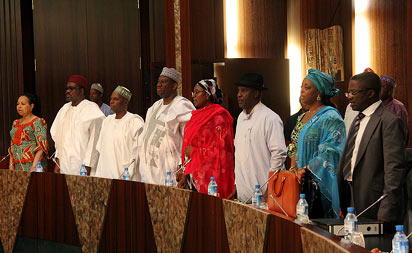
*Some of the ministers at the opening session of the Federal Executive Council in Abuja
By Daniel Idonor
They come in one after the other in their regalia. Some of them are wearing their robes for the very first time. Some actually went the extra mile to buy or make the apparel specially, for the day’s meeting. They black-slap; some grin; a few grimace; some smile with their teeth; a few, very few others are actually happy smiling; yet, some are fidgeting, being their second time in the council chambers, the first being the day of swearing in; indeed, there are those who are just fishing for the camera lights for pure publicity; to be fair, there are those whose main concern is to really fashion out a way to develop Nigeria. Welcome to the inaugural meeting of the Executive Council of the Federation, EXCOF, in this tenure of President Goodluck Jonathan.
But would they deliver for him the transformation he has promised Nigerians? Nigerians wait.
Barely 51 days after the inauguration of Jonathan, the EXCOF which is constitutionally empowered to meet regularly on Wednesday, held its first weekly session thereby formally kick-starting the business of governance.
As early as 9a.m, as had been the case, one by one, the 40 ministers, with great excitement and expectation, began to take the long walk from where their Sport Utility Vehicles, SUVs, are parked, to the Aso Council Chambers, venue of the meeting, which commenced at 10a.m. prompt. But what is very clear is that as they walked in, besides their facial recognition, their physical and mental appearances and expression, were all that journalists required to separate the new cabinet members from the old or “ranking” ministers.
While direction and location of the venue was not an issue as officials of the Protocol Unit were on hand to usher the ministers to the hallowed chambers; and straight to their seats which have since been marked alphabetically – this time not according to their names or state of origin but in line with their portfolios, the new ministers were understandably not relaxed.
Everything appeared new to the new members, especially those of them who were having their first short at the prestigious cabinet, except for the Minister of Works, Mike Onolememen from Edo State, who was once a minister of State for Defence and, of course, the Minister of Youth Development, Malam Bolaji Abdullahi from Kwara State, a journalist— trust journalists, ever relaxed, anywhere they find themselves.

*Some of the ministers at the opening session of the Federal Executive Council in Abuja
Of course, as is the practice, when ministers arrive for EXCOF meeting, before or exactly at 9:30 am, the presiding officer, Mr. President, will not walk in to flag-off the discussions and consequent resolutions until 10 a.m. or few minutes after.
And, as such, the ministers have 30 minutes to spend either at the tea room for coffee/snacks or in the next room, venue of the meeting.But last Wednesday, the session was just a continuation or conclusion of the earlier two-day induction for members of the new cabinet, as no memo was sent and presented to Council.
So, while the 30 minutes waiting session lasted journalists were obviously faced with two classes of people – the ranking and new cabinet members. As they continued to throw banters and exchanged pleasantries it was not difficult to make a distinction between the two classes. The returnee-ministers could be seen with so much excitement congratulating one another on staging a tortuous comeback, even as some of them confessed to the extent of lobby and pleas as well as high-level politicking with the powers-that-be before they were reconsidered.
They also moved very freely from one seat to another and spoke freely with one another. Most of them have nicknames only fellow members or colleagues identify them with. Such names emanated from one hard policy decision so far made or the nature portfolio/ministry they occupy.
However, for most new-comers, the story was different. Many in this class just remained on their seats after being ushered in.
They could hardly interact or mix with others; they barely knew one another. The common denominator was the way they sat, quiet, with a mixture of excitement and somber disposition. They simply did not know which name to call when they even reluctantly attempted to hug one another.
But you must give it to the new ministers because as fast learners they wasted no time after seeing how their ranking colleagues walked round in exchange of pleasantries, rose to the occasion and also stepped out of their mental enclosure, to enjoy the prevailing atmosphere characterised by great excitement and joy.
One man who undoubtedly stole the show was the returnee Minister of Labour and Productivity and Abia State-born Chief Emeka Wogu, who may not have slept the night before the FEC meeting as a result of the long meeting between the government and organised labour, which eventually led to the shelving of last Wednesday’s planned three day nationwide warning strike, which lasted till few hours to the resumption of EXCOF meeting. As he entered the venue of the meeting he was the toast of his colleagues, as they showered praises on him for resolving the looming industrial crises. This is certainly not the first time the minister will be delivering on his assigned mandate. He has at different times rescued the economy from total collapse due to labour-government looming face-off.
The returnee ministers are Alhaji Yusuf Suleman, Sports; Navy Captain Caleb Olubolade, Police Affairs; Senator Bala Mohammed (Bauchi), Federal Capital Territory, FCT; Mrs. Diezani Alison-Madueke (Bayelsa), Petroleum; and Elder Godsday Orubebe (Delta), Niger Delta Affairs. Others are Professor Onyebuchi Chukwu (Ebonyi), Health; Prof (Mrs) Ruqayyatu Rufai (Jigawa), Education; Dr. Shamsudeen Usman (Kano), National Planning; Mr Mohammed B. Adoke, (Kogi), Attorney General of the Federation and Minister of Justice, AGF; Mr. Olusegun Aganga (Lagos), Trade and Investment; and Mr Labaran Maku (Nasarawa), Information.
The new ministers are Senator Idris Umar, Transport; Hajia Zainab Maina (Adamawa), Women Affairs; Prof. Ita Okon Bassey Ewa (Akwa-Ibom), Science and Technology; Mrs. Stella Oduah-Ogiemwonyi (Anambra), Aviation; Comrade Abba Moro (Benue), Interior; Hajia Zainab Ibrahim Kuchi (Niger), (State), Niger Delta Affairs; Alhaji Bukar Tijani Borno, (State for Agriculture and Natural Resources; Arc. Mike Onolememen (Edo), Works; Prof. (Mrs) Viola Onwuliri, (State I) Foreign Affairs; Arc. Mohammed Musa Sada (Katsina), Mines and Steel Development; Dr. Bello H. Mohammed (Kebbi), Defence; Mallam Bolaji Abdullahi (Kwara), Youth Development.
The new entrants also include Dr. Samuel Ioraer Ortom (Benue), State for Trade and Investment; Amb. Olugbenga Ashiru (Ogun), Foreign Affairs; Erelu Olusola Obada (Osun), State for Defence; Mrs. Olajumoke Akinjide (Oyo), State for FCT; Senator Idris A.Umar (Gombe), Transport; and Dr. Yerima Lawal Ngama (Yobe), State for Finance. Others are Ambassador Bashir Yugudu (Zamfara), State for Works; Dr. Akinwunmi Adesina, Agriculture and Natural Resources; Mr. Edem Duke, (Cross River) Culture and Tourism; Dr. Nuruddeen Mohammed (State II), Foreign Affairs; Mrs. Hadiza Mailafia, Environment; Mrs. Omobola Johnson Olubusola, Communication Technology; Mrs. Sarah Ochekpe, Water Resources; Mr. Nyesom Wike (State), Education; and Ms. Ama Pepple, (Rivers) Lands and Housing; Dr. Mohammed Pate (State) Health.
On the whole, all the ministers were well- dressed and business-like, except for one from the South-South zone (names withheld) who succeeded in neutralising the popular Hausa dress code of Senegalese kaftan, when he paired it with a cap made from the same fabric, as against a wool handmade cap.
This was expected, as most of them were not doing badly economically either in their private or public career before their appointments. The youngest Minister of State II for Foreign Affairs, Dr Nurudeen Mohammed, 36, from Jigawa State, was not left behind as he was decked in black suit with a pair of black shoes to match. The medical doctor assured Vanguard that he cannot afford to fail, as that would mean a “generational failure by Nigeria and the youths of Africa”.
For the Minister of Youths, Malam Abdullahi Bolaji, who had a fruitful career in journalism as a Deputy Editor with Thisday newspaper before picking up a political appointment for three consecutive teems now – both as special adviser, commissioner and now a minister, there was nothing extra-ordinary appearing in Council for the first time as a cabinet member, except for the power of the office. Besides his black stripped-kaftan, the Kwara State-born technocrat cum politician was just himself, as he interacted freely with everybody; after all, it is not the first time this senior journalist will be the meeting with the high and mighty in the society.
For the Minister of Housing and Urban Development, Ms Ama Pepple, a former Head of Civil Service of the Federation, the EXCOF appearance was obviously a second home coming, as she was an active member of Council for a year before handing over. But it must be pointed out that the noticeable disconnect between the new and the old ministers at the beginning of the half-hour salutation session soon faded away, as they were seen mixing up more, towards the end of the session; and even after they dismissed from the weekly EXCOF meeting.
On the main business of the day for reporters, which is the outcome of the weekly EXCOF meeting, the Minister of Information, Mr Labaran Maku, accompanied by his Foreign Affairs counterpart, Ambassador Olugbenga Ashiru, who briefed State House Correspondents, said President Jonathan charged all ministers to assume full responsibility of their ministries while they initiate fresh policies and better methods of achieving results different from the past.
He said that the meeting which was chaired by Mr President, with Vice- President Namadi Sambo in attendance also approved three ministries from the existing two thus: Communication Technology; Science Technology; and Information. Throwing more light on the newly-created Ministry of Communication Technology, saying it was carved from the former Ministry of Information and Communication and Ministry of Science Technology, he quoted President Goodluck Jonathan as saying that government’s focus will be on major policy directions on new methods of doing things and set criteria to assess performance of ministries, departments and agencies, MDAs.
Maku said the President noted that EXCOF was not just a body for awarding and approving contracts, but for making major policies as it concerns the citizenry, saying that it is new policies that will bring development; and this dispensation will review policies that no longer have impact on the lives on Nigerians.
According to Maku, “for purposes of clarity, the Ministry of Communication Technology was created from both the Ministry of Information and Communications and Science and Technology. The Ministry of Science and Technology will retain its name while the Ministry of Information and Communications is now Ministry of Information.”
Maku said members of council took turns to speak but all agreed they have a challenge that must be met and every MDAs must matter. He said there are three areas of focus governance which takes into cognizance vision, due process, and integrity, second being infrastructure development and third, human development.
”Council commended the Minister of Labour, Emeka Wogu, the Nigeria Labour Congress, the Trade Union Congress and the Governors’ Forum for doing everything to reach a truce that prevented the planned strike over minimum wage from going on.
Minister of Foreign Affairs, Ashiru, speaking on government’s foreign policy direction said, “henceforth we are going to ensure, like has been demonstrated even yesterday (Tuesday) with the UK Prime Minister all foreign high level visitors to Nigeria, we will make sure that our own private sector will interface with their own, because at that level they have the opportunity to interact.
”His trip will be focused on attracting capital and investment back to Nigeria so that our economy will be the beneficiary and, of course, Nigerians will also benefit from this in various ways.
“Our embassies in Europe, Asia and America will focus more on investment promotions; this is a key direction that this administration would pursue with the support of President Jonathan. We are tying foreign policies to investments as demonstrated yesterday; the Prime Minister and his 50 businessmen interacted with our business community,” he said
Disclaimer
Comments expressed here do not reflect the opinions of Vanguard newspapers or any employee thereof.