By Ochereome Nnanna
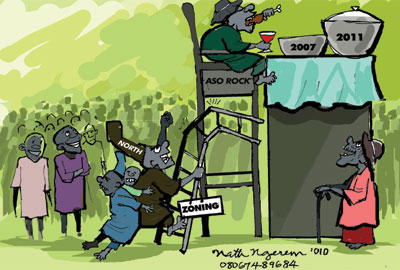
FOR the first time in 20 years when I started actively chronicling Nigeria’s political affairs, I am feeling on top of the world at the end of a transitional process. This is the first time that I, as an Igbo person, was part and parcel of designing the outcome of a general election without being a mere passenger in a bus owned by others, driven by others and being taken to a destination dictated by others. Before now, the Igbo nation stood by while the North, and from the 1990s, the North and West, decided our political affairs and imposed on the rest of us.
The original tripod foundation of the Nigerian state was smashed during the second military adventure which started in 1984. It would seem that the second military intervention was meant to stamp out the surviving embers of Igbo clout, which still remained strong enough in 1979 to enable Igbo produce the Vice President of Nigeria barely nine years after the civil war. After 1983, the tripod was altered to two legs by a military controlled by the North with a strong South West presence.
The upshot was that in 1992 only Northerners emerged as presidential front runners in the two registered political parties (Alhaji Umaru Shinkafi and Malam Adamu Ciroma in the National Republican Convention, NRC; and retired Major General Shehu Yar’Adua in the Social Democratic Party, SDP).
When General Babangida disqualified the duo and banned them from contesting the next round of elections, it gave room to the emergence of Alhaji Moshood Abiola in the SDP and Alhaji Bashir Tofa in the NRC.
Even when multi-party democracy was restored in 1999, only political parties led or largely populated by Northerners and South Westerners (Peoples Democratic Party, PDP; the All Peoples Party, APP and the Alliance for Democracy ,AD, were registered, even though AD did not qualify for registration. No Igbo party was registered, and no Igbo man was picked as presidential or vice presidential candidate. In fact, the North and West, aided by the military, went about it as if other parts of the country (not the least, Igbo) did not exist.
This was in spite of the fact that Dr Alex Ekwueme, who played vital roles during the negotiations at the Abacha Constitutional Conference, was initially seen as the most suitable person to run the post-military democratic dispensation. Of course, President Olusegun Obasanjo, himself the central script writer of the post-war Nigerian politics, took power back to the North and picked an Ijaw man as Vice President for ailing Umaru Yar’Adua. In doing so, an Igbo man of South-South extraction, Dr Peter Odili, was thwarted when he was coasting home to winning the presidential ticket of the PDP in 2007.
When Yar’Adua died (as speculated by those who chose the presidential ticket), the Ijaw man, Dr Goodluck Jonathan, was appointed President, Commander-in-Chief. He picked a Northerner, Architect Namadi Sambo, as his Vice President. Today, the Igbo do not have the exalted positions of President, Vice President, Senate President, or Speaker, House of Reps. And so, why do I feel so good?
The answer is simple. The emergence of Dr Jonathan is the realisation of 20 years of strategic efforts to redesign the Nigerian polity to demonopolise power by Igbo elite. The various efforts by Igbo leaders and their counterparts in the defunct Eastern Nigeria to create power shift, has borne fruit. From retired Commodore Ebitu Ukiwe’s Council for Unity and Understanding, CUU, in 1988-1993, to the Igbo caucus at the Abacha Constitutional Conference, 1994-1995; down to Ambassador Matthew Mbu/Ukiwe’s labours in the Council of South East and South-South, COSESS, in 2001 to 2006, the bricks were laid one after the other.
The former regions were broken up into six and the minorities of the North and South now have geopolitical zones of their own with which to negotiate power. The Minorities of the South can no longer be the lackeys of the North and West against the Igbo, just as they have since ceased to be those of Igbo. Above all, the Igbo nation played the central role that made the election of Jonathan possible.
A consensus was built around the resolve not to run for President or Vice President and to throw their full weight behind Jonathan. There were no split votes as in the past. And for the first time since the war, the Igbo produced an electoral turnout unlike any other time and unequalled by any other geopolitical region; all in favour of Jonathan. An Easterner is now in the presidential seat. What does it matter if he is not an Igbo man? Their time will come, and when it does, the nation will rise in support. The Igbos are now no longer mere passengers. They are a vital and robust part of the six-legged creature that represents the Nigerian Commonwealth.
The Igbo circumstance in Nigeria is an uncommon one. The nation levied a civil war against them and they lost their place of pride in the system. For 40 years they were sidelined. I am a victim of this phenomenon. As an Igbo man, I lost five academic years to that war. The losses cannot be quantified. But the emergence of a Minority, South-Southerner from the Niger Delta as an elected President of Nigeria is a sure sign that this country is outgrowing the demons imposed on her by colonial and military rule. I am proud of Nigerians for putting the internal colonialists out of business, and I am even prouder of the roles that the Igbo political elite played over the past 20 years to bring this to fruition.
No matter how badly Jonathan turns out to be, this nation can never go back to where it has just emerged from. I no longer feel sidelined, marginalised and irrelevant because I am one of the inventors of the new dispensation. And I like the feeling.
Disclaimer
Comments expressed here do not reflect the opinions of Vanguard newspapers or any employee thereof.