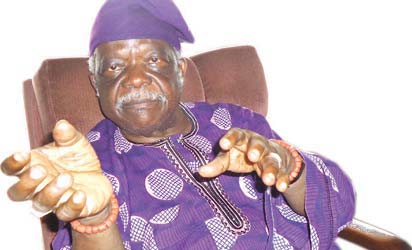
Olusegun-Olusola
Born at Iperu-Remo, Ogun State, Nigeria on March 18, 1935. Amb. Olusegun Olusola attended the Roman Catholic School, Wesley School, Iperu and the Remo Secondary School, Sagamu respectively. After a one-year service as Account Assistant at the ECN, now PHCN, he began his broadcasting career in 1955 at the Ibadan station of the Nigerian Broadcasting Service and in September 1959, he became Africa’s first Television producer with the WNTV now – NTA Ibadan in a Television career that lasted till 1967 during which he created the longest running TV Drama series, ‘The Village Headmaster’.
He is the founder of the African Refugee Foundation, ARF. He got the initiative from accumulated experiences in other parts of African countries including Ethopia, Lybia, South-Africa, Zambia to mention just a few. His words: “My experiences in other parts of African countries were what transformed in my founding the African Refugee Foundation”.
Amb. Olusola grew up in a carpenter’s workshop where he learnt wood works. His late mother was a mat weaver while his father was a wood worker. Today, Past Perfect brings to you Chief Olusegun Olusola an icon whose footprint cannot be forgotten in the history of Nigeria. I was the last child of my parents.

Chief Olusegun-Olusola
I had elder sisters and one elder brother but they have all passed on. I have one younger sister who is 70 years old now. She is the head of one local church now in Iperu Remo. I am the only living male child of my parents. In a traditional Yoruba family, it is a taboo to count the children of anyone. I was born in 1935 in Iperu-Remo in Ogun State. I grew up in Iperu-Remo. My father was a carpenter, a wood worker and I grew up in the company of apprentices working with wood.
My late mother was a mat weaver and so, she was called “Iya-Eleni”, while my father was called “Baba carpenter”. And I grew up in his workshop. As a matter of fact, the wood workers and carpenters in Lagos State have just appointed me as the patron of the association. My early life began at the Roman Catholic School in Iperu. It was the first co-educational secondary school in West Africa. We were the foundation members of the school.
Although my parents didn’t want me to go to a Roman Catholic School, I found myself there. One of my father’s wives who didn’t consent to my going to that school started calling me padre, meaning, I was going to end up as a Roman Catholic priest but I didn’t become one. I’m happy that I didn’t become a Roman Catholic priest as they thought. My life’s challenges started when I graduated. My first working experience was at the ECN where I was the Account Assistant. Then, I went into broadcasting in 1955. I joined broadcasting as features producer.
There after, I went for broadcast related studies.I studied at the BBC and I worked all through until 1993. It was in 1993 that I retired and was appointed as an Ambassador of Nigeria to Ethiopia and Africa Union. I served till 2000. Then, I established the African Refugees Foundation, ARF. I’ve lived all my life facing one challenge or the other. I haven’t seen anyone who has lived for 76 years without any challenge in his life. I went through lots of challenges and never thought I would survive to live to be 76 years . I never thought I would live beyond 30 years.
As I was growing up, something told me that I wasn’t going to live long at all. My late wife and I used to talk about it but I thank the Lord for living this long. The Lord assisted me in my growing up years. By the time I was 30, in the year 1965, I’ve served with WNTV, WNBS as a senior officer. I got married and I have three children: one boy and two girls. My third child Toyin was born in 1964, the last amongst the three children by my late wife.
So, I thought it was a good and fulfilling life for a young man like me to be married with children and even as a serving broadcaster, I had this feeling that I would pass on at 30. Today, I am 76 years. One significant experience I had in broadcasting was when I went to write and produce a feature programme in a community called Ayetoro in Ilaje area of Ondo State where they were practicing communal living. I went there by boat to produce a programme. I had finished working on the programme, recorded all my interviews and I was returning from Ayetoro back to Ibadan. So, I had to go by boat from Ayetoro to Ondo where I could catch a big lounge that would take me to Lagos.
I’d already put all my equipments including the recording machine, batteries inside the big lounge. Just as I was about to mount the big lounge, my hand slipped and I sank, I drowned and passed out. It took lots of efforts for people around to lift me up from the deep sea. I didn’t remember anything until I was brought out of the deep sea into the lounge where I was revived. That was a near disaster but I survived it.
Fortunately, all my equipments were saved and I came back to Ibadan. I was able to produce a feature programme called, “Ayetoro: An experiment in communal living.” And it was broadcast all over Nigeria. That was the closet shave I had with death. I didn’t anticipate I was going to drown in the mid-sea. Unfortunately, as a result of that experience, I never learnt to swim. I am grateful to the Lord for living this long.
Perhaps, there are still a few things for me to do. But, I will try and make the most of what is left of my life. My late wife (Essien) and I were very close. We lived together at Addis Ababa for some months. After a while, she came back to Nigeria. All of a sudden, she took ill which made her went to her mother in Warri. So, when I came to Lagos for a meeting as an Ambassador of Nigeria to Ethopia, I got a phone call which was my wife’s. She started crying and I asked what was wrong. She replied, I was going to leave her and return to Ethopia alone.
That was a peculiar thing that had never happened to my wife before. She was a tough and strong woman but that day, she broke down. And that was the last time we spoke. When I got back to Addis Ababa for my work, I received a phone call. It was just an information that government wanted me for urgent consultation. So, one of my colleagues paid for my ticket and his and accompanied me back to Nigeria.
When I got to the Lagos airport, I wanted to buy a newspaper and on that paper was the obituary of my late wife. They didn’t want me to see the paper because they hadn’t broken the news to me. So, I was wondering why they wouldn’t let me read an ordinary Sunday Newspaper until I got to the reception area and I met some older and senior friends who broke the news that my late wife had passed on two days ago. At that point, I was shocked and perplexed. That was the greatest challenge of my life but I’d to move on.
According to the Yoruba tradition and as traditional chief of Iperu-Remo, I made her family in Warri to know that I was coming to the hospital where she died and that they should prepare to release the body to me. Her body should be buried in my home-town. The Olu of Warri, the Oba of Itshekiris, was also consulted and he allowed me to bring the body of my late wife back to Iperu where she was buried. And that was almost twenty years ago. Luckily our children were looking after me.
But at a certain juncture, they advised that I should marry and suggested a particular woman for me to marry. They knew there was a very old friend of mine who was like a member of the family and who was never married. So, they suggested that I propose marriage to the lady and I did and she agreed to be my wife. Right now, I am happy at 76 years. When I pass on, I would like to be remembered for the “Village Head Master” that I and my late wife worked on. She played Sisi Clara in the play.
The experiences I went through in Ethopia, Lybia, South-Africa and Zambia led to the establishment of African Refugee Foundation. I would want to die a happy man because I enjoyed myself while I was on earth and I made a lot of friends.
Disclaimer
Comments expressed here do not reflect the opinions of Vanguard newspapers or any employee thereof.