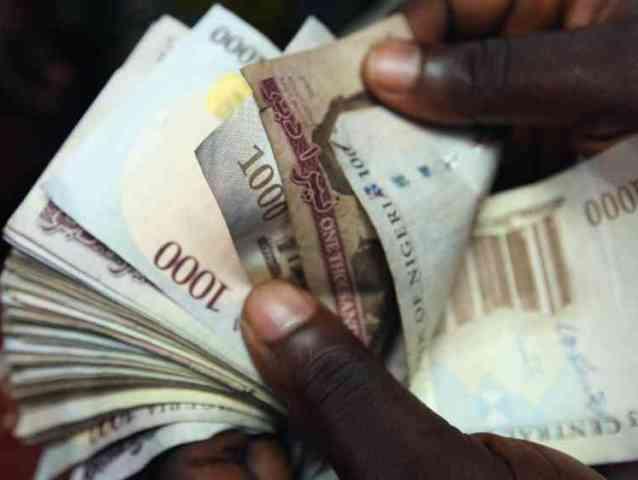
Naira
THE above title was the first leg of a trilogy published on the naira exchange rate between May and June 2014 in both the Punch and Vanguard Newspapers. The other titles are “Advantages of a stronger naira” (26/5/2014) and “Who is afraid of a stronger naira” (02/06/2014). See www.lesleba.com.
Evidently, the controversy surrounding appropriate naira exchange rates has been sustained over the years; nonetheless, the fundamental questions remain the same. In this week’s article, we will provide answers to some of the most frequently asked questions regarding the naira exchange rate. Please read on:

Naira
“Why are some experts recommending that the naira rate of exchange be devalued?
Indeed, the suggestion that the naira is overvalued is not new, and even the management of the much celebrated, yet comatose economic empowerment and development strategy, NEEDS, had, over a decade ago, indicated N180 as the appropriate equilibrium and desirable rate of exchange for the naira.
Much more recently, however, the huge untamed market demand for the dollar may have influenced the suggestion by some experts that the naira should be quickly devalued to avoid a catastrophic free fall.
Would the naira rate become stable with devaluation?
Historically, the naira has suffered multiple devaluations, which evidently, did not prevent further depreciation in the last two decades. Consequently, another official devaluation of the naira would not necessarily induce long-term stability of the naira.
Experts have claimed that naira depreciation would increase our exports
Curiously, this argument has often been made to confuse and deceive Nigerians; interestingly, the Nigerian industrial subsector was more diversified and productive, with increasing employment opportunities when the naira exchange rate remained less than N5:$1.
Amazingly, the industrial landscape has become famished, and Nigerian exports, with the exception of crude oil, have actually plummeted, as the naira fell to N160:$1. Sadly, much cheaper imports have quickly replaced the output of our erstwhile thriving industrial subsector. There is therefore, no reason to believe that naira rate below N160:$1 would reverse this trend.
Will a weaker naira reduce inflation?
Capital no! Historically, once again, the rate of inflation remained below 5% between 1975-85, when the naira was much stronger. In fact, a weaker exchange rate will instigate higher production cost across the board for the productive sector of the economy, and also fuel inflation. All manufacturers, who import vital raw materials for production, have sadly suffered similar fate, with disastrous consequences for growth and employment.
Nonetheless, a weaker naira will not increase the export price or demand for crude oil, which incidentally, still contributes over 70% of government revenue.
Will a weaker naira reduce cost of funds to the real sector?
No! If anything, a weaker naira will actually instigate higher cost of funds, especially whenever we earn increasing dollar revenue from crude oil.
How does a weaker naira instigate cost of funds?
A simple example may suffice; if Nigeria earns $1bn from crude oil, with naira exchanging at N1:$1, the three tiers of government would therefore, share N1bn; if on the other hand, the exchange rate falls to N160:$1, the $1bn forex revenue would be substituted with freshly created N160bn before distribution to the three tiers of government. Inadvertently, the payment of N160bn would instigate the burden of excess naira supply, in bank coffers particularly if the mandatory Cash Reserve Requirement(CRR) is modest.
However, the fear of excess naira chasing relatively fewer/static volume of goods and services and precipitating inflation, will compel the monetary authorities to restrain liberal access to the surplus funds unleashed on the system when CBN increases money supply with the substitution of naira for distributable dollar revenue.
The CBN, thereafter, proceeds to restrain lending to customers, by offering to pay commercial banks mouth-watering interest rates above 12% to reduce consumer demand and borrowing, and restrain inflation. Obviously, banks are happy with this arrangement, which allows them to earn double-digit ‘subsidy’ on what are ordinarily risk-free loans which government simply sterilizes! Such high returns inadvertently also reduce the attraction of lending to the real sector.
Consequently, the more dollars we earn, the greater is the threat of surplus naira and the attendant regime of high interest rates, when CBN unconstitutional substitutes fresh naira supply for dollar revenue.
Will a weaker naira reduce fuel prices and subsidy?
Once again, the answer is no; in actual fact, if petrol remains at the current level of N97/litre, a weaker naira will increase the domestic price of fuel, and will also increase the value of fuel subsidy. For example, since international crude oil price remains the benchmark price for the feed stock of all refineries worldwide, thus, if 1litre of petrol sells for $1 ex refinery, this would be equivalent to N160 in Nigeria.
If conversely, the naira rate falls from N160:$1 to, for example, N200/$1, although this would not affect the price/demand for our crude oil exports, this would mean that the same petrol ex-refinery in Nigeria would sell for N200/litre.
Furthermore, if however, petrol continues to be sold domestically at N97/litre instead of the actual market price of about N147/litre, then, of course, this would increase subsidy value to N103/litre, instead of the current N53/litre with $1:N160 exchange rate.
Will a weaker naira reduce the dollarization of the economy and stop capital flight?
The truth, of course, is that a weak and unstable naira rate of exchange will actually promote dollarization of the economy. A continuously depreciating naira elicits less consumer confidence in holding the local currency as a store of value. Conversely, however, a stronger and stable naira would induce confidence, and make the local currency desirable as a means of exchange and a solid store of value, at the expense of other foreign currencies.
Inevitably, therefore, the greater the intensity to forsake the naira because of unceasing depreciation over time, the greater will also be the propensity for capital flight as well as the adoption of dollars, for local transactions.
In reality, a weak naira exchange rate is actually not the result of reduced earnings of dollar revenue; in fact, evidence on ground suggests that the naira rate of exchange has steadily fallen simultaneously with vastly improved foreign reserves.
For example, in spite of our relatively paltry reserves of $4bn with four months’ imports cover from 1995, the exchange rate remained at N80:$1 for over four years. Curiously, however, the naira exchange rate fell to below N150:$1, when our reserves rose above $50bn with over 15 months’ imports cover about three years ago!
Undoubtedly, however, a weak naira is actually the product of the surplus naira caused by CBN’s monthly substitution of naira allocations for dollar revenue and an inappropriate CRR.”
SAVE THE NAIRA, SAVE NIGERIANS!
Disclaimer
Comments expressed here do not reflect the opinions of Vanguard newspapers or any employee thereof.