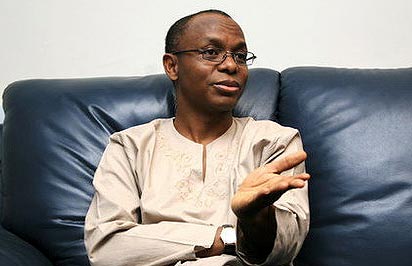
Gov. Nasir-El-Rufai of Kaduna state
Governor of Kaduna State, Malam Nasir El-Rufai recently fielded questions from reporters in Kaduna. He spoke on various issues ranging from challenges of governance to modest achievements he has recorded so far in office.
There is a lot of apprehension amongst civil servants that your public service reform programme is aimed at retrenching workers. Can you clarify what the reforms are all about?
People usually worry when you talk of public service reforms because of retrenchment and so on. I think if people have been very discerning as far as this government is concerned, we’ve been a job creating government, not a job destroying government. I think we are the only state in Nigeria that has hired 5,000 people in its first year in office. We also brought back 800 retired nurses because we have a shortage of nurses in the state. We brought them back to mentor the younger nurses. We have not retrenched since we came.
We have verified and removed ghost workers, but that is not retrenchment, that is removing those that don’t exist. Though we have added 5,000 people to the payroll, we still spend less on salaries and allowances than when we came into office. The purpose of this reform has nothing to do with retrenchment. We call it public service revitalisation programme.

Gov. Nasir-El-Rufai
The qualification of those in service is not commensurate with the level of education in Kaduna state. You see many people who joined the service after secondary school, they just attend one course and they convert when you have people with degrees and HNDs looking for work. One of the key objectives of the programme is this renewal. How do we inject new, young blood into the service.
How do we get new skills? You have confidential secretaries who are used to typewriter . Nobody uses typewriter any more. You need new skills. The world is changing, even education is evolving. Skills have disappeared, new ones are coming in, we have young people out there with these skills and they are not in the service. Bring them so that the skills that you have, match with the people of the right age. You revitalise the service, you make it better.
The way and manner public servants think needs to be restructured. We are called public servants, but we don’t behave like public servants. We behave like lords of the manor, we behave like masters. You need to take all various grades and cadre of the public service for a reorientation programme for them to understand that they exist to serve the people and not the other way round.
All these are the key components of the programme. We have no intention of retrenching any one; of course, some people will lose their jobs because some have fake certificates. Someone sent me the name of a person through Whatsapp with the photocopy of his degree certificate from Ahmadu Bello University, Zaria, and said governor, it is fake, check.
I asked the commissioner for education to check, the certificate looks as good as my ABU certificate but it was fake. They said the name has never registered in ABU. But he has a proper ABU certificate and NYSC discharge certificate and he is working in one of our agencies! So one of the things we are going to do as part of this reform is to cross check things like that as there are many people with certificates that are fake. If you find such a person are you going to leave him in the service ? There are people who have three birth dates.
They had gone to their records and changed their age three or four times because they don’t want to retire, if you catch those people, according to public service rule, it is gross misconduct, they should be punished. In the process of the reform and checking, all these people will lose their jobs. But that is not the intention, the goal is to clean the service, get the right people. For me, it is more important to inject young people into the service.
There have been a lot of hues and cries over the banning of the Islamic Movement in Nigeria(IMN) as activists argued that their human rights have been violated. Why did the government decide to infringe on the Shiites’ freedom of association and the freedom to practice their religion?
The issue of Islamic Movement in Nigeria (IMN) and their declaration as an unlawful society is something that we did with all sense of responsibility. Many media outlets have presented what we did in various ways which are misleading. What we did was not to ban any organization; we have no power to ban an organisation if it exists, we cannot ban religion or religious practice. What we did is to say that the Islamic Movement in Nigeria is an unlawful society and we derived the powers to do this under the Penal Code that was passed in 1963, so it is not a new thing that we did.
The governor can declare any organisation an unlawful society, if it poses a threat to the security, peace and governance of the state. And we concluded, after receiving the report of the Judicial Commission of Inquiry that looked into the clashes between the IMN and the army, that the IMN poses a threat to the peace, security and good governance of Kaduna state. That is what we did. We did not ban Shiism, we did not ban Shiites. We did not say they cannot practise their religion, because in Kaduna state, there are at least two Shiites organisations that we know.
There is Al-Thaqalayn Foundation, there is Rasul A’azam Society. These are all Shiites organisations and they are not outlawed. They are not outlawed because all they do is to preach their brand of Islam and they practise their brand of Islam and they are free to do so. Both of them are registered with the Corporate Affairs Commission (CAC), they recognise the constitutional order in Nigeria, they recognise President Muhammadu Buhari as president of Nigeria. They recognize Nasiru El-Rufai as governor of Kaduna state and they obey the laws of Nigeria and Kaduna state. They have no paramilitary arm, they do not carry arms, they do not block public highways, they do not occupy schools.
The IMN does not recognise the constitution of Nigeria, they do not recognize Buhari as President of Nigeria, they do not recognise me as governor of Kaduna state because they had their governor in Tudun Wada. They have their para military wing, they call them ‘Hurras’. They train them in violation of our laws. They do not accept that any law in Nigeria applies to them. They block public high ways, they occupy schools when they are doing their processions and they feel that to practice their religion, they have to infringe on the right of others. That is completely wrong!
There is also a misconception that IMN is the same as Shiites. IMN is only one out of many Shiites organisations. There is a prominent Shiite organisation with its headquarters here in Kaduna that is headed by Sheikh Hamza Lawal. Because IMN doesn’t recognise Nigerian laws, they are not registered with CAC, so they cannot be sued or held responsible. They build anywhere they want without approval. They don’t even bother to acquire title to land. Their allegiance is not to Nigerian government, their allegiance is to somewhere else. I want to ask you, if you put all these facts together, what does IMN look like? IMN looks like an insurgency waiting to happen.
The report of the commission of inquiry recommended that we should proscribe IMN because they are not registered, they can’t sue or be sued in their own name. The media should stop referring to the IMN as Shiites because they are just one group out of many others. I will like you to speak with other groups to hear what they think of IMN. The IMN is a political organisation.
The objective of El-Zakzaky is to gather enough followers to effect an Iranian type of Islamic Revolution in Nigeria and you know what that can cause! Nigeria is not 100 per cent a Muslim country where you can effect Islamic Revolution, it is a recipe for crisis. I laugh when some people who are not informed on this subject are sympathetic to him, talking about human rights. With what he has in plan for you, you will not have any human rights. That is the agenda. So let us understand this problem.
The crises in Southern Kaduna have been recurrent and there seem not to be an end in sight. Recently, the Centre of Humanitarian Dialogue has started a peace building effort. Will this initiative make any difference?
When we came to office, the two problems we faced in the area of security were cattle rustling in Birnin Gwari/Giwa axis and communal killings in southern Kaduna. We were very concerned about both and we did two things. We needed to understand what was happening in Southern Kaduna. We understood cattle rustling and we convened a meeting of all the north west governors because the problem was centred around the forest ranges of Kuyambana and we felt state cooperation was necessary. We came together and launched an operation to deal with cattle rustling. We were successful because we degraded their ability to engage in cattle rustling, even though that created a problem of kidnapping, because they moved from cattle rustling to kidnapping which we are still facing.
For southern Kaduna, we didn’t understand what was going on and we decided to set up a committee under Gen. Martin Luther Agwai (rtd) to find out what was going on there. What was established was that the root of the problem has a history starting from the 2011 post election violence. Fulani herdsmen from across Africa bring their cattle down towards middle belt and southern Nigeria.
The moment the rains starts around March, April, they start moving them up to go back to their various communities and countries. Unfortunately, it was when they were moving up with their cattle across southern Kaduna that the elections of 2011 took place and the crisis trapped some of them. Some of them were from Niger, Cameroon, Chad, Mali and Senegal. Fulanis are in 14 African countries and they traverse this country with the cattle. So many of these people were killed and cattle were lost. They therefore organised themselves and came back to revenge.
So a lot of what was happening in Southern Kaduna was actually from outside Nigeria. We got a hint that the late Governor Patrick Yakowa got this information and he sent someone to go round some of these Fulani communities, but of course after he died, the whole thing stopped. That is what we inherited. But the Agwai committee established that. We took certain steps.
We got a group of people who were going round trying to trace some of these people in Cameroon, Niger republic and so on to tell them that there is a new governor who is Fulani like them and has no problem paying compensations for lives lost and he is begging you to stop killing. In most of the communities, once that appeal was made to them, they said they have forgiven. There are one or two that asked for monetary compensation.
They said they have forgiven the death of human beings, but want compensation for cattle. We said no problem, and paid some of them. As recently as two weeks ago, the team went to Niger republic to attend one Fulani gathering that they do every year with a message from me.
So this was the problem, we knew this by August last year and we started taking steps. But what is happening now, I don’t want it to be restricted to Southern Kaduna. I noticed that some people are trying to bring religion or ethnicity into it. What about Zamfara state? Are there southern Kaduna people in Zamfara? That is why I considered the statement by the President of Christian Association of Nigeria ( CAN ) as regrettable. Some people don’t understand the burden of leadership. The same Fulani are killing Fulani in Zamfara, it is not about religion or ethnicity, this is a pure case of banditry! They are criminals, their ethnicity, their religion does not matter. Let’s fight the problem, let’s not bring sentiments, sensationalism and division into it. What is happening in southern Kaduna today, in my opinion, has roots in banditry, it has nothing to do with what has happened in the past to a large extent.
It was a small problem that started in Ninte village, Godogodo that could have been handled better by the local communities; but the leaders of the Fulanis and the leaders of the communities did not do it well. I was very sad, I went there. Any life lost in Kaduna state is a burden on me because as the governor, I have to defend the life of every one. As a government, we regret the loss of lives. We regret the destruction of property.
Today in Kaduna state we have arrested 400 people for kidnapping and cattle rustling and armed robbery. All except about five of them are Fulanis. I am Fulani, does it mean I should not have them arrested and prosecuted? I don’t consider them Fulani, I consider them criminals. Whenever I sit with Fulani leaders I tell them that we arrested over 400 suspects and 99 per cent of them are Fulanis and they should ask themselves why is it that only Fulanis are doing this. Is that part of the culture of the fulanis, since when did they start carrying AK47 rifles and so on!
From a small problem in Ninte, some people found a way to add fuel to the fire, because it is politically expedient to do so not caring how many people get killed. Over time, the culture of impunity has permeated all segments of society, people think they can do anything and get away with it. There is very weak law enforcement or uneven law enforcement. If you are from this ethnic group or religion, you can do something and get away with it but the other one cannot. There is a mindset that you can take the law into your hands. This is what has been happening and escalating the problem. So it is most unfortunate, but honestly the whole challenge is that of banditry and it has to be addressed.
Secondly I think that those who preach the message that this one is a settler, he shouldn’t he here or this one is of different tribe and religion, he should not live with you, are more responsible for what is happening than anything else. How can you look at somebody who has stayed in a place for 200 years and say he is a settler. How long have you lived there? We all came from somewhere.
The media should not give these kind of people the oxygen that they need to propagate this. Those who think that there is any profit to be made from this kind of narrative and division should go to Plateau state and ask. Jos is quiet, peaceful, because after years of killing each other both sides realised that it doesn’t make any sense.
How have you been able to create jobs and yet reduce your recurrent expenditure?
We have been able to increase our revenue generation to N1.6 billion since July. We have never gone below this since then. The reforms we introduced, largely made this possible. We got a new tax code enacted by the state House of Assembly which centralised all revenue collections in the Kaduna Internal Revenue Service, so we stopped all other agencies from collecting revenue. We stopped all agencies from collecting cash. Every revenue must be paid through the bank or POS, bank transfer, so no cash collection. This caused a little problems particularly in hospitals when people want to pay for N100 hospital card, but we now have POS terminals there that take the cash.
Just ensuring that there is no cash collection, increased our revenue by nearly 50 per cent. We have not introduced any new tax. In fact we are reducing taxes because very soon the State House of Assembly will pass a resolution to reduce ground rent and land charges in Kaduna state because we want more people to own certificate of occupancy and to encourage them, we are reducing the charges.
We are also broadening the tax net. We are bringing small businesses to make their own contributions. We believe that what we have shown on the ground, how state revenue are being spent will make people to know that their monies are not being stolen, their monies are being used for the purpose that are meant for. We are also diversifying our sources of revenue away from just relying on federation allocation and Pay As You Earn, from businesses, to include agriculture and minerals. If we can get more of our farmers to produce more and more, the more they sell, the more we are going to get taxes from them.
We are working very aggressively on mining because we have a lot of gold in Kaduna state. We have nickel and tantalite in Jama’a local government. We picked on a few of these minerals to focus on developing them so that they become a source of revenue.
We have also abolished Kaduna state ministry of land and survey and created Kaduna Geographic Information Service (KADGIS) and vested all land matters in it and it is now collecting more revenue than ever because the land registry is being computerised, everything is easier and there is much transparency.
Disclaimer
Comments expressed here do not reflect the opinions of Vanguard newspapers or any employee thereof.