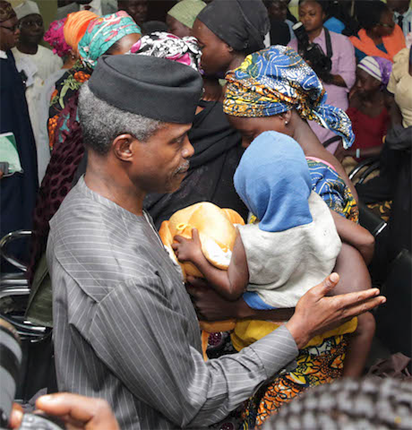
VP Yemi Osinbajo with the Chibok schoolgirl and her child
By Douglas Anele
The recent unprecedented nocturnal raid on the residences of Supreme Court justices and judges of the Federal High Court by the Department of State Services (DSS) based on allegations of corruption has been discussed from every angle by Nigerians. In my opinion, it is really a sad reflection of serious intellectual kwashiorkor in our universities that two well-known Professors of Law, Yemi Osinbajo and Itse Sagay, actually endorsed the Gestapo-like tactics used by DSS operatives around midnight sometime in October to arrest the top-ranked judicial officers.
I am not sure they would approve the action if it was carried out during the administrations of late General Sani Abacha or Dr. Goodluck Jonathan. Anyway, their uncritical support conforms with the growing trend in which senior academics who, because they occupy high positions in government, allow the temporary elixir of public office to overshadow respect for decorum and healthy disdain towards brute force they ought to have internalised while in the university, which are the hallmarks of genuine intellectuals. Ideally, in democratic countries worldwide, it is accepted that no one is above the law.
At the same time, there is a venerable jurisprudential maxim that an accused is presumed innocent until proved guilty. There are laid down procedures for dealing with corruption and abuse of office by judicial officers.
In the case we are discussing, there is no evidence to show that the DSS went through all of them and failed before storming the homes of Justice Sylvester Ngwuta and others at a time most law-abiding citizens were sleeping. Even so, strictly speaking, the DSS overstepped its legitimate bounds by usurping the powers of the police and the EFCC. Afe Babalola, an experienced lawyer and Senior Advocate of Nigeria (SAN), in a series of essays entitled “DSS midnight arrest of judges: legal issues and recommendations” published by Vanguard newspaper, correctly questioned the legality of the action by the DSS and insisted that despite the evils and alarming spread of corruption in Nigeria, the relevant agencies and institutions involved in combating it must adhere strictly to the rule of law and due process.
The way I see it, even if the judges were eventually found guilty, it would not justify their being harassed like common criminals trying to evade justice. They ought to be treated with respect commensurate with their elevated positions in the judiciary, especially considering that they are yet to be pronounced guilty by a competent court of law. Of course, the law does not permit law enforcement agencies to treat accused persons inhumanely or infringe on their fundamental human rights.
This aspect of the matter seems to escape the crowd of vociferous and hypocritical holier-than-thou supporters of the jackboot approach of the government: they forgot that arbitrary exercise of power opens the door to tyranny and the wickedness of dictatorship. Existing laws against corruption are imperfect, no doubt; yet they protect the citizens from arbitrary use of state power and discourage chaotic deployment of public resources to harass and intimidate those who disagree with or criticise a sitting government. The laws are designed to ensure that innocent people do not suffer unjustly, which implies that we should not allow anger and indignation towards elephantine corruption in governance to spill over into advocacy of garrison methods in dealing with the problem.
Thus far, President Buhari’s anti-corruption programme has achieved far less than he promised during his campaigns, leading to his lamentation that corruption is fighting back. But what did he expect – that the looters, including former governors who funded his presidential election campaigns, would just sit back and let him destroy the impressive financial empires they built while in office? Besides, the programme has lost much of its appeal because of avoidable errors of judgement by Buhari and his advisers. As I noted earlier, it is unduly restricted to Jonathan’s administration. In addition, there is no concrete evidence that Buhari is interested in robustly probing allegations of corruption against members of his inner circle.
Of course, there is the issue of lack of transparency and accountability in key aspects of the programme. For example, no one knows for sure the identities of those who allegedly returned money and public assets to the federal government and how much they had returned to date. In fact, Buhari did not fulfil his promise to name those who gave back funds and property, fuelling speculation that it was to protect his political benefactors, close friends and acolytes. Not surprisingly, many agbata ekee politicians from other political parties are decamping to the ruling party because they believe that doing so will deflect the EFCC from pursuing pending corruption cases against them. Should a genuine anti-corruption programme have such a self-abnegating effect?
The method President Buhari is using to fight corruption will not yield much positive result because he is attacking symptoms of the problem, not its root causes, with inefficient tools. The very system that makes corruption in high places easy and profitable still exists, and in some cases, has actually worsened. For example, the Emir of Kano and former Central Bank governor, Sanusi Lamido Sanusi, reportedly said that incompetent management of foreign exchange by government encourages unprecedented corruption. For more effective and sustainable battle against corruption, there must be a paradigm shift in the mindset of our so-called leaders: there is an urgent need for a moral revolution; but Buhari does not have the moral and spiritual stature of Mahatma Gandhi or Nelson Mandela to trigger such a revolution.
Second, the country must be restructured according to the provisions in the regional constitution of the First Republic or even in the Aburi Accord of January 1967. Unfortunately, the President is not even thinking of letting power devolve to the component parts of the federation: he is too wedded to the unitarist, command-and-obey architectonic retired General Yakubu Gowon imposed on the country in 1967 to thwart the secessionist eastern region.
Since the present government, like the ones before it that began in May 29, 1999, is unwilling to take radical steps to change the convoluted federal system and expensive presidential model which breed corruption, I am not optimistic about the ongoing anti-corruption programme. However, if eventually between now and the end of his presidency in May 28, 2019 a tangible percentage of high profile corruption cases are successfully concluded and there is noticeable reduction in the quantum of money and assets stolen from government, then one can say that the effort is worthwhile. But we must insist that the evils of corruption should not make us support illegalities by government using the invalid Machiavellian argument that “the end justifies the means.” Corruption can be fought decently, legally and justly, and those found guilty must be severely punished.
Now, I want to look at President Buhari’s bias against the south east, which has reared its ugly big head once again in the unjust exclusion of the zone in projects earmarked for the 29.96 billion dollars foreign loan sought by the federal government. It is well known that the President is discriminating against the south east in terms of federal projects and appointments in critical sectors of our national life, perhaps to fulfil his pledge to treat different parts of the federation according to the number of votes he received during the election. But does it make sense for Buhari to discriminate against any part of the country so blatantly, in a multiply plural society such as ours?
Objectively speaking, despite their disastrous defeat in the civil war and periodic killings in northern Nigeria, Ndigbo have demonstrated practically more than any other ethnic group in Nigeria solid belief in the concept of “One Nigeria.” The Igbo can be found in the remotest part of the country outside Igboland contributing in many ways to the overall development of the town or rural community where they live.
Thus, any government that treats the Igbo unfairly for whatever reason is not only alienating some of the country’s best and brightest, it is also discouraging the very people that take the idea of a united Nigerian nation very seriously. On this issue, I think the President is pandering to the Baconian idol of the theatre, namely, to the unreasonable doctrine of subjugating the south to the north formulated more than half a century ago by the arch feudalist and imperialist, late Alhaji Ahmadu Bello.
Those who still nurse the ambition of subjugating their compatriots from another ethnic nationality should look critically at our chequered history and realise the futility of such mission. It is a shame that prominent Igbo sons and daughters in Buhari’s cabinet and the National Assembly are not taking the rampaging marginalisation of our people very seriously. Possibly, out of self-interest, they seem unduly pusillanimous in letting the President know that Ndigbo are not happy that they are being treated as third class citizens in their own country. To be continued.
Disclaimer
Comments expressed here do not reflect the opinions of Vanguard newspapers or any employee thereof.