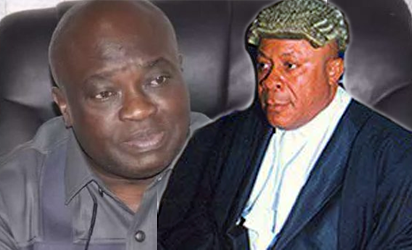
Governor Okezie Ikpeazu of Abia State and Justice Okon Abang
By Ben Nwabueze
In the suit before the FHC Abuja, the sole plaintiff was Dr Uche Ogah while the defendants were Dr Ikpeazu, Chief Nwanozie Nwosu, PDP and INEC.
The judgment in the case delivered by Justice Abang on 27 June, 2016 carried both an FHC Abuja No, FHC/ABJ/CS/71/2016 and an FHC Umuahia No, FHC/UM/CS/94/2015. Dr Ogah first filed the suit at the FHC Umuahia before Justice Olubanjo but later moved it to Abuja. As Justice Abang said at 32 of his cyclostyled judgment, “it is not even clear when the case file arrived this division.”
The parties in the suit before the FHC Owerri were Chief Nnanozie Nwosu as sole plaintiff against Dr Ikpeazu, Dr Ogah, PDP and INEC.
In the FHC Abuja suit Dr Ogah, who was placed second to Dr Ikpeazu in the PDP primary but who never contested the general election as a candidate, prayed the court to declare him winner of the election on the basis of Dr Ikpeazu’s anticipated disqualification by the court.
In the FHC Owerri suit, on the other hand, Chief Nwosu who came 7th in the PDP primary but who also never contested the general election as a candidate, prayed the court to declare himself winner on the following tenuous, if not somewhat bizarre, argument.
He (i.e. Chief Nwosu) was one of the eight contestants in the PDP primary, the result of which, i.e. the victory of Dr Ikpeazu, was rejected by all the other contestants, who refused to endorse and sign it. He alone accepted and signed it.
Chief Nwosu’s argument is that, since he was the only one who accepted the result of the primary, the other contestants, having rejected it and thereby put themselves out of the race, he was the person, in the event of Dr Ikpeazu being disqualified by the court, entitled to be declared the PDP nominated candidate, based on the party’s primary.

Governor Okezie Ikpeazu of Abia State and Justice Okon Abang
The tenuousness of the argument shows the desperateness of the ambition for high elective public office in Nigeria, especially the offices of president and state governor. Pushed by desperate ambition, Chief Nwosu went to court praying it to disqualify Dr Ikpeazu and declare himself winner of the election. He failed in both his two bizarre desires.
The two separate suits before Justice Okon Abang and Ambrose Allagoa of the FHC Abuja and Owerri respectively were not in fact the second but the third round of the litigation. The second was a suit filed in the FHC Abuja by Obasi Ekagbara and Chukwemeka Mba as joint plaintiffs against Dr Okezie Ikpeazu , PDP and INEC as defendants : see Ekagbara & Anor v. Dr Ikpeazu & 2 Ors (2016) 4 NWLR (1503) 411. It complained of the falsity of tax papers and other information submitted by Dr Ikpeazu and PDP to INEC in support of Dr Ikpeazu’s candidature for the governorship of Abia State which, it was claimed, disqualified him for the election. This round in the litigation was fought from the FHC to the Court of Appeal to the Supreme Court solely on the basis as to the court that has jurisdiction over the suit.
The Court of Appeal, reversing the FHC Abuja, ordered the suit to be transferred to the Abia State High Court, as the court with jurisdiction over it. The Supreme Court reversed the Court of Appeal, and remitted the suit to the FHC Abuja where it was initially filed. It was this suit, as remitted to the FHC Abuja by the Supreme Court, that came before Justice Okon Abang for trial. It is not clear how the case arrived at Justice Okon Abang’s court, whether it was merged and absorbed into the case already pending before him (under the name Dr Sampson Uchechukwu Ogah v. Dr Okezie Victor Ikpeazu & 3 Ors) or by some other means.
FUNDAMENTAL IMPORTANCE OF THE OBSERVANCE OF DUE PROCESS OF LAW IN THE SETTLEMENT OF DISPUTES THROUGH THE COURTS
The term due process of law is used in a variety of senses. In one of such senses, it refers to the quality or moral content of the law, whether it is just; in this sense, it only requires that the “law shall not be unreasonable, arbitrary or capricious.” But all its various senses or aspects may be said to be embodied in the more or less all-encompassing phrase the rule of law, which is universally regarded as the pillar of constitutional democracy.
The primary and essential meaning of the concept of the rule of law is that law, applying equally to all persons, and administered impartially by independent courts, is to rule the affairs of people in society, as well as the dealings and relations of the state with the individual, as opposed to arbitrary rule or rule according to the whims and caprices of the rulers unfettered by law, as under socialism/communism where so many aspects of the lives of people are determined, not by law, but by the unfettered discretion of the authorities – production quotas, prices, rationing of essential goods, allocation of jobs, distribution of benefits, apportionment of burdens and punishments, etc. In the time honoured definition of John Locke, writing in 1690, “the rule of law means the freedom of men under government to have a standing rule to live by….; a liberty to follow my own will in all things, where that rule prescribes not; and not to be subject to the inconstant, uncertain, arbitrary will of another man.” J. Locke, The Second Treatise of Civil Government, ed. J.W. Gough (1946) ss. 22, p. 15.
The rule of law is tied to the manner or procedure, which may be used to accomplish the purpose of the law. The restraints of the law on the administration of the affairs of a community of people has limited value in constitutionalising government unless the way and manner the law is applied is regularised. Regularity enables the individual to know in advance how he stands with the government, and how far the latter can go in interfering with the course of his life and activities.
The relationship between the rule of law and state power is an intricate one that needs elucidation. The relationship is pre-figured in the very first section of our Constitution which provides as follows:
“(1)This Constitution is supreme [law] and its provisions shall have binding force on all authorities and persons throughout the Federal Republic of Nigeria;
(2)The Federal Republic of Nigeria shall not be governed, nor shall any person or group of persons take control of the Government of Nigeria or any part thereof, except in accordance with the provisions of this Constitution;
(3)If any other law is inconsistent with the provisions of this Constitution, this Constitution shall prevail, and that other law shall to the extent of the inconsistency be void.”
The provisions of section 1 of our Constitution quoted above embody the concept of a law-governed state, which is the opposite of a lawless state. The state is characterised by power and physical force. But state power, backed by organised coercive force, is not just arbitrary power but rather one to be exercised in accordance with definite rules of law defining and limiting its extent and regulating the procedure for exercising it.
And force, which is the central attribute of the state, and without which it cannot exist – “states exist or not according as they have the force to impose their commands” – is also not just brutish, unregulated and uncontrolled force but rather “force displayed in a regular and uniform manner” in accordance with law that regulates, conditions, controls and therefore limits it – see section 214 – 216 of the Constitution (relating to the police force) and 217 – 219 (relating to the armed forces). In more succinct language, the state denotes power and force exercised “in the name of the law”; it connotes a legal order, a body of laws that regulates, conditions, controls and limits the exercise of power backed by force within a given community.
It follows that the state, as an organisation of power and force, can no more be defined apart from law. While law is created by the state, and is “an instrument more or less necessary for carrying out the state’s activities and attaining its ends”, the state, in its turn, is grounded upon law; it is the law that imparts to the state its character as an organisation whose “activities are systematised, co-ordinated, predictable, machinelike and impersonal”. Law and the state are thus correlative entities neither of which can be properly defined without the other. Each is conditioned by the other in the sense that the existence of one is a condition for the existence of the other.
The state cannot exist apart from or without law any more than law can exist without the state. Accordingly, force or power and, ipso facto, a state, not regulated, conditioned and limited by law, that is to say, a lawless state, is a perversion, a complete distortion, of the state concept. Mike Ikhariale in an article in the Sunday Independent newspaper of March 19, 2006 has put it in simple, non-philosophical language thus: “without the law, there will be nothing like Nigeria.”
An organisation of power and force unregulated and unlimited by law or not exercised in accordance with law is typified by a case where the military government in Nigeria, with thirty army and airforce personnel, all heavily armed, invaded and took forcible possession of the property of a person indebted to it, which happened to be in the occupation of a hospital; chased out and sacked the hospital staff, discharged all the patients, seized the records of the hospital and closed it down.
Thereafter it began to make structural alterations to the buildings – all in the belief, which was erroneous, that the hospital also belonged to the debtor personally. Its action would have been no less a case of state lawlessness even if the hospital had belonged to the debtor; see Obeya Memorial Specialist Hospital Ayi-Oneyema Family Ltd. v. The Att-Gen. of the Federation & Anor [1987] 3 NWLR (Part 60).
Disclaimer
Comments expressed here do not reflect the opinions of Vanguard newspapers or any employee thereof.