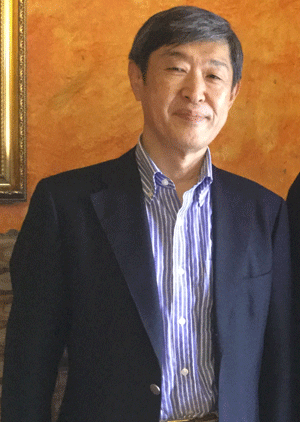
Shinichi Kitaoka
By Soni Daniel, Northern Region Editor
IN an upscale Mediterranean restaurant in Abuja, a group of four Nigerian journalists and three other officials of the Japanese Government in Nigeria are discussing the relationship between Nigeria and Japan. The lead discussant is the President of Japanese International Cooperation Agency, JICA, Shinichi Kitaoka, while the journalists are drawn from four different media establishments in Nigeria, who had been assembled to seek information from the JICA chief. He was in Nigeria for a three-day working visit.
Why was Kitaoka in Nigeria and what was of paramount interest to him and his Asian country? These and many more were the issues that the media men engaged the visitor, who was at his best trying to explain all the details before calling it a day.

Shinichi Kitaoka
Kitaoka, who became JICA’s new president on October 1, 2015, succeeding Akihiko Tanaka, is a thoroughbred diplomat and legal luminary, who has been deeply involved in the development and politics of Japan. He is also a top scholar who has done Japan proud in many areas, including serving as Deputy Permanent Representative to the United Nations and Ambassador Plenipotentiary. He had once served as the Professor of College of Law and Politics, Rikkyo University and his area of specialty is Japanese modern politics and diplomacy. He is also Emeritus Professor of the University of Tokyo.
As he begins to talk about what unites Nigeria with his country, it becomes clear that Kitaoka really understands the issues at stake and what his country holds in stock for Nigeria, and what the development cooperation between the two nations entails. Without mincing words, Kitaoka extols the strategic position of Nigeria in Africa and why it makes sense for Japan to take Nigeria very seriously in its scheme of things.
Hear him: “Nigeria is one of the most important countries in Africa despite its challenges which have affected its economic growth and development.
“Nigeria is key to a stable Africa and development and our general interest is to have a stable and prosperous Nigeria. We will, therefore, be supporting the stability and growth of Nigeria in all possible ways,” the JICA chief stated.
And the areas in which Japan has been intervening in the development of Nigeria are wide and variegated. Since its offices were flung open in Lagos in 1983, JICA has happily offloaded not less than N600 billion in development assistance to Nigeria and is still working out new areas across the country to assist. But of all the areas that the agency has so far intervened, Nigeria has received tremendous support in the development of solar power, building and equipping of schools, particularly in Oyo State, establishment of health institution to promote maternal/child health care and provision of infrastructure generally.
With Japanese leading role in technological advancement, it has been sending routine support to aid Nigeria’s fight to eradicate polio, one of the most devastating childhood diseases that has ravaged many on the African continent and left a sore in the families. But Kitaoka gives a ray of hope: “We have a unique approach to health issues in Nigeria having been deeply involved in the eradication of polio and provision for Universal Basic Health programmes in the country.
“We are currently assisting in the building of classroom blocks in primary schools in Oyo State. And once security improves in the North-East of Nigeria, Japan will send volunteers to teach in schools in the area.
Although he noted that Nigeria is blessed with lush green vegetation, Jitaoka lamented that food was still expensive in Nigeria because of its crude method of cultivation, processing and preservation of food. This, he noted, was no longer fashionable. According to him, Nigeria should be producing cheaper, greener foods given its large expense of land and good climate.
To solve the problem, the JICA chief indicated the willingness of Japan to send agricultural experts to Nigeria to assist in the development of agriculture, particularly, rice cultivation and production. “Food is expensive here and we can send our experts to come down and teach the farmers how to produce rice and other foods that can grow very well in Nigeria. But this must be based on a request by Nigeria. Once we have a request, we can send our small but very successful agriJICA. As he puts it, “JICA has been sending volunteers to other African countries but not Nigeria because of security challenges. Once this is sorted out, we will begin to send our volunteers to assist Nigeria in many ways,” he assured.
Within the three days that Kitaoka spent in Nigeria, he paid a visit to the Presidency during which he met with Vice President, Yemi Osinbajo, who stood in for President Mohammadu Buhari and also visited some IDP camps in the North-East, held meetings with some interest groups before returning to Tokyo.
Indeed, the JICA Chief came with a bag full of love and benevolence from Tokyo to Abuja.
Disclaimer
Comments expressed here do not reflect the opinions of Vanguard newspapers or any employee thereof.