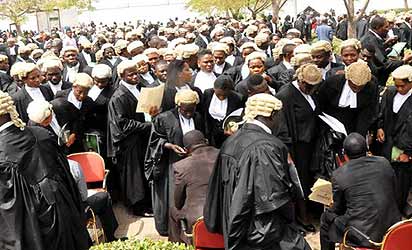
File: Lawyers
By Innocent Anaba
The National Judicial Council, NJC, has given Justice Mohammadu Yunusa of a Federal High Court sitting in Lagos, 14 days to respond to allegations of judicial, abuse, compromise and misconduct levelled against him by a group, Civil Society Network Against Corruption, CSNAC.
In a letter with reference number NJC/F.3/FHC.49/1/421, dated March 16, 2016, signed by the Chief Justice of Nigeria and Chairman of NJC, Justice Mahmud Mohammed, which was sent through Justice Ibrahim Auta, the Chief Judge of the Federal High Court, Justice Yunusa was given a 14-day deadline to submit his response to the allegations.
In its query, Justice Muhammed said, “I forward herewith a petition dated December 21, 2015 against you by Mr. Olanrewaju Suraju, Chairman, Civil Society Network Against Corruption, on the above subject matter. The petition speaks for itself. I shall be glad to have your comments within 14 days from the date of your receipt of this letter, please.”
CSNAC had in a petition, accused the judge of consistent refusal to abide by judicial precedents, laid down by the apex courts, in granting orders and injunctions against the EFCC.
According to CSNAC, the actions of Justice Yinusa “will undoubtedly serve as a leeway for unscrupulous and corrupt individuals, who will stop at nothing to truncate their arrest, investigation and prosecution by the appropriate law enforcement agencies, to render our criminal law ineffective, as well as allowing corruption fester in the society.”
The group had alleged that “The grant of the orders of mandatory and perpetual injunctions by Justice Yunusa against the EFCC is a grave departure from the established principles in the mentioned cases, as laid down by the Supreme Court and Court of Appeal which are binding on the Federal High Court, being a lower court. Justice Yunusa, by the grant of these orders, has stripped EFCC of its constitutional powers as a law enforcement agency, as well its powers under the enabling law, the Economic and Financial Crimes (Establishment) Act, LFN 2004, a Federal Legislation. It is also a gross abuse of his powers as a judicial officer.”
The group listed the alleged cases to include FHC/L/CS/1471/2015 Mr. Simon John Adonmene & 3ors v EFCC on September 21, 2015 before Justice Yunusa; suit No. FHC/L/CS/487/14 – FRN v. Michael Adenuga; Suit No. FHC/L/CS/1342/15 – Senator Stella Odua v. AG Federation, EFCC, ICPC and IGP; Suit No. FHC/L/CS/1285/15 – Jyde Adelakun & Anor v. Chairman EFCC & Anor; Suit No. FHC/L/CS/1445/15 – Dr. Martins Oluwafemi Thomas v. EFCC; Suit No. FHC/L/CS/1269/15 – Shamsudeen Abogu v. EFCC & Ors; Suit No. FHC/L/CS/1012/15 – Teeth Dauzia Loya v. EFCC.
Disclaimer
Comments expressed here do not reflect the opinions of Vanguard newspapers or any employee thereof.